According to Amazon Web Services (AWS), tenant isolation is one of the foundational concerns in SaaS architecture because customers using shared infrastructure must be prevented from accessing another tenant’s resources. AWS also identifies multiple approaches to tenant isolation, including pooled, bridge, and silo models, each involving different tradeoffs between cost, complexity, and isolation.
This highlights why multi-tenant SaaS architecture is more than simply putting multiple customers on the same application. A well-designed system must allow organizations to share application resources efficiently while keeping their data, users, permissions, and configurations logically separated. The architecture directly affects infrastructure costs, scalability, security, deployment speed, and compliance. In this guide, we’ll explore how multi-tenant SaaS architecture works, how it differs from single-tenant architecture, the main database and tenant isolation models, and the best practices for building a secure and scalable SaaS platform.
Table of Contents
ToggleWhat Is Multi-Tenant SaaS Architecture?
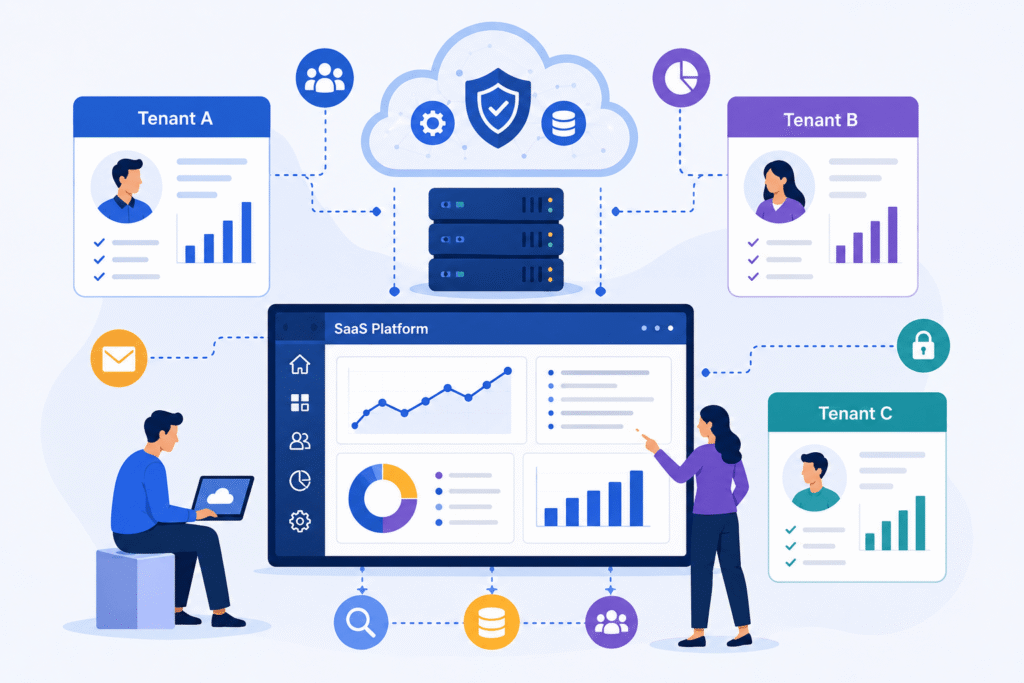
Multi-tenant SaaS architecture is a design pattern where a single instance of an application, and often a single instance of its database and supporting infrastructure, serves multiple customers at once. Each customer is called a tenant. A tenant can be one user, but in B2B software it’s usually an entire company, with its own team members, permissions, and data.
Every tenant experiences the platform as if it were built just for them. They log in to their own workspace, see only their own records, and apply their own settings. Behind the scenes, though, they’re sharing the same application code, the same compute resources, and frequently the same shared database as every other customer on the platform. This is the opposite of a single-tenant setup, where each customer gets a fully dedicated, isolated deployment.
Salesforce, Slack, and HubSpot are well-known examples of SaaS platforms that use multi-tenant approaches. Millions of organizations use these products every day, and none of them are running a private copy of the software. They’re all tenants inside one carefully engineered multi-tenant application.
Single-Tenant vs Multi-Tenant SaaS Architecture
The single-tenant vs multi-tenant decision shapes almost everything else about a SaaS product: cost structure, deployment speed, and how compliance gets handled.
Single-tenant architecture gives each customer a dedicated application instance and database. Nothing is shared. This delivers the strongest possible isolation, which is why regulated industries like healthcare, finance, and government contracting sometimes require it. The tradeoff is cost. Provisioning, patching, and monitoring hundreds of separate environments does not scale the way a shared system does, and every feature release has to be rolled out instance by instance.
Multi-tenant SaaS flips that equation. One codebase serves everyone, so a feature shipped once reaches every tenant immediately through centralized updates. Infrastructure costs are pooled rather than duplicated per customer, which is why multi-tenant platforms can profitably serve a $10,000-a-year customer and a $10-a-month customer on the same system. The tradeoff shifts from infrastructure cost to engineering discipline: tenant data isolation has to be enforced correctly at every layer, or one tenant’s bug becomes another tenant’s data breach.
Some platforms land on a hybrid: most tenants share pooled infrastructure while a handful of large enterprise accounts get dedicated resources for compliance reasons. AWS’s own SaaS architecture guidance treats this as a legitimate variation rather than an exception, noting that a system can still be managed and operated as multi-tenant even when some components are siloed for specific tenants.
How Multi-Tenant SaaS Architecture Works
A working SaaS platform architecture is built in layers, and multi-tenancy has to be threaded through each one rather than bolted on afterward.
The Application Layer
The application layer runs the actual business logic that every tenant interacts with. In a multi-tenant setup, this layer has to be tenant-aware at every request. When a user logs in, the system identifies which tenant they belong to, usually through a subdomain, a custom domain, or a tenant ID attached to their session, and scopes every subsequent action to that tenant alone.
The API Layer
As SaaS application design matures beyond a single monolith, most platforms split functions into services that communicate through an API layer. This layer acts as the gatekeeper, validating which tenant is making a request and routing it to the correct data before any business logic runs. It’s also usually where rate limiting lives, so one tenant sending an unusual volume of requests doesn’t degrade performance for everyone else.
Cloud Infrastructure
The compute, storage, and networking underneath the application make up the cloud infrastructure layer. In a pooled model, this infrastructure is shared across tenants and scales horizontally as customer volume grows. In a siloed model, dedicated infrastructure gets provisioned per tenant. Most production systems use a mix, adjusted by pricing tier.
Tenant Isolation Models: Choosing a Database Strategy
Data isolation is the single most consequential decision in any multi-tenant SaaS database architecture, and it’s usually made earlier in a project than it should be. There are three common patterns.
Shared database, shared schema. Every tenant’s records live in the same tables, distinguished by a tenant ID column on every row. This is the most cost-efficient and the easiest to scale, since adding a tenant means adding a row, not provisioning anything new. The risk is that every single query has to correctly filter by tenant ID, and most platforms enforce this with database-level row-level security rather than trusting application code alone.
Schema per tenant. Each tenant gets its own schema inside a shared database instance. This gives stronger separation than shared tables while still running on shared computers, which makes it a common middle ground for mid-market B2B SaaS. Schema-per-tenant also simplifies certain compliance requests, since a tenant’s entire dataset can be located, exported, or deleted without touching anyone else’s schema.
Database per tenant. Each tenant gets a fully separate database. This is the highest level of customer data separation available short of single-tenant infrastructure, and it’s the model most often required by healthcare, financial services, and government customers. The cost is real: schema migrations, backups, and monitoring all have to run per database rather than once for the whole platform, which is why this model is usually reserved for the highest-paying enterprise tier rather than applied to every customer.
Many platforms don’t pick just one. It’s common to run shared-schema for smaller self-serve customers and database-per-tenant for enterprise accounts on the same product, adjusting tenant management by pricing tier rather than forcing every customer into an identical isolation model.
Authentication, Authorization, and Access Control
User authentication in a multi-tenant product has to answer a question single-tenant apps never face: which tenant does this person belong to, and what are they allowed to see inside it? Many platforms resolve this before a user even reaches a password field, by detecting their organization from a subdomain or verified email domain and routing the login flow accordingly.
Once a user is authenticated, access control takes over. Role-based permissions determine what a user can do inside their own tenant, but the isolation boundary between tenants has to hold regardless of role. An admin at Company A should never be able to reach Company B’s records, no matter what permission level they hold. This is typically enforced at both the application layer, through authentication and authorization middleware, and the database layer, so a bug in application logic doesn’t become a cross-tenant data leak on its own.
Data Security and Privacy in Multi-Tenant SaaS
Data security in SaaS gets harder, not easier, once infrastructure is shared. The core risk in any pooled system is the “noisy neighbor” problem: one tenant’s usage spike, bad query, or security incident bleeding into another tenant’s experience.
Strong multi-tenant SaaS security practices generally include enforcing tenant ID checks at the database level rather than trusting application code alone, encrypting tenant data both at rest and in transit, and running regular audits that specifically test for cross-tenant data leakage rather than only testing each feature in isolation. Data privacy obligations compound this further. Depending on which industries a platform serves, tenants may be subject to different regulatory requirements, and a platform’s isolation model has to be strong enough to satisfy the strictest customer on the system, not just the average one.
Scalability and Performance at the Tenant Level
SaaS scalability is one of the strongest arguments for multi-tenancy in the first place. Adding a new tenant to a well-designed pooled system means creating a new record, not provisioning new servers. That’s what allows a scalable SaaS architecture to serve ten customers and ten thousand customers without a fundamental redesign in between.
Load balancing distributes incoming requests across available compute resources so that traffic from one tenant doesn’t starve the rest of the platform. Combined with SaaS resource management practices like usage quotas and rate limits per tenant, this keeps SaaS performance predictable even as tenant count and usage patterns vary widely. Monitoring and analytics close the loop, giving engineering teams visibility into per-tenant resource consumption so that a single high-usage account can be identified and rebalanced before it degrades service for others.
Benefits of Multi-Tenant SaaS Architecture
The case for multi-tenant architecture comes down to a handful of durable advantages:
- Lower infrastructure cost per customer. Shared compute and storage mean the cost of serving one more tenant is a fraction of standing up a new dedicated environment.
- Faster feature rollouts. A single codebase means a new feature ships to every tenant at once instead of being deployed instance by instance.
- Simplified maintenance. SaaS maintenance, patching, and monitoring happen once across the whole platform rather than being repeated for every customer’s environment.
- Predictable scaling. Growth is handled by scaling shared infrastructure horizontally, not by provisioning new stacks for every signup.
- Built-in customization without fragmentation. SaaS customization at the tenant level, like branding, roles, or workflow settings, can coexist with a single shared codebase.
Challenges of Multi-Tenant SaaS Architecture
The challenges of multi-tenant SaaS architecture are just as real as the benefits, and most of them show up after a platform has already scaled past its first hundred customers.
Data isolation has to be airtight, since the cost of a mistake is a cross-tenant data leak rather than a contained bug. The noisy neighbor problem means one tenant’s inefficient query or usage spike can degrade performance for everyone sharing that infrastructure. Compliance gets more complex when tenants operate under different regulatory regimes but share the same underlying system. And retrofitting proper tenant isolation onto a product that was built single-tenant first is a substantially harder engineering project than designing for multi-tenancy from day one, since schema changes, migrations, and backup strategies all have to be reworked around a tenant boundary that wasn’t there originally.
Best Practices for Designing a Multi-Tenant SaaS Application
Teams that get this right tend to follow a similar set of habits when they’re learning how to design a multi-tenant SaaS application:
- Decide on a tenancy model before writing schema, not after the first enterprise customer asks for stronger isolation.
- Enforce tenant boundaries at the database layer, using row-level security or per-schema permissions, rather than relying solely on application code to filter by tenant ID.
- Build usage monitoring per tenant from day one, so noisy neighbor issues are visible before they become support tickets.
- Design for a hybrid isolation model early, since most platforms eventually need to offer stronger isolation to their highest-paying tier.
- Automate tenant onboarding and offboarding, including data export and deletion, since compliance requests get harder to fulfill manually as tenant count grows.
Related reading: for teams still weighing whether they need a fully custom-built platform at all, it’s worth comparing this against a SaaS vs PaaS approach, and product teams tracking the health of a multi-tenant platform after launch will want a working set of essential SaaS metrics to monitor tenant-level performance and retention.
FAQs About Multi-Tenant SaaS Architecture
1. What is multi-tenant SaaS architecture in simple terms?
It’s a setup where one instance of a software application serves many customers, called tenants, from shared infrastructure. Each tenant’s data and settings stay isolated and invisible to other tenants, even though everyone is running on the same underlying system and codebase.
2. How does multi-tenant SaaS architecture differ from single-tenant?
Multi-tenant architecture pools infrastructure across customers, while single-tenant gives each customer a fully dedicated, isolated deployment. Multi-tenant costs less to run and updates faster. Single-tenant offers stronger isolation, which some regulated industries require.
3. What are the main tenant isolation models?
The three common models are shared database with shared schema, schema per tenant, and database per tenant. Each trades cost efficiency for isolation strength differently, and many platforms combine models across pricing tiers rather than using just one.
4. Is multi-tenant SaaS architecture secure?
It can be, when tenant boundaries are enforced at the database level rather than application code alone. Encryption, row-level security, and regular cross-tenant leakage audits are standard practices that keep a shared system secure for every tenant on it.
5. What is the noisy neighbor problem in multi-tenant SaaS?
It’s when one tenant’s heavy usage, inefficient queries, or traffic spikes degrade performance for other tenants sharing the same infrastructure. Rate limiting, usage quotas, and per-tenant monitoring are the standard defenses against it.
6. Can a multi-tenant SaaS platform support enterprise customers with strict compliance needs?
Yes, usually through a hybrid model. Smaller customers share pooled infrastructure while enterprise accounts are moved to schema-per-tenant or database-per-tenant isolation, satisfying stricter compliance requirements without redesigning the whole platform.
7. Why do most SaaS companies choose multi-tenant architecture over single-tenant?
Cost and speed. Shared infrastructure means lower cost per customer, and one codebase means every feature can reach all tenants through centralized deployment. Single-tenant setups require provisioning and patching separate environments for every customer, which can increase operational overhead as the customer base grows.
8. How does authentication work across multiple tenants?
The system identifies which tenant a user belongs to, often through a subdomain or verified email domain, before or during login. Access is then scoped so a user only sees data and permissions inside their own tenant, regardless of role.
9. What happens when a multi-tenant SaaS platform needs to scale?
Well-designed multi-tenant systems scale horizontally by adding compute and storage to shared infrastructure rather than provisioning new environments for every customer. Load balancing and per-tenant resource monitoring help maintain stable performance as tenant count grows.
10. Is it hard to switch from single-tenant to multi-tenant architecture later?
Yes, it can be significantly harder than designing for multi-tenancy from the start. Retrofitting tenant isolation may require changes to the database schema, migrations, backup strategies, authentication, and application logic. This is why SaaS teams should consider their long-term tenancy requirements early in the product design process.
Final Thoughts
Multi-tenant SaaS architecture isn’t a single technical choice so much as a set of tradeoffs made early and lived with for years. Getting the tenancy model, isolation strategy, and monitoring right from the start is what separates a SaaS software architecture that scales cleanly from one that needs a painful rebuild at the first sign of real customer growth.
For teams still shaping their product roadmap, it’s worth working backward from actual tenant requirements, compliance obligations included, rather than defaulting to whatever felt simplest to build first. A model that works fine for small customers can fall apart the moment a bigger client asks for stronger isolation, and fixing that later always costs more than designing for it up front.