NeverBounce vs ZeroBounce is a comparison most serious email marketers eventually face. When your revenue depends on inbox placement, the quality of your email list is not a minor detail. According to Litmus, email marketing delivers an average return of $36 for every $1 spent. That kind of ROI only holds when your messages actually reach real inboxes.
Invalid addresses, spam traps, and disposable emails quietly damage sender reputation. Over time, even a strong domain can struggle with lower open rates and higher bounce percentages. That is where verification tools step in. The question is not whether you should verify your list. The real question is which platform fits your business model.
This guide breaks down both tools in practical terms so you can make a decision based on performance, features, and long term value.
Why Email Verification Still Matters
The hidden cost of a dirty list
Unverified lists create several problems at once:
- Hard bounces that signal poor list quality
- Soft bounces that slow down delivery
- Spam complaints that hurt domain trust
- Reduced inbox placement
- ESP warnings or temporary suspensions
Most email service providers recommend keeping bounce rates under 2 percent. Once you cross that line consistently, your sender reputation starts to decline. Recovery can take weeks or months.
For businesses running paid acquisition campaigns, the damage is even more expensive. You pay for every lead, but invalid emails turn that spend into a wasted budget.
What a verification tool actually checks
Both NeverBounce and ZeroBounce perform layered verification, including:
- Syntax validation to catch formatting errors
- Domain and MX record checks to confirm mail server existence
- SMTP verification to test if an address can receive mail
- Detection of role based emails such as support@ or sales@
- Identification of disposable email providers
- Catch all domain detection
No tool can guarantee 100 percent accuracy, especially with catching all domains. However, strong verification significantly reduces risk and improves list quality.
NeverBounce vs ZeroBounce Comparison Table
| Feature | NeverBounce | ZeroBounce |
|---|---|---|
| Bulk Email Verification | Yes | Yes |
| Real Time API Validation | Yes | Yes |
| Claimed Accuracy | 99%+ | 99%+ |
| Email Scoring | No | Yes |
| Data Enrichment | Limited | Yes |
| Spam Trap Detection | Yes | Yes |
| Catch All Detection | Yes | Yes |
| Blacklist Monitoring | No | Yes |
| Activity Data Insights | No | Yes (on select emails) |
| CRM & ESP Integrations | HubSpot, Mailchimp, Salesforce, Zapier, more | HubSpot, Mailchimp, Salesforce, Zapier, more |
| GDPR Compliance | Yes | Yes |
| Pricing Model | Credit based, volume discounts | Credit based, volume discounts |
| Entry Level Pricing | Competitive for small lists | Slightly higher depending on features |
| Best For | Simple, fast list cleaning | Data driven teams needing deeper insights |
Feature Snapshot: NeverBounce vs ZeroBounce
At a high level, both platforms offer:
- Bulk email list cleaning
- Real time email verification API
- Integrations with major CRMs and ESPs
- Credit based pricing
- Reporting dashboards
The difference appears when you look deeper into enrichment, scoring, compliance features, and pricing flexibility.
NeverBounce Overview
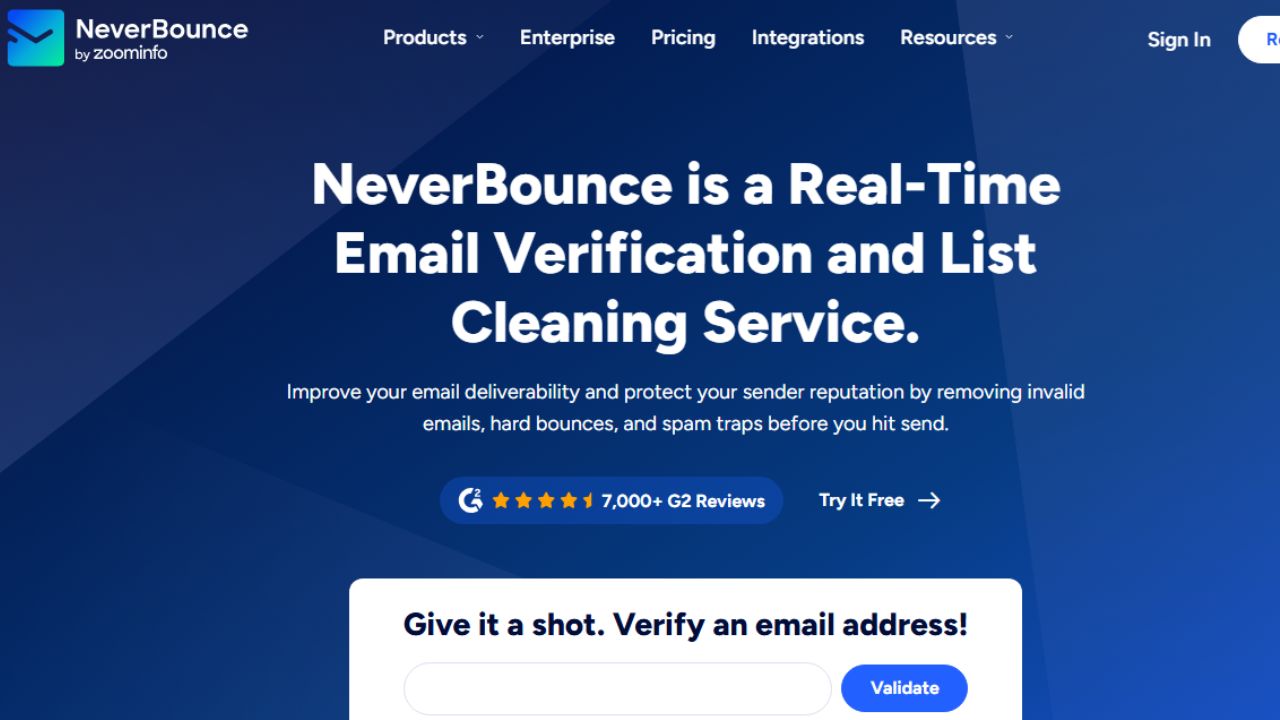
NeverBounce is widely used by agencies, SaaS companies, and high volume senders who need fast, reliable list cleaning.
Key features
- Bulk email verification with quick turnaround
- Real time API for form validation
- Automated list cleaning options
- Integrations with tools like HubSpot, Mailchimp, Salesforce, and Zapier
- Clear dashboard reporting
Where NeverBounce stands out
NeverBounce is known for speed and simplicity. Large lists can be processed quickly, and the interface is straightforward. For teams that mainly need accurate verification without extra layers of enrichment, it delivers what most marketers require.
Agencies managing multiple client accounts often appreciate the clean workflow and scalable credit model.
Potential drawbacks
- Limited data enrichment compared to more feature heavy platforms
- Fewer advanced analytics features
- Pricing can become significant for very large or frequent uploads
For companies focused strictly on validation rather than additional data insights, these limitations may not matter.
ZeroBounce Overview
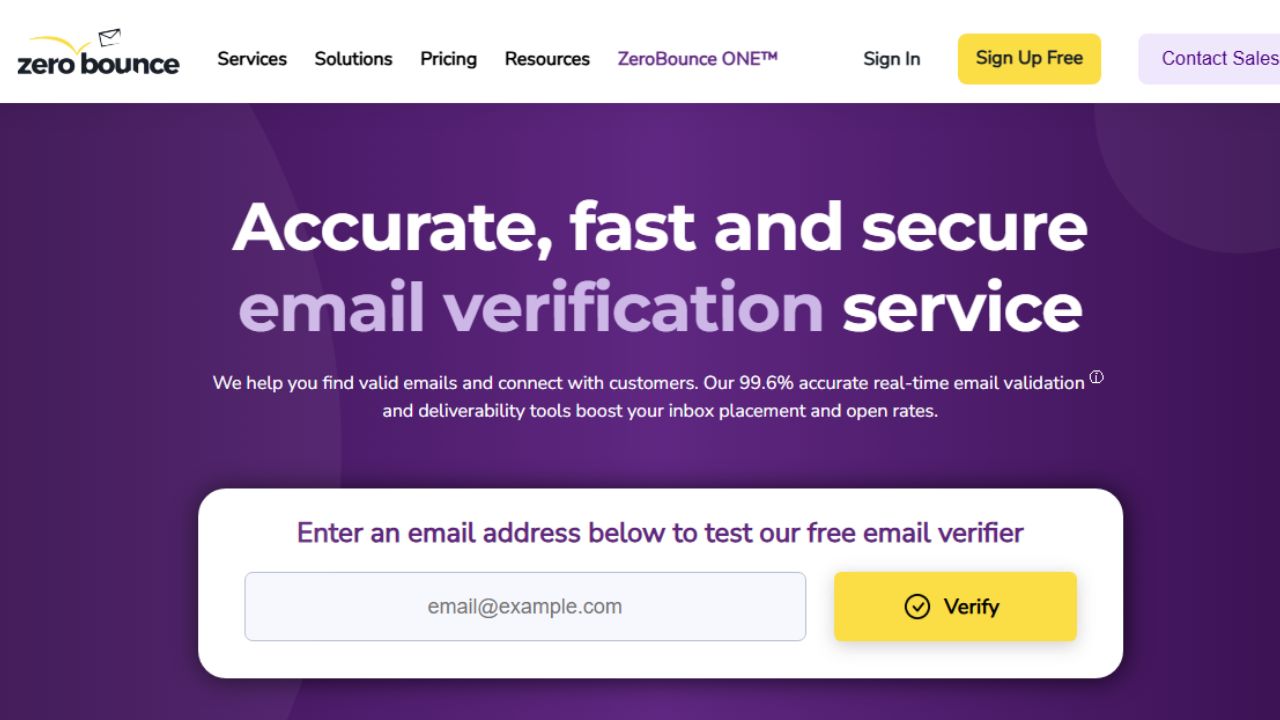
ZeroBounce positions itself as more than just a verification tool. In addition to cleaning lists, it provides extra data points and monitoring features.
Key features
- Bulk email verification
- Real time API validation
- Email scoring system
- Spam trap and abuse detection
- Email activity data in certain cases
- Blacklist monitoring tools
Where ZeroBounce stands out
ZeroBounce appeals to data driven teams. Its email scoring feature helps marketers segment contacts based on quality and engagement likelihood. The platform also emphasizes compliance and security, which can be important for enterprise users or regulated industries.
For companies that want deeper visibility into list health beyond simple valid or invalid status, ZeroBounce offers more layers.
Potential drawbacks
- Higher complexity for smaller teams
- Pricing may feel higher depending on usage volume
- Some features may be unnecessary for basic list cleaning
If your only goal is to reduce bounce rates, you may not need every feature ZeroBounce provides.
Accuracy and Verification Technology
Both platforms use similar technical foundations, including SMTP checks and domain validation. The challenge comes with catching all domains. These domains accept all incoming messages at the server level, making it difficult to determine whether an address is truly active.
While both tools claim high accuracy, real world performance depends on:
- The age of your list
- The source of your data
- The percentage of catch all domains
- How frequently you clean your database
The smartest approach is to test both tools with a sample of your own list. Compare bounce rates in your next campaign. That result will matter more than any marketing claim.
Read Also: How Email Still Dominates When It Comes To Business Communication
Pricing Comparison
Both NeverBounce and ZeroBounce use a credit based pricing system. The cost per email decreases as volume increases.
When comparing pricing, consider three scenarios:
- Occasional one time cleaning of 10,000 emails
- Quarterly cleaning of 100,000 emails
- Ongoing verification of 1 million or more emails
For startups with small lists, both platforms are affordable. For large enterprises sending millions of emails per month, even small price differences per thousand can add up significantly over time.
Also factor in API usage if you plan to validate emails at the point of capture.
Integrations and API Capabilities
For modern marketing teams, integration matters as much as accuracy.
Both platforms integrate with major tools such as:
- HubSpot
- Mailchimp
- Salesforce
- Zapier
If you run a SaaS platform or lead generation website, real time API validation is essential. It prevents bad data from entering your CRM in the first place.
Developers should evaluate:
- API documentation clarity
- Webhook support
- Rate limits
- Ease of implementation
In most cases, both tools provide solid developer support, but testing within your own workflow is the best way to judge fit.
Compliance and Data Protection
Data privacy is a growing concern, especially for companies operating in the EU or serving global customers.
When evaluating either tool, review:
- GDPR compliance statements
- Data processing agreements
- Data retention policies
- Security certifications if available
For enterprise teams, these details are often as important as verification accuracy.
Use Case Recommendations
Best for high volume bulk cleaning
If your primary need is fast and efficient cleaning of large lists, NeverBounce often fits well. Its streamlined approach works well for agencies and performance marketers.
Best for deeper data insights
If you want email scoring, blacklist monitoring, and added layers of intelligence, ZeroBounce may offer more value.
Best for startups and small businesses
If your budget is limited and your focus is simply reducing bounce rates, compare entry level pricing and test both platforms before committing long term.
Pros and Cons Summary
NeverBounce
Pros
- Fast bulk processing
- Simple interface
- Strong core verification
Cons
- Limited enrichment features
- Fewer advanced reporting options
ZeroBounce
Pros
- Email scoring and enrichment
- Blacklist monitoring
- Strong compliance positioning
Cons
- More complex feature set
- Potentially higher cost depending on usage
Final Thoughts on NeverBounce vs ZeroBounce
When it comes to NeverBounce vs ZeroBounce, there is no universal winner. The better choice depends on your goals.
If you need straightforward, reliable list cleaning at scale, NeverBounce may be the practical option. If you want added intelligence, scoring, and monitoring tools alongside verification, ZeroBounce may justify the investment.
Before making a decision, run a real test with your own data. Measure bounce rates, inbox placement, and campaign performance. The tool that protects your sender reputation and supports your growth strategy is the one worth choosing.