Pharmaceutical companies are managing increasingly complex relationships with healthcare professionals (HCPs), which makes specialized CRM software more important than ever. IQVIA’s ChannelDynamics Global Reference for 2026 tracks engagement data from more than 30,000 HCPs across pharmaceutical markets worldwide, and the findings reflect how pharma engagement now spans field sales, digital channels, and multiple touchpoints rather than a single sales visit.
A pharmaceutical CRM needs to go beyond basic contact and pipeline management. It should support HCP and HCO data, field force automation, sample tracking, compliant communication, territory management, and analytics. With those requirements in mind, this guide compares five leading CRM software options for the pharmaceutical industry, covering their key features, pricing, ideal use cases, and real-world deployments.
What Is CRM?
Customer relationship management (CRM) refers to the processes and tools businesses use to organize customer information, track interactions, manage sales activities, and maintain relationships. For a general overview of CRM and how it supports business operations, you can also read What Is CRM Software.
In the pharmaceutical industry, these systems are used to manage relationships with healthcare professionals (HCPs), healthcare organizations (HCOs), distributors, and field representatives. They can help teams maintain HCP profiles, record interactions, plan visits, manage territories, coordinate follow-ups, and analyze engagement data. These requirements make CRM particularly relevant to the way pharmaceutical companies manage their commercial relationships.
Why Pharma Needs a Different Kind of CRM
A generic sales CRM tracks deals and closes tickets. A CRM for pharmaceutical companies has to do that and also manage sample distribution, log every interaction with a healthcare professional (HCP) for audit purposes, track transfer-of-value reporting under laws like the U.S. Sunshine Act, and keep marketing content within the boundaries set by regulators. That is the core difference between a healthcare CRM built for clinics and hospitals, which I covered in our healthcare CRM roundup, and a pharmaceutical CRM platform built for manufacturers, medical reps, and life sciences commercial teams.
Before you shortlist anything, look for these essentials in pharmaceutical customer relationship management software:
- HCP and HCO data management with 360-degree profiles, prescribing history, and segmentation
- Field force automation for territory management, visit reporting, and route planning
- Sample management that tracks chain of custody and regulatory limits
- Compliance tooling aligned with HIPAA, GDPR, and the Sunshine Act
- Marketing automation for compliant multi-channel HCP engagement
- AI-powered analytics for next-best-action recommendations and sales forecasting
With that framework in mind, here are the five pharma CRM solutions worth putting on your evaluation list this year, based on real product data, vendor documentation, and reported customer deployments rather than marketing copy alone.
Pharma CRM vs General CRM: A Side-by-Side Breakdown
I get this question constantly from smaller pharma teams: “Can’t we just use HubSpot or Zoho and save the budget?” You can, for a while. But the gap shows up fast once your field team scales past a handful of reps or your legal team asks for an audit trail. Here is how the two actually compare on the things that matter in this industry.
| Feature | Pharma CRM | General CRM |
| HCP & HCO Management | Built specifically for healthcare professionals and organizations | Usually requires customization |
| Field Force Automation | Territory planning, visit tracking, route planning, and mobile access | Basic sales activity and task tracking |
| Compliance | Supports pharma-specific requirements and audit trails | General privacy and security controls |
| Transfer-of-Value Tracking | Designed to support reporting requirements such as Sunshine Act disclosures | Usually requires third-party tools or customization |
| Medical Affairs | Supports MSL workflows and scientific interactions | Limited or requires customization |
| Marketing | HCP segmentation and compliant omnichannel engagement | General marketing automation |
| Product & Batch Tracking | Can support pharmaceutical products, batches, and expiry information | Usually requires customization |
| Best For | Pharmaceutical manufacturers, life sciences, medical reps, and commercial teams | General businesses and sales teams |
The pattern I see over and over is teams that start on a general CRM because it is cheaper, then spend the next year building compliance features that a pharma-specific platform already ships with. If you are a very early-stage pharma startup with no field sales force yet, a general CRM can buy you time. Once reps are calling on doctors and your legal team starts asking about audit trails, that gap becomes expensive to close after the fact.
Best 5 CRM Software for the Pharmaceutical Industry
1. Creatio
Creatio is a strong option for pharmaceutical companies that want CRM flexibility without building every workflow from scratch. Its no-code platform allows sales, marketing, and service teams to customize processes around HCP engagement, territory management, field activities, and compliance requirements. This makes it particularly useful for mid-size and enterprise pharma teams that need to adapt their CRM as products, markets, and commercial strategies change.
Key features:
- HCP and HCO data management
- Sales, marketing, and service automation
- Territory and account management
- No-code workflow customization
- AI-powered next-best-action recommendations
- Mobile CRM for field teams
- HCP segmentation and omnichannel engagement
- Process and workflow automation
- Integration with external business systems
Pricing: Creatio’s Growth platform starts at $40 per user per month, with individual CRM products such as Sales, Marketing, and Service available separately from $15 per user per month.
Who it fits: Mid-size to enterprise pharma companies that want a customizable platform without a heavy IT build. If your team already struggles with rigid CRM software for pharma industry deployments, Creatio’s no-code layer is worth a serious look.
2. Veeva Vault CRM
Veeva Vault CRM is one of the most specialized CRM platforms for the pharmaceutical and life sciences industry. It is designed around the way pharma commercial and medical teams work, including HCP engagement, territory planning, sample management, and field activities. For large biopharma organizations operating across multiple regions and product portfolios, its deep industry focus makes it a strong choice when regulatory requirements and complex commercial operations are more important than having a simple, general-purpose CRM.
If you are evaluating pharma CRM solutions right now, this transition matters. Any new Veeva deployment should go straight to Vault CRM rather than the legacy version.
Key features:
- HCP and HCO profiling
- Territory and account planning
- Pharmaceutical sample management
- Field engagement and call reporting
- Offline mobile CRM for field representatives
- Medical affairs and MSL support
- HCP content sharing and management
- AI-powered engagement recommendations
- Integration with other Veeva Vault applications
- Support for region-specific regulatory requirements
Pricing: Veeva does not publish pricing. You will need to request a quote directly, and expect the conversation to include your existing tech stack since many pharma teams run other Veeva Vault products alongside CRM.
Who it fits: Large biopharma, animal health, and consumer health companies that need the deepest life sciences CRM specialization on the market and are prepared for an enterprise-scale implementation.
3. Krayin CRM
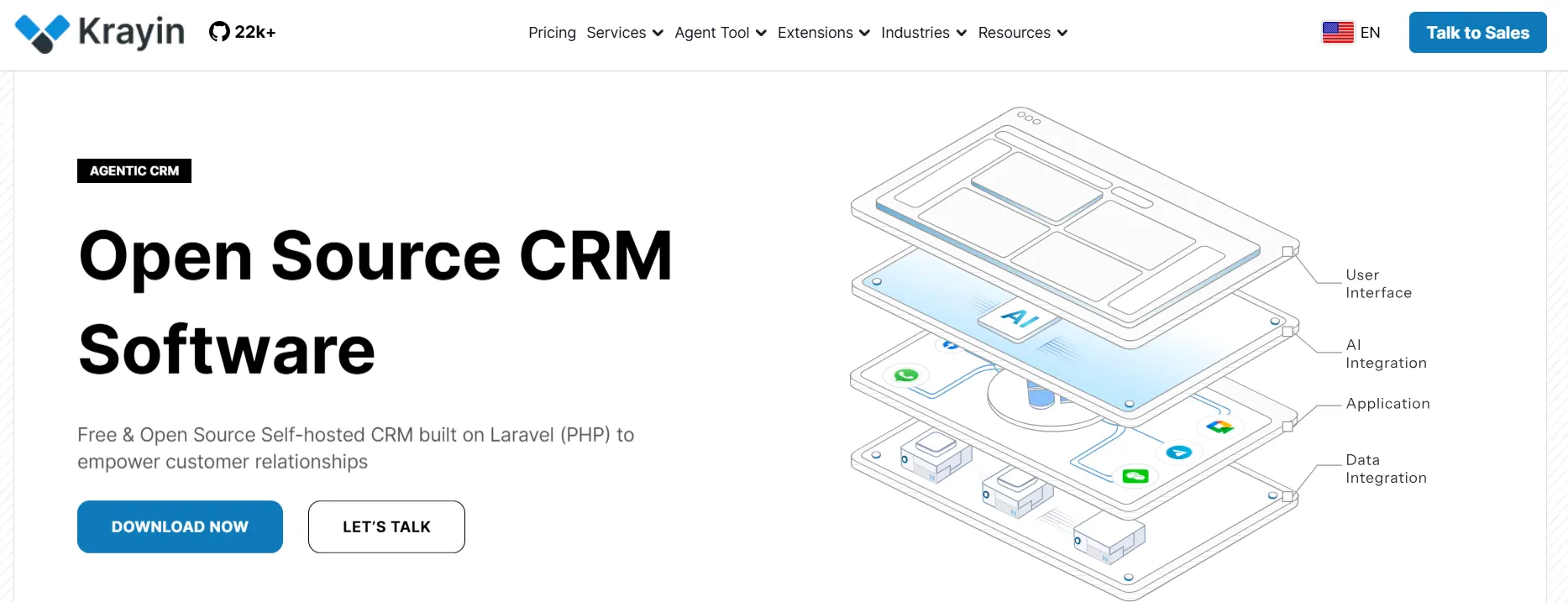
Krayin CRM takes a very different approach from enterprise pharmaceutical platforms. It is an open-source CRM that gives pharmaceutical manufacturers and distributors greater control over customization and deployment costs. While it does not come with the same level of pharma-specific compliance functionality as Veeva or Exeevo, its flexible Laravel-based architecture allows companies with development resources to build workflows around distributor management, sales tracking, customer relationships, and other business requirements.
Key features:
- Lead and contact management
- Sales pipeline management
- Product and quotation management
- Email and activity tracking
- Custom fields and workflows
- Role-based access and permissions
- Data import and migration capabilities
- Open-source Laravel architecture
- Developer-friendly customization
- Workflow automation
Pricing: The core CRM is free and self-hosted. Add-ons run separately, including a multi-tenant SaaS plan and WhatsApp and VoIP extensions, priced individually through Krayin.
Who it fits: Smaller pharma manufacturers and distributors, particularly in emerging markets, that need distributor and sales visibility without an enterprise licensing bill and have development resources to customize compliance features.
4. LionO360 (LionOBytes)
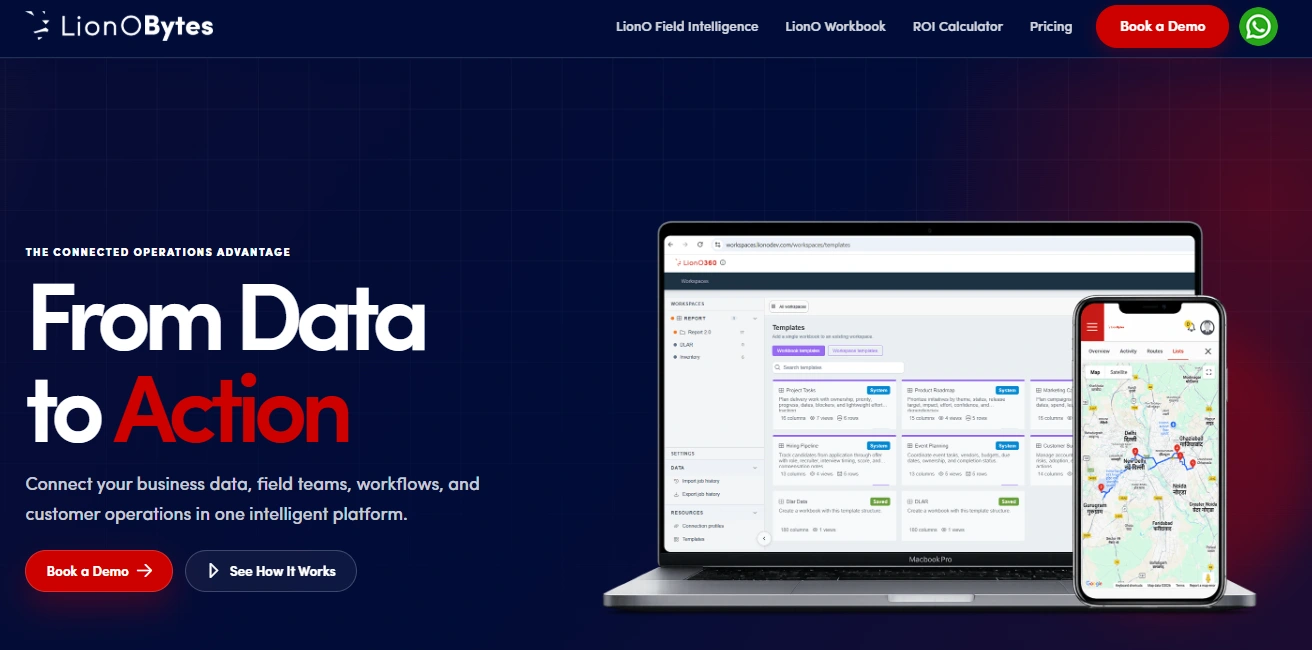
LionO360 is designed for pharmaceutical sales teams that need to manage doctor relationships, field representatives, distributors, and day-to-day sales activities from one platform. Its focus on medical representative workflows makes it particularly relevant for small and mid-size pharma companies where field teams spend much of their time visiting doctors, hospitals, clinics, and other healthcare accounts. The platform combines CRM capabilities with field reporting and analytics to give managers better visibility into sales activity and territory performance.
Key features:
- Doctor, hospital, clinic, and chemist account management
- Medical representative field reporting
- Visit planning and follow-up management
- Territory and sales activity tracking
- Mobile access for field representatives
- Sales and distributor management
- Customer interaction history
- Sales reporting and analytics
- AI-powered sales insights
Pricing: LionO360’s CRM pricing shown on its U.S. pricing page starts at $59 per user per month for the CRM Gold plan and $79 per user per month for the CRM Diamond plan, based on the 10-user monthly pricing shown. Field Intelligence is listed separately at $39 per user per month.
Who it fits: Small to mid-size pharmaceutical sales teams that want dedicated pharma workflows without an enterprise price tag, particularly companies already comfortable with LionOBytes’ broader ERP and field service tools.
5. Exeevo Omnipresence
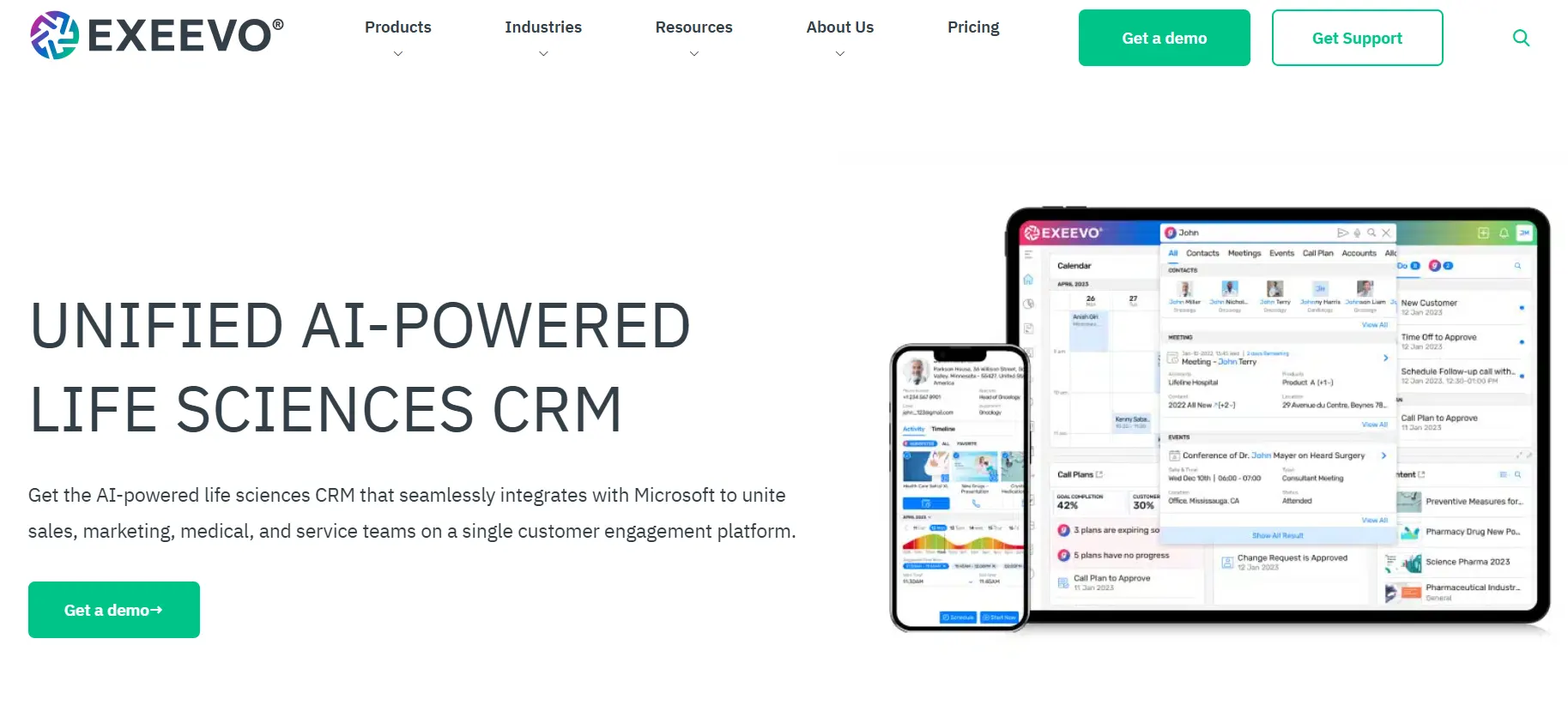
Exeevo Omnipresence is built specifically for life sciences companies that want pharmaceutical CRM capabilities on a Microsoft-based technology stack. The platform brings sales, marketing, medical affairs, and HCP engagement into a unified environment, making it suitable for organizations managing complex commercial operations across multiple channels. Its Microsoft Dynamics 365 foundation can also make it an attractive alternative for companies that already rely heavily on Microsoft technologies and want to avoid building their pharma CRM around Salesforce.
Sanofi’s China operations moved to Omnipresence to meet strict data residency and PIPL compliance requirements, using Exeevo’s integration with 21Vianet, Microsoft’s trusted China cloud partner. A separate multinational French pharma company also reported measurable HCP satisfaction gains after switching from a legacy CRM to Omnipresence in its Indian subsidiary.
Key features:
- 360-degree HCP and customer profiles
- AI-powered next-best-action recommendations
- Omnichannel HCP engagement
- Sales and field force automation
- Medical affairs and MSL workflows
- AI-powered marketing segmentation
- Compliance and privacy controls
- Microsoft Dynamics 365 integration
- Microsoft Cloud integration
- Mobile and offline field access
- ERP, MDM, and analytics integrations
Pricing: Exeevo uses a simplified, all-inclusive licensing model, but exact figures are not published. You will need to request a quote based on your team size and modules.
Who it fits: Life sciences and MedTech companies already standardized on Microsoft infrastructure who want deep pharma-specific functionality without adopting a Salesforce-based stack.
Real Pharma Companies Using These CRMs
It is easy to list features. It is more useful to see where these platforms actually run in production. Here are three documented deployments that show how different the use cases can be depending on company size and region.
Teva Pharmaceuticals and Veeva Vault CRM. In May 2026, Teva committed to Veeva Vault CRM globally, expanding a long-standing partnership with Veeva. Teva works across neuroscience, immunology, generic medicines, and biosimilars, and the move to Vault CRM gives its commercial teams a technical foundation for global execution rather than region-by-region systems. This is the kind of deployment that shows what Veeva is built for: large, multinational biopharma companies with complex product portfolios.
Sanofi China and Exeevo Omnipresence. Sanofi’s China operations needed a CRM that could meet Chinese Data Residency and PIPL requirements, which ruled out platforms without local infrastructure support. Exeevo’s integration with 21Vianet, Microsoft’s approved China cloud partner, let Sanofi run Omnipresence while staying compliant with local data laws. This case matters if your company operates in markets with strict data residency rules, since not every CRM vendor has that infrastructure in place.
VIDIPHA and Krayin CRM. VIDIPHA, a Vietnamese pharmaceutical manufacturer producing antibiotics, vitamins, and respiratory treatments, had customer, distributor, and sales data spread across disconnected systems before adopting a custom Krayin CRM build. The implementation centralized quoting, distributor communication, and order tracking, giving the company real-time visibility into its distribution network. It is a good example of a mid-size manufacturer solving a real operational problem without an enterprise-scale budget.
Three very different company sizes, three very different priorities: global scale for Teva, regional compliance for Sanofi, and operational visibility on a budget for VIDIPHA. That is usually the right lens to evaluate your own shortlist through.
Quick Comparison
| CRM | Best For | Starting Price |
| Creatio | Mid-size to enterprise, customization-heavy teams | From $40/user/month + $15/user/month per CRM product |
| Veeva Vault CRM | Large biopharma and life sciences enterprises | Quote only |
| Krayin CRM | Small manufacturers with in-house developers | Free (self-hosted) |
| LionO360 | Small to mid-size pharma sales teams | From $59/user/month |
| Exeevo Omnipresence | Microsoft-standardized life sciences teams | Quote only |
How to Choose Between Them
I always tell pharma clients to start with compliance, not features. Every platform on this list can manage contacts and pipelines. Not every platform can prove, during an audit, exactly who said what to which doctor and when. After compliance, weigh these factors:
- Existing tech stack – A Microsoft shop will find Exeevo easier to integrate than a Salesforce-native team, and vice versa for Veeva’s legacy architecture.
- Team size and budget – Enterprise platforms like Veeva justify their cost at scale, but a 15-person sales team may get more value from LionO360 or a customized Krayin build.
- Field force complexity – If your reps work in areas with unreliable internet, prioritize offline-capable field tools like Veeva’s.
- AI maturity – Creatio and Exeevo both lean heavily into AI-driven next-best-action recommendations, which matters if your marketing team wants predictive targeting rather than static segmentation.
- Implementation timeline – Open-source and mid-market platforms typically deploy faster than enterprise suites, which often take several months of configuration.
Common Mistakes Pharma Companies Make When Choosing a CRM
After five years of watching pharma teams go through this process, the same mistakes show up again and again. Here is what I would tell a friend evaluating a pharma CRM for the first time.
Choosing on price before compliance. A cheaper CRM that cannot generate a Sunshine Act report or produce an audit trail on demand is not actually cheaper once your compliance team has to build that functionality manually or, worse, once a regulator asks for records you cannot produce.
Underestimating field rep adoption. The best CRM in the world fails if your reps will not use it in the field. I have seen enterprise rollouts stall for months because the mobile app was clunky or visit logging took too long between appointments. Test the mobile experience with actual reps before you sign a multi-year contract, not after.
Ignoring HCP data migration complexity. Moving years of prescriber history, interaction logs, and consent records from a legacy system is rarely as simple as vendors make it sound in a demo. Budget real time and real testing for this step, especially if you are consolidating data from multiple regional systems.
Skipping the integration conversation. A pharma CRM that cannot talk to your ERP, your marketing automation platform, or your EMR and prescription data providers becomes another data silo instead of solving the silo problem it was bought to fix. Ask vendors for specific integration case studies in your tech stack, not a generic list of supported connectors.
Assuming one platform fits every market. Companies with global operations, like Sanofi in China, sometimes need to weigh data residency and local regulatory requirements market by market. What works for your U.S. commercial team may not clear compliance review in the EU or APAC.
Treating the CRM purchase as an IT decision instead of a cross-functional one. The teams that get the most value out of a pharma CRM involve compliance, field sales, marketing, and medical affairs in the evaluation from the start, not just IT and procurement. Each of those teams has different requirements, and finding that out after the contract is signed is an expensive way to learn it.
Frequently Asked Questions
- What is CRM software for pharmaceutical companies? It is a specialized customer relationship management platform built to manage relationships with healthcare professionals, healthcare organizations, and distributors while meeting pharma-specific regulatory requirements like the Sunshine Act, HIPAA, and GDPR.
- Why can’t pharma companies just use a general CRM like generic Salesforce or HubSpot? General CRMs lack built-in compliance controls, sample tracking, transfer-of-value reporting, and HCP-specific data models. Pharma companies that try to force a general CRM into this role usually end up bolting on custom compliance workarounds, which increases audit risk.
- What features matter most in a pharmaceutical CRM platform? HCP and HCO data management, field force automation, sample tracking, compliance and consent management, marketing automation for regulated content, and AI-driven analytics for territory and account prioritization.
- Is Veeva CRM still built on Salesforce? No, not for new deployments. Veeva has moved its flagship CRM product to its own Vault CRM platform. Legacy Salesforce-based Veeva CRM instances have support through December 31, 2029, but the company is actively migrating major customers, including Teva Pharmaceuticals, to Vault CRM.
- How much does pharma CRM software cost? It ranges widely. Krayin’s core platform is free to self-host, LionO360 starts around $20 to $35 per user per month, Creatio starts at $40 per user per month plus $15 per application, and enterprise platforms like Veeva and Exeevo require a custom quote based on team size and modules.
- Is Creatio CRM HIPAA and GDPR compliant? Yes. Creatio includes built-in HIPAA and GDPR compliance guardrails as part of its pharma-focused CRM offering, along with role-based access controls and audit trails.
- Can a small pharmaceutical company use an open-source CRM like Krayin? Yes, particularly manufacturers and distributors that need centralized customer and sales data without enterprise licensing costs. VIDIPHA, a Vietnamese pharmaceutical company, used a custom Krayin CRM implementation to unify its distributor and sales operations. Keep in mind you will likely need in-house or contracted developers to build out pharma-specific compliance features.
- What is the difference between a healthcare CRM and a pharmaceutical CRM? Healthcare CRM software, like the platforms built for clinics and hospitals, focuses on patient engagement, appointment scheduling, and provider-to-patient communication. Pharmaceutical CRM software focuses on manufacturer-to-HCP relationships, field sales, sample management, and commercial compliance, which is a different workflow entirely.
- How does AI improve pharma CRM software? AI features in modern pharma CRM platforms handle next-best-action recommendations for HCP outreach, automated call and meeting logging, demand forecasting based on prescribing trends, and real-time compliance risk flagging during HCP interactions.
- How long does it take to implement a pharmaceutical CRM? It depends on the platform and your existing data complexity. Smaller, more configurable systems can go live in weeks. Enterprise platforms like Veeva or Creatio, especially when integrated with existing ERP, EMR, or clinical trial systems, commonly take a few months of planning, data migration, and compliance validation before full rollout.
Conclusion
Managing relationships with healthcare professionals, field teams, distributors, and regulatory requirements requires a platform that can support the unique demands of the pharmaceutical industry. The options discussed in this guide offer different approaches for handling HCP data, field activities, compliance, marketing, analytics, and integration needs.
The best fit depends on factors such as company size, budget, existing technology infrastructure, field force requirements, data residency, and compliance priorities. Taking time to evaluate these areas can help pharmaceutical teams improve operational visibility, strengthen HCP engagement, reduce manual work, and build a more connected commercial process.