
The global subscription billing management market is on track to grow from $9.16 billion in 2025 to $10.92 billion in 2026, according to The Business Research Company’s 2026 market report. That growth is not surprising. Every SaaS founder I know has hit the same wall: your product is ready, your customers are signing up, and then your billing stack turns into a spreadsheet held together by hope.
This is where SaaS billing management software becomes essential. Instead of relying on spreadsheets or disconnected payment tools, these platforms automate the entire subscription lifecycle while helping businesses reduce churn, improve cash flow, and maintain financial accuracy. According to industry research from Gartner and other leading analysts, subscription-based business models continue to expand across software, AI, media, and digital services, making reliable billing infrastructure a business necessity rather than a convenience.
What SaaS Billing Management Actually Means
SaaS billing management is the software layer that handles everything after a customer clicks “subscribe.” It covers recurring invoicing, payment collection, plan changes, taxes, and revenue reporting for subscription-based businesses. If you are still getting familiar with how the broader SaaS model works, our guide on what SaaS is breaks down the delivery model these billing platforms are built around.
A good SaaS billing platform does more than send an invoice. It manages the full subscription lifecycle: trials, upgrades, downgrades, cancellations, usage-based billing, dunning management for failed payments, and revenue recognition for your finance team. If this layer is not managed properly, your monthly recurring revenue (MRR) reports may not align with your actual bank deposits.
What to Look For in SaaS Billing Software
Before I get into the tools, here is the checklist I actually use when I audit a company’s billing setup. Not every SaaS billing platform needs every item below, but the more boxes a company can check, the fewer fires it puts out later.
- Recurring and usage-based billing support. Flat subscriptions are easy. Metered billing, tiered pricing, and hybrid models are where most billing software for SaaS companies falls apart.
- Dunning management and failed payment recovery. Involuntary churn from a declined card is one of the most fixable revenue leaks in SaaS, and it is one finance teams still underestimate.
- Payment gateway integration. Stripe, PayPal, Braintree, and Adyen support matters if you sell in more than one region.
- Revenue recognition (ASC 606 / IFRS 15). If you have investors or an audit coming, this is not optional.
- Multi-currency billing and tax compliance. Global payments bring VAT, GST, and sales tax rules that a spreadsheet cannot keep up with.
- A customer billing portal. Self-service upgrades and invoice downloads cut down support tickets fast.
- API integrations with your CRM, ERP, and accounting stack. Billing data that stays trapped in one tool is only half useful. If your team is still comparing CRM options, our guide to choosing the right CRM is worth reading alongside this one, since most billing platforms plug directly into whichever CRM you pick.
With that out of the way, here is how the five platforms stack up.
Best Top 5 SaaS Billing Management Software
1. Chargebee
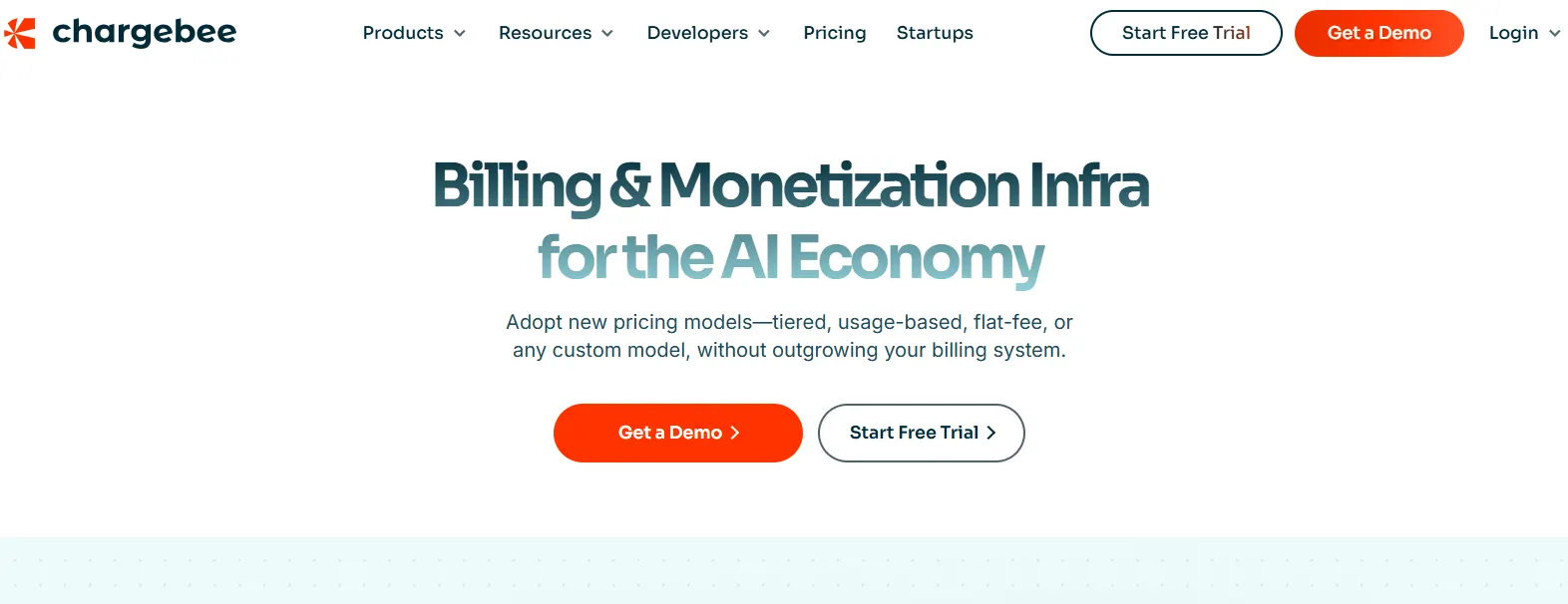
Chargebee is usually the first name that comes up when a SaaS company starts shopping for subscription billing software, and there is a reason for that. Founded in Chennai in 2011 and now dual-headquartered in San Francisco and Chennai, Chargebee serves more than 6,500 SaaS and AI companies across 180 countries and was named a Leader in Gartner’s 2025 Magic Quadrant for the category.
Key features: Chargebee automates the full recurring-revenue loop, from signup through payment collection, invoicing, dunning, and ASC 606 revenue recognition. The platform ships as seven modules, Billing, CPQ, Receivables, Retention, RevRec, Payments, and Growth, backed by 60-plus native integrations and 35-plus payment gateways. In 2026, Chargebee pushed further into usage-based billing for AI products, adding schemaless usage ingestion so companies can bill for tokens, API calls, or agent workflows without rebuilding their pricing infrastructure.
Pricing: Chargebee offers a free Starter plan covering the first $250,000 in cumulative lifetime billing, a Performance plan billed at $599 per month ($7,188 annually with an annual commitment), and custom Enterprise pricing. Both paid tiers add a 0.75% overage fee once billing volume crosses the plan threshold.
Best for: Series B and later B2B SaaS companies that need CPQ, multi-entity accounting, and compliant revenue recognition in one place.
Watch out for: The published price rarely matches the final invoice. Revenue-based overage fees, add-on modules for retention and revenue recognition, and gateway costs stack up quickly for companies scaling past $100K in monthly billing.
2. Recurly
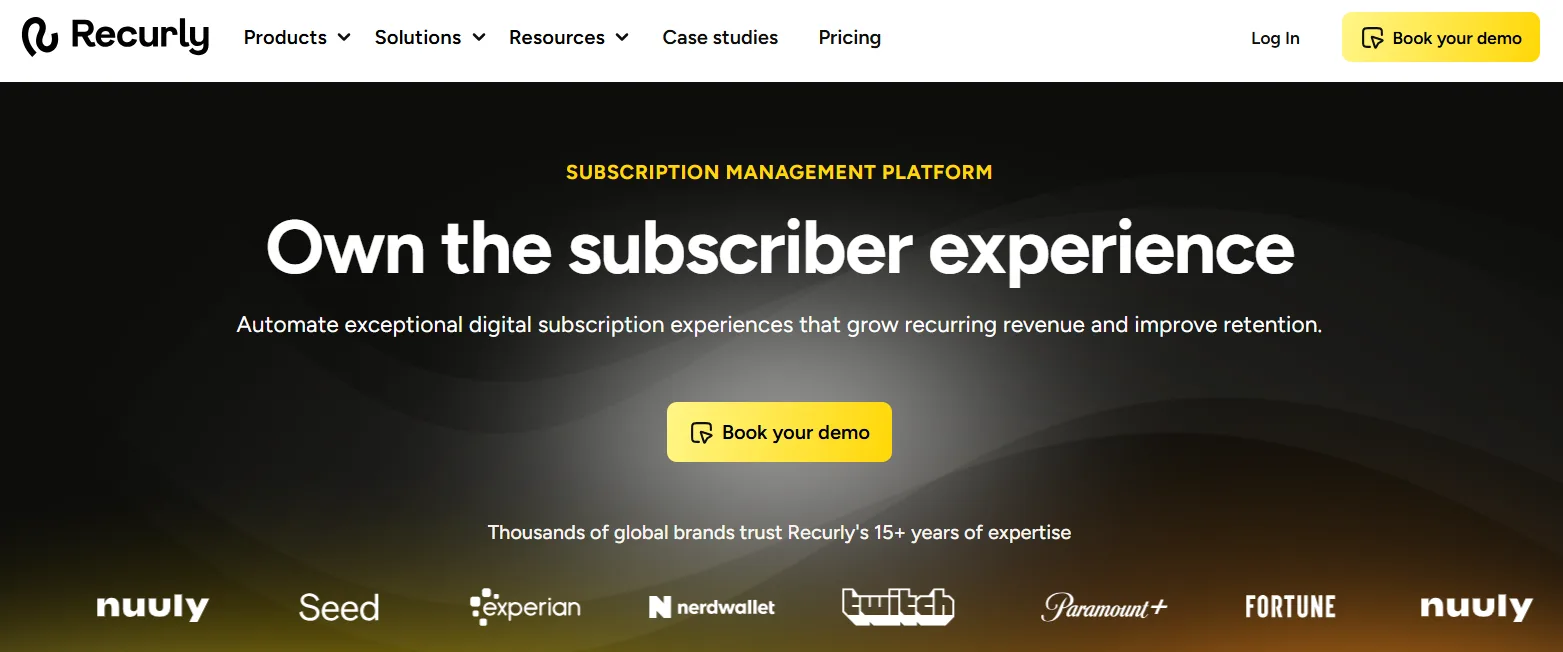
Recurly built its reputation on churn reduction, and that focus still shows in the product. The platform is aimed at direct-to-consumer and high-volume subscription businesses, with customers including Sling, Twitch, BarkBox, FabFitFun, Paramount, and Sprout Social.
Key features: Recurly’s core strength is machine-learning-powered dunning and revenue recovery, covering retry logic, account updater integrations for expired cards, and configurable email sequences. Beyond recurring invoicing, the platform includes native Shopify subscription management, no-code subscriber journey testing, and automated revenue recognition for ASC 606 and IFRS 15 compliance.
Pricing: Recurly runs four tiers: a free Starter/Trial plan (three months, capped at $40,000 in payments), a custom-quoted Scaling plan for growing SaaS businesses, a custom Enterprise plan, and Recurly Commerce for Shopify brands at $399 per month plus a percentage of gross merchandise value. One thing to flag for your finance team: Recurly’s pricing covers the billing platform only, and payment gateway fees such as Stripe’s standard rate are charged on top.
Best for: Subscription businesses with high transaction volume and a real involuntary-churn problem, especially D2C and media companies.
Watch out for: Custom pricing means you will not know your real cost until you talk to sales, and several reviewers on Capterra have flagged unclear contract terms around fees that only surfaced after signing.
3. OneBill
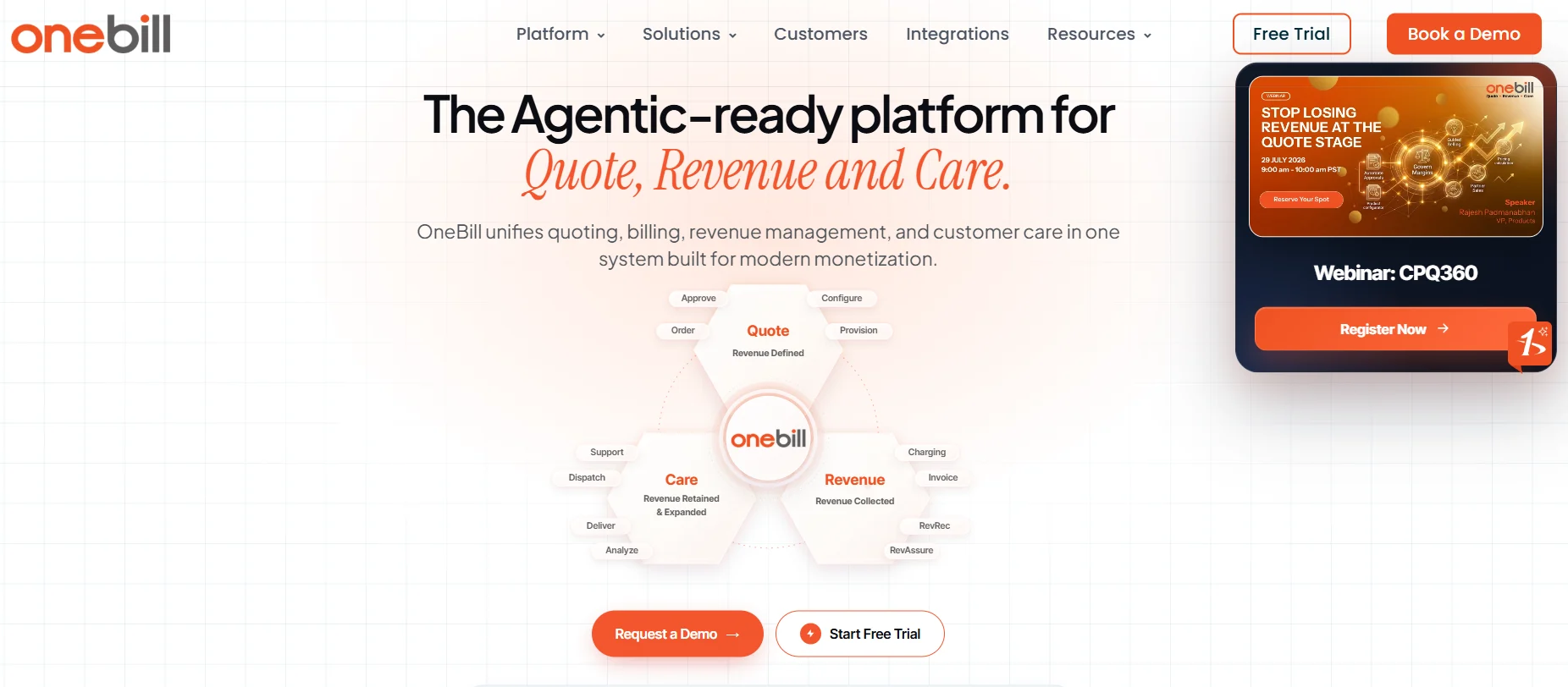
OneBill takes a different approach than the first two. Instead of focusing purely on recurring SaaS subscriptions, it is built as an end-to-end quote-to-cash platform for companies with more complex revenue models, including channel partners and resellers.
Key features: OneBill supports one-time, recurring, usage-based, rule-based, and hybrid billing models inside a single system. Its CPQ360 module handles quoting and contract generation with built-in eSign, Billing360 manages usage-based rating and invoicing, and Churn360 flags at-risk subscribers for renewal outreach. No-code configuration lets finance teams adjust pricing and launch new products without pulling in engineering. OneBill was named a Visionary in Gartner’s 2024 Magic Quadrant for Recurring Billing Applications.
Pricing: Published estimates put OneBill’s starting price around $299 per month, with most implementations quoted based on business complexity and reseller or partner requirements.
Best for: B2B SaaS companies with reseller networks, telecom-adjacent billing needs, or hybrid pricing models that a pure subscription tool cannot handle cleanly.
Watch out for: User reviews on Gartner Peer Insights and Software Advice consistently mention a longer learning curve during setup, along with limited invoice-correction and custom reporting options compared to some competitors.
4. Billforward
Billforward is the leanest team on this list, and that is worth knowing going in. Founded in San Francisco in 2013 by Ian Saunders, Aubone Tennant, and Mark Parry, and backed by Y Combinator, Billforward positions itself as a flexible subscription and recurring billing platform for businesses with complex billing needs.
Key features: The platform supports flat-fee, event-based, and usage-based metered billing, along with volume and tiered discounts, coupons, and free trials. Integrations include Salesforce, QuickBooks, HubSpot, and Google Data Studio. Its dunning management automatically reschedules unpaid invoices for reprocessing, which helps recover revenue without manual follow-up from your team.
Pricing: Publicly listed tiers include an Essentials plan at $50 per month, a Growth plan at $179 per month, a Scale plan at $439 per month, and custom Enterprise pricing.
Best for: Smaller SaaS teams that want flexible metered billing without paying enterprise-platform prices, and that are comfortable working with a small, specialized vendor team.
Watch out for: Billforward operates with a notably small headcount, which is fine for support responsiveness but worth factoring in if you need a vendor with deep bench strength for a large-scale enterprise rollout.
5. Stax Bill
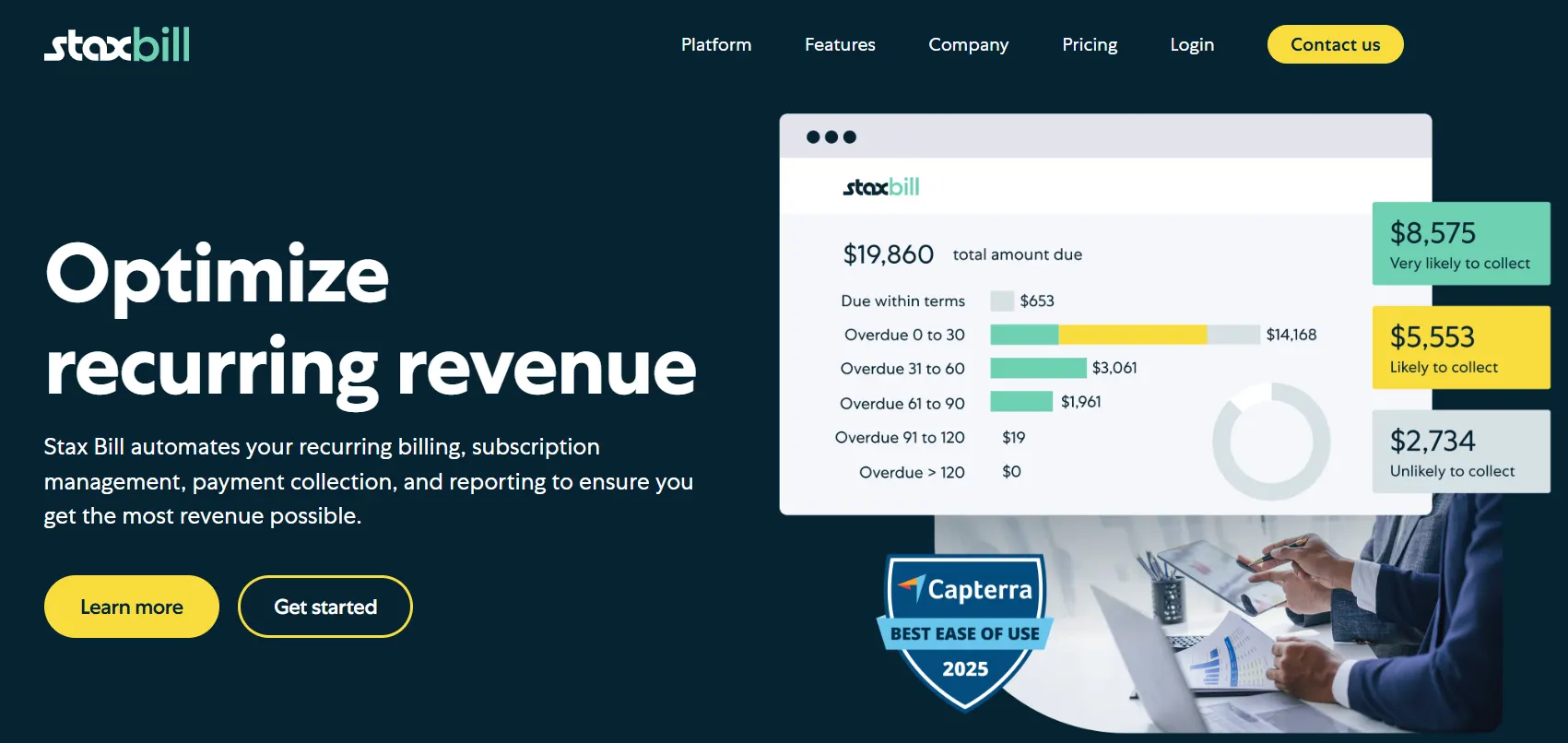
Stax Bill, formerly known as Fusebill, rounds out this list as a solid mid-market option for companies that want subscription billing without a steep implementation curve.
Key features: Stax Bill automates recurring invoicing, renewals, collections, and reconciliation, and supports usage-based pricing with proration for mid-cycle changes. The platform includes a branded self-service customer billing portal, over 50 customizable reports covering revenue trends and payment performance, and dunning management to reduce failed payments. It integrates with CRM systems like Salesforce and ERP systems like NetSuite, and maintains PCI Level 1 compliance for payment security.
Pricing: The Growth plan starts at $499 per month and includes subscription billing, account hierarchy, churn prevention, revenue recognition, and security and compliance features. Enterprise pricing is quoted separately based on business needs.
Best for: Mid-market subscription businesses that want an easy-to-navigate interface and do not need the deep AI-usage billing features that larger platforms have started building out.
Watch out for: Reviewers on G2 mention wanting deeper native integration with tools like HubSpot and more flexible custom reporting than the current 50-plus templates allow.
Quick Comparison Table
| Software | Best For | Starting Price | Standout Feature |
| Chargebee | Scaling B2B SaaS with complex revenue models | Free tier, then $599/mo | CPQ + AI usage billing modules |
| Recurly | High-volume D2C and media subscriptions | Free trial, custom pricing | ML-powered dunning and churn recovery |
| OneBill | B2B SaaS with resellers or hybrid billing | ~$299/mo | Full quote-to-cash automation |
| Billforward | Small SaaS teams needing flexible metered billing | $50/mo | Lean, flexible pricing tiers |
| Stax Bill | Mid-market subscription businesses | $499/mo | Self-service portal + 50+ reports |
FAQs
What is SaaS billing management software?
SaaS billing management software automates how subscription businesses charge customers, including recurring invoicing, payment collection, plan upgrades, dunning management, and revenue recognition. Popular platforms include Chargebee, Recurly, OneBill, Billforward, and Stax Bill, each built for different SaaS billing platform needs.
What is the difference between recurring billing software and subscription management software?
Recurring billing software only handles scheduled charges and invoice generation. Subscription management software covers the full subscriber lifecycle, including trials, plan changes, cancellations, and renewals, alongside billing. Most modern SaaS billing platforms combine both functions in one system.
Which SaaS billing software is best for startups?
Chargebee’s free Starter plan, covering the first $250,000 in cumulative lifetime billing, and Billforward’s $50-per-month Essentials plan are the most accessible entry points for early-stage SaaS companies that want recurring billing software without enterprise pricing.
Which SaaS billing platform is best for enterprise companies?
OneBill and Chargebee’s Enterprise tier suit larger SaaS companies best. OneBill handles quote-to-cash automation with reseller and partner billing, while Chargebee adds CPQ, multi-entity accounting, and compliant revenue recognition for Series B and later B2B SaaS businesses.
How much does SaaS billing software cost?
Pricing varies widely by platform and billing volume. Billforward starts at $50 per month, OneBill starts around $299 per month, Chargebee’s Performance plan runs $599 per month, and Stax Bill’s Growth plan starts at $499 per month. Most platforms add usage-based or revenue-based overage fees above a set threshold.
What is dunning management in SaaS billing?
Dunning management is the automated process of retrying failed card payments and notifying customers when a charge declines. It directly reduces involuntary churn, since customers who leave because of a failed payment, not a decision to cancel, are one of the most preventable revenue losses in subscription billing.
Do SaaS billing platforms process payments themselves, or do I need a separate gateway?
Most SaaS billing platforms, including Chargebee, Recurly, and Stax Bill, do not process payments directly. They connect to gateways like Stripe, Braintree, PayPal, or Adyen, so your total cost includes both the billing platform’s fee and the gateway’s transaction fee.
What is usage-based billing, and which platforms support it?
Usage-based billing, also called metered billing, charges customers based on consumption, such as API calls or active seats, instead of a flat fee. Chargebee, Billforward, and OneBill all support usage-based and hybrid pricing models alongside standard recurring billing.
Which SaaS billing software is best for reducing churn?
Recurly is built specifically around churn reduction, using machine-learning-powered dunning, retry logic, and account updater integrations to recover failed payments. OneBill’s Churn360 module offers similar renewal-risk tracking for companies with reseller or partner billing.
Does SaaS billing software handle tax compliance and multi-currency billing?
Yes, most established SaaS billing platforms support multi-currency billing and automated tax calculation, though depth varies. Chargebee and Recurly both offer multi-region tax handling, while Stax Bill integrates with third-party tax tools like Avalara for state and country-level compliance.
Final Take
The best SaaS billing management software depends on your business model, pricing strategy, and growth stage rather than a single “best” platform for everyone.
If you need an enterprise-ready solution with advanced subscription management and revenue recognition, Chargebee is a strong choice. Recurly stands out for businesses focused on reducing churn and recovering failed payments. OneBill is well suited for organizations with hybrid pricing models or reseller networks, while Billforward offers an affordable option for startups that require flexible usage-based billing. Stax Bill remains a reliable choice for mid-market companies looking for straightforward subscription billing with solid reporting capabilities.
Before making a decision, evaluate your current billing complexity, expected transaction volume, required integrations, and long-term pricing model. Selecting a platform that can scale with your business today will save significant time, reduce operational overhead, and support sustainable recurring revenue growth as your SaaS business expands.