Artificial intelligence is no longer limited to systems that merely respond to prompts or follow fixed rules. The current emphasis is on agentic AI, which are systems that aim to act, make decisions, and carry out tasks with little human intervention. This change is happening as a consequence of the fact that businesses and users now expect AI to do more than just respond to queries. They want AI to be the one to solve the problem completely.
Knowing the working mechanism of AI agents is a must for any person who is digitally product building, operational managing, or automation exploring. AI agents are available to run workflows, manage data pipelines, and support customers, developers, and even other AI systems. They derive their worth from the fact that they can plan their actions, choose between different alternatives, carry out tasks, and learn from the results.
This article describes how AI agents function outside the lab, with a focus on the plan, decide, and execute cycle that is the core of contemporary agent based systems.
What Are AI Agents? A Clear, Practical Definition
Simply put, an AI agent is a system that uses software to achieve a certain goal by learning about the surroundings, deciding what to do, and then doing it. An AI agent is not a traditional program in that it is not limited to only following the steps that have been specified beforehand. It changes its behavior depending on the inputs, the environment, and the feedback it receives.
To better understand an AI agent, you might imagine it as a digital employee. One thing at a time you can charge it with one task of, for instance, answering customers’ questions, analyzing reports, or coordinating tasks, and it will figure out how to accomplish that task by using the tools and information it has at hand.
Three key distinctions between AI agents and simple chatbots or scripted automation are as follows: operations with goals, not just commands; the ability to select one action over another based on the context; and the capability to change their behavior depending on the results. Agentic AI, the use of which is being extensively spread across different industries due to its ability to function with a certain degree of independence, is thus the reason for this massive success.
Read Also this :- ChatGPT vs Gemini vs Copilot: Understanding the Key Differences Between AI Giants.
The Core Architecture of AI Agents
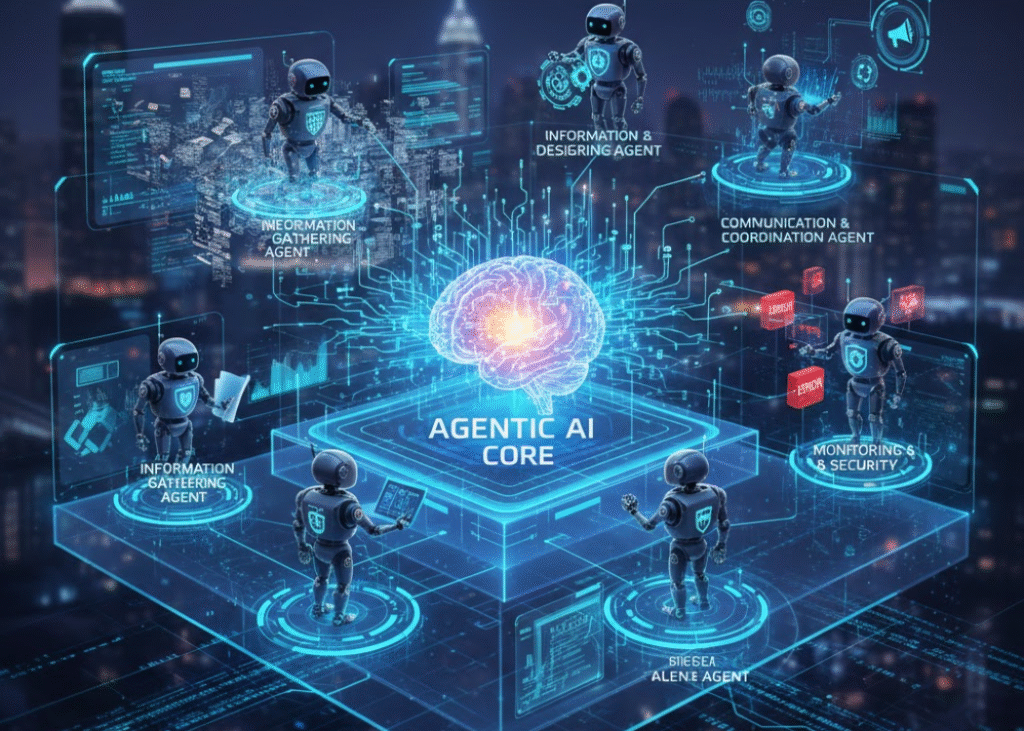
Knowing the internal structure will definitely help to understand how AI agents operate. In fact, the majority of AI agents have the same basic architecture which consists of several essential components.
Environment
The environment refers to everything the agent interacts with. Depending on the situation, this may be a website, a database, an application interface, or even other AI systems.
Goals
Goals are the things which represent success. For instance, a goal might be the closing of a support ticket, the generation of a report, or the completion of a multi step workflow.
Inputs and Outputs
Inputs can be user requests, data feeds, system signals, or sensor data. On the other hand, outputs are the activities the agent performs, for instance, sending messages, updating records, or calling APIs.
Memory and State
Memory is what enables the agent to keep the context of a certain time. This can be the past interactions, the progress of a task, or the previous decisions made.
An effectively crafted architecture is what guarantees the agent’s ability to function consistently, keep up with its intended purpose, and increase in capacity as more complex tasks develop.
How AI Agents Work: The Plan, Decide, and Execute Cycle
Agentic AI at its core is a single cycle of planning, decision making, and execution which is continuously repeated. This cycle is what allows agents to operate on their own and yet be able to react to changes.
Planning: Defining Goals and Breaking Down the Work
Planning is the point where AI agents start operating. Basically, an agent receiving a goal is obliged to figure out how to reach it. Mostly this means decomposing an enormous target into smaller and manageable tasks.
As an illustration, consider the goal of delivering a sales summary for the week. In this case, the agent may decide to collect data from various sources, clean and organize the data, analyze the trends, and finally create a report.
Now, AI agents turn to reasoning models and well organized prompts to make decisions on the best course of action. They also think about limitations like time, the tools that can be used, and the level of accuracy required. Planning is not something that stays the same. Agents still have the option to change their plans if the circumstances change.
Decision Making: Choosing the Best Action
After the agent has a plan, it still has to figure out what to do next. Decision making means that the options are evaluated and the most effective action is chosen at each step.
Agents weigh these factors: current context and data, past outcomes retrieved from memory, risk levels and constraints, and task priority.
This is the point where autonomy is singled out. Instead of the agent merely following a predetermined path, it changes. It picks another if the first one fails. In time, the quality of the decisions gets better as the agent learns which actions result in positive outcomes.
Execution: Taking Action in the Real World
Execution is the stage where the decisions and the plans are transformed into actual results. AI agents use tools, integrations, and APIs to communicate with external systems.
Execution might be doing any of the following: sending messages or emails, updating databases, triggering workflows, or calling other AI services.
Upon performing an action, the agent keeps track of the result. If the output is what it expected, then it proceeds. Otherwise, it logs the problem, changes its plan, and makes another attempt. This feedback loop is very important for the system’s consistency and upgrading.
Memory and Learning in AI Agents
Memory is extremely important to AI agents; it is what keeps the whole system going. If the AI agent did not have memory, it would not be able to differentiate the tasks from one another, and thus every task would be treated as a brand new one and the context would be lost completely.
Short term memory is used by agents to handle ongoing tasks and dialogues.
Long term memory has room for historical data, likes, and lessons learned.
Learning is the process of agents figuring out from the results and changing their behavior in the future accordingly. It is not always the case that learning leads to model retraining. Most of the time, learning is carried out by means of updated rules, refined prompts, or better decision strategies.
Memory is what makes it possible for agents to be more reliable, regular, and user friendly as they go on with their work.
The Different Types of AI Agents That Are Available Today
There are several types of AI agents, and each of them is designed to serve a certain kind of need.Reactive agents are those that react to present stimuli only and they lack long term planning capacity.
Goal based agents take decisions on the basis of how well a particular goal is accomplished by the action taken.
Utility based agents opt for those actions that lead to maximum output or efficiency.
Learning agents gain experience and thereby improve their performance through feedback over time.
Multi agent systems are those systems where several agents are either working together or competing for the completion of a certain task.
Most of the present day applications are of the hybrid type, they have features from several types that give them the advantages of both flexibility and control.
Real World Applications of Agentic AI
Agentic AI is leading the change in the way companies do their work.
In business operations, agents are the ones who facilitate scheduling, reporting, and internal workflows.
In customer support, agents take the lead in handling inquiries, escalate issues, and automatically follow up.
In software development, agents are the ones who facilitate testing, deployment, and monitoring.
In finance and healthcare, agents are the ones who analyze data, flag risks, and support decision making.
In personal productivity, agents are the ones who plan tasks, track goals, and manage information for users.
These examples demonstrate how AI agents have moved beyond just a trial phase to being an integral part of daily life.
Benefits of Using AI Agents
The agentic AI trend is not without its reasons, notably advantages that contribute to its growth.
AI agents bring about efficiency in operations by performing repetitive and complex tasks without any fatigue. They decrease the amount of manual work thus giving the freedom to the teams to engage in more strategic work. Agents also have the capability of increasing the volume of work they can handle without a proportionate increase of costs. In addition to this, they improve the user experience by delivering the requested services swiftly and with greater accuracy.
On account of good design, AI agents turn into dependable co workers rather than a mere instrument needing continuous supervision.
Challenges and Limitations of Agentic AI
In a few words, AI agents have a great potential, but they face some challenges as well. One of the biggest problems is control. Systems operating on their own have to be in line with business objectives and moral principles. The performance of the system depends directly on the data, and if the data is biased, the decisions will be too. Security and privacy issues appear when agents are given access to the most sensitive parts of the system. Also, the costs related to deployment and maintenance can be quite substantial. These limitations serve as a reminder that the issues of design, monitoring, and human oversight are always present.
Current Market Trends in Agentic AI
A number of trends are leading to the future of agentic AI. Companies are implementing autonomous workflows which allows them to cut down on the number of handoffs between systems. AI agents are being supported by large language models more and more to improve their reasoning and communication abilities. The use of multiple agent systems is becoming more popular as a means for complex problem solving. Big companies are looking for more transparency and control as means to ensure trust and compliance. These trends suggest that agentic AI is around the corner as a core part of the present day software rather than a small scale experiment.
Best Practices for Building and Using AI Agents
Successful AI agents are based on having clearly defined goals and limits. Still, human monitoring is necessary, especially at the early stage of the release. Slow or gradual rollouts allow for the discovery of risks and issues related to performance. Keeping track of results is a way of ensuring that agents are a source of real value to the company. Responsible usage, on the other hand, is characterized by concern for fairness, accountability, and security.
Adhering to these rules enables organizations to fully harness the potential of agentic AI while at the same time keeping the risk to a minimum.
Agentic AI
AI agents will be more capable and collaborative in the future. They will be able to perform longer tasks, communicate with other agents, and change their behavior more effortlessly. Human jobs will become more supervisory, strategic, and creative, while agents will take care of the implementation.
Knowing the working of AI agents at present is a stepping stone for organizations to a future where autonomous systems will have a central role in daily operations.
Summary: Knowing the Working of AI Agents in Practice
Agentic AI is a practical step forward in artificial intelligence. By integrating planning, decision making, and execution, AI agents are no longer passive tools but active problem solvers. As more people start to use them, it becomes crucial to understand how AI agents work for the creation of systems that are efficient, scalable, and responsible.
When designed thoughtfully, AI agents do not replace human judgment. They extend it, making complex work more manageable and more effective.