According to a 2025 industry report from OnRamp, nearly half of customers may abandon onboarding if they do not see value quickly. The research, based on a survey of 161 customer success and onboarding leaders across SaaS, highlights why the early customer experience matters for growing software companies. For startups, a complicated setup or unclear product guidance can make it harder to turn new sign-ups into active customers.
SaaS customer onboarding helps customers move from signing up to achieving meaningful results with a product. By simplifying setup, providing relevant guidance, and helping users discover essential features, startups can build a smoother onboarding experience. This guide covers the onboarding process, practical strategies, workflow creation, best practices, and key metrics for measuring success.
What Is SaaS Customer Onboarding?
SaaS customer onboarding is the structured process that takes a new customer from sign-up to the first real result in your product, and then to a steady habit of using it. It covers the welcome, the setup, the training, and the early support a customer gets in the first days and weeks.
Think of it as a handover. The sales team or the sign-up page made a promise. Onboarding shows the customer that the promise is true. When it works, user activation happens fast and the customer keeps using the product. When it fails, the customer leaves before they ever see the benefit.
SaaS User Onboarding vs. SaaS Customer Onboarding
These two terms overlap, and most teams use them loosely. If the model itself is new to you, start with our explainer on what SaaS is. The difference helps you pick the right tools.
- SaaS user onboarding is product-led. It happens inside the app through tours, tooltips, checklists, and prompts that help one person find value quickly.
- SaaS customer onboarding often involves a team. It can include implementation, data import, training sessions, and account setup run by a customer success manager.
A self-serve tool with a free trial leans on user onboarding. A product sold to a company with ten seats leans on customer onboarding. Many startups need both, which is why this guide covers the full customer onboarding journey.
Where Onboarding Fits in Customer Lifecycle Management
In customer lifecycle management, onboarding sits between the sale and long-term adoption. It feeds product adoption, customer retention, and later expansion revenue. A weak start makes every later stage harder, because a customer who never reached value has little reason to renew.
Why Customer Onboarding Is Important in SaaS Companies
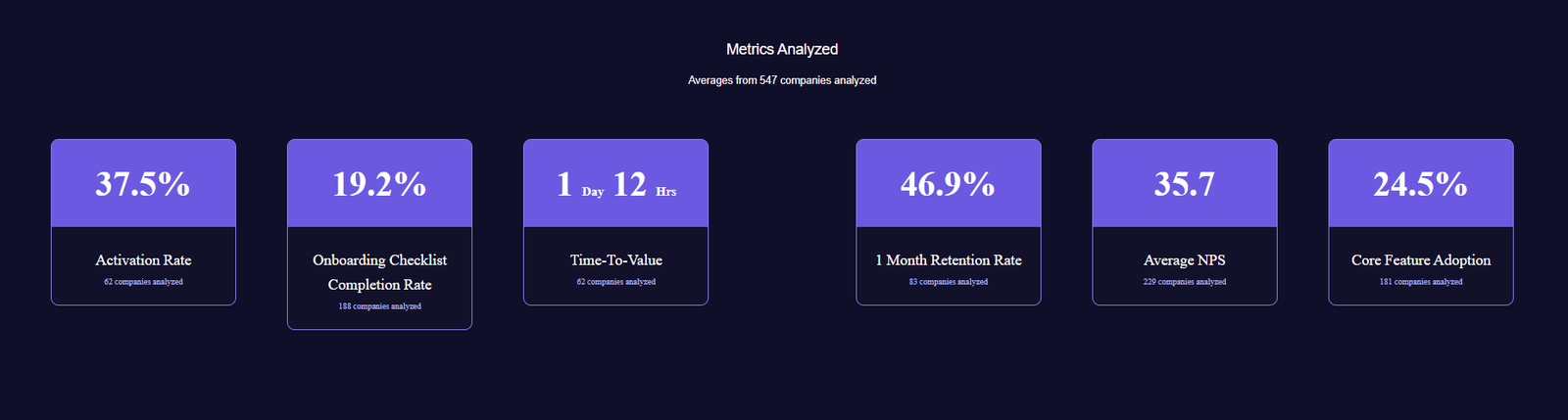
Customer onboarding decides whether a new customer ever sees the value they signed up for. Userpilot’s 2025 benchmark shows how thin that margin is: average activation sits at 37.5%, and average first-month retention sits at 46.9% across 83 B2B SaaS companies. Fewer than half of new users are still active a month later.
Faster Time to Value (TTV) and User Activation
Time to value (TTV) is the gap between sign-up and the first moment a user gets a real result. In the same Userpilot report, the average TTV across 62 B2B SaaS companies was 1 day, 12 hours, and 23 minutes. Every extra hour in that gap gives a new user one more reason to close the tab.
A tight onboarding flow shortens the gap. It removes setup steps that do not matter and points the user at the one action that proves the product works. That is the core job of user activation.
Higher Customer Retention and Customer Lifetime Value (CLV)
Customers who reach value early have a reason to stay, and every extra month they stay raises customer lifetime value (CLV). General business research backs the payoff. Frederick Reichheld of Bain & Company found that raising customer retention by 5% can lift profits by 25% to 95%, as Harvard Business Review reported. That figure covers business in general, not only SaaS, so treat it as a direction rather than a promise for your product.
For a startup, the practical point is simple. Acquisition costs money every time. Customer retention is where that spend starts to pay back.
Customer Churn Reduction
Churn often starts early, long before a cancellation email arrives. A customer who never completes setup or never sees a useful result drifts away quietly. Good onboarding is the earliest and cheapest form of customer churn reduction.
Fewer Support Tickets and a Better SaaS Onboarding Experience
Customers who learn the product properly ask fewer basic questions. Docebo notes that an onboarding program that teaches features and how to use them is likely to lower the number of support tickets. A smooth SaaS onboarding experience also sets the tone for the whole relationship. The first impression decides whether a customer sees your team as a helpful partner or a hurdle.
The SaaS Onboarding Process: Steps for New Customers
A SaaS onboarding process moves a customer through five stages. The labels differ between companies, but the guides from Custify, G2, and Stackmatix describe overlapping stages: welcome, setup, first value, learning, and handoff into long-term support. Onboarding is not finished at setup. It finishes when the customer has repeated the core action enough that using the product is a habit.
Step 1: Welcome and Set Expectations
The first message after the sale sets the tone. Custify recommends three pieces here:
- A welcome email that explains how your team works and what the customer can expect
- An onboarding survey that collects account details and goals
- An onboarding call for most types of SaaS customers, so you can learn their goals in a relaxed way
Step 2: Setup and Data Import
This is where the customer configures the product. For most tools, that means creating accounts, connecting other software, and importing existing data. Keep it short. Each extra setup screen is a place where a new user experience can break.
Step 3: Guide the Customer to First Value
First value, often called the “aha” moment, is the point where the product proves it works. Your whole SaaS onboarding workflow should point at this moment. Decide what it is for your product, such as sending a first campaign or building a first report, and remove every obstacle in front of it.
Step 4: Teach the Product Through Customer Education
Once the customer sees value, teach them how to get more of it. Use short customer education assets: a few help articles, a short video, and in-app guidance. Introduce the basic features first, and add advanced ones later. Help content follows the same rules as any good SaaS content, so our guide to content marketing for SaaS can help you plan it.
Step 5: Build the Habit and Hand Off to Customer Success
In larger SaaS companies, a separate onboarding team passes everything it learned to the SaaS customer success team, according to G2. That handoff keeps trust intact, because the customer does not have to repeat their story. Smaller startups often run both jobs with the same person, and the principle still holds: write down what you learned in onboarding and use it in every later conversation.
Choosing Your SaaS Onboarding Strategy
A SaaS onboarding strategy starts with one decision: how much human help each customer gets. Whatfix and Stackmatix both describe three delivery models, and your choice shapes every tool and hire that follows.
| Model | What the customer gets | Typical touchpoints |
| Self-serve (tech-touch) | Software guides them with no human help | Welcome email series, product tour, checklist, in-app tutorials |
| Low-touch | Software plus light human help at key moments | Automated flows plus check-ins at key moments |
| High-touch | A person guides setup and training | Kickoff call, implementation, training sessions, dedicated customer success manager |
The right model usually depends on how complex your product is. A simple tool with a free trial can run on self-serve. A product with integrations and data migration usually needs people involved.
Product-Led Growth Onboarding vs. Sales-Led Onboarding
In product-led growth, the product itself does most of the onboarding. In a sales-led model, a salesperson or customer success manager does more of the work. Userpilot’s 2025 benchmark found that sales-led companies beat product-led companies on onboarding checklist completion rate. Userpilot’s explanation is the hands-on approach that sales-led teams take. It also notes that product-led onboarding can start slower, because users have to discover value alone.
Neither model wins every time. Match the model to your price, your product, and the person buying it. If you sell to businesses, our explainer on what B2B SaaS is covers how those buying cycles differ from consumer products.
SaaS Onboarding Strategies for Early-Stage Startups
Early-stage teams have little time and few staff. These moves fit that reality:
- Pick one value event. Appcues advises building onboarding around goals instead of a laundry list of features, and it notes that Slack does not try to teach every feature at the start.
- Segment lightly. Different user groups need different flows. Start with two, such as admins and regular users.
- Onboard your first customers by hand. A personal call teaches you where people get stuck. Then automate what you learn.
This is also where customer onboarding for startups differs from enterprise work. You do not need a large platform. You need a clear first-value moment and a way to see who reached it.
How to Create a SaaS Onboarding Process: Workflow and Checklist
Here is how to create a SaaS onboarding process from a blank page. The result is a customer onboarding workflow for SaaS businesses that your team can run the same way every time.
Map Your SaaS Onboarding Workflow
- Define the value event. Name the one action that proves your product works, such as publishing a first page or sending a first invoice.
- Work backward. List every step a new customer must take to reach that event, from sign-up to setup to the action itself.
- Cut what does not help. Remove or delay any step that does not move the customer toward the value event.
- Choose a model for each step. Decide whether the software, a person, or both handle it (see the table above).
- Assign an owner. Name who sends the welcome email, who runs the call, and who reviews drop-offs.
- Set a measure. Pick the number that shows success, such as the share of customers who reach the value event in their first week.
SaaS Customer Onboarding Checklist
Use this SaaS customer onboarding checklist as a starting point and adapt it to your product.
- Welcome email sent when the customer signs up
- Onboarding survey collects goals and account details
- Kickoff call booked for customers who need one
- Setup steps and data import completed
- Customer reaches the first-value event
- Core features explained through help content or in-app guidance
- Feedback collected at the end of onboarding
- Handoff notes passed to customer success
Custify also suggests keeping three documents ready for every account: a list of desired outcomes, a list of customer requirements, and a list of common questions the customer has answered. They keep your team and the customer working from the same page.
Tools for the Onboarding Experience
Whatfix lists the common building blocks of in-app onboarding: checklists, product tours, video guides, in-app tutorials, progress bars, walkthroughs, and chatbots. Userpilot adds that a checklist reduces confusion and gives users a clear roadmap, so they do not skip important steps or miss core features. Start with a welcome email series and one checklist. Add the rest only when your data shows a gap.
SaaS Customer Onboarding Best Practices
These customer onboarding best practices appear again and again in guides from Appcues, Docebo, Whatfix, and UserGuiding. They work for most products, and they cost little to start.
Personalize by Segment
Appcues recommends segmenting users, because different groups need different flows, teaching styles, and goals. Collect one or two answers at sign-up, such as role and main goal, and use them to change what the customer sees first. This helps customer experience optimization because the first screens match what the customer came to do.
Teach the Basics First
Docebo advises introducing only the basic features in the early stage of onboarding, then giving new customers time to try what they learned. A customer who succeeds at a small task builds confidence. A customer buried in a feature tour does not.
Make It Interactive
Docebo also says interactivity helps people retain what they learn. Pop-ups that guide a user the first time they use a feature are one example Whatfix gives. Pair them with a short checklist so the customer can see progress.
Automate the Repetitive Parts
Whatfix lists automation of repetitive processes as a core practice. Welcome emails, reminders, and nudges for customers who stall can all run on triggers. Save human time for the conversations that need judgment.
Set Clear Milestones
Moxo suggests setting clear success milestones to create a roadmap for the customer’s onboarding journey. Milestones also give your team natural moments to check in, such as “setup done” or “first report created.”
Keep Onboarding Going After Day One
UserGuiding makes a point many teams miss: onboarding never fully ends. Products change, and customers need to learn new features over time. In-app messages announcing updates keep SaaS user engagement alive long after the first week.
How to Improve Your SaaS Customer Onboarding Process
If you already have an onboarding flow, do not rebuild it. Improve it one measured change at a time. Here is how to improve SaaS user onboarding with the data you have.
Find Where Customers Drop Off
Userpilot’s benchmark puts average onboarding checklist completion at 19.2% across 188 companies, with a median of 10.1%. A low completion rate tells you something is wrong, but it does not say where. Build a funnel from sign-up to your first-value event and look for the step with the biggest drop. Fix that step first.
Ask Customers What Got in the Way
Rocketlane suggests adding a Customer Satisfaction Score (CSAT) survey and a Customer Effort Score (CES) question to the onboarding journey. CSAT shows whether customers feel their goals were met, and CES shows how hard the process was. A short survey at the end of onboarding gives you both signals. Custify also recommends an onboarding survey at the start, so you can compare what customers wanted with what they got.
Watch Usage After Onboarding Ends
Docebo asks a useful question: how often and how much do customers use the product once onboarding finishes? If usage does not grow over time, customers may not be getting enough value. That points to a gap in teaching, not only in setup.
Change One Thing at a Time
Pick one fix, such as cutting a setup step or rewriting the welcome email. Release it, then compare the new group of customers with the old one. Changing five things at once leaves you guessing which one worked.
Re-Onboard When the Product Changes
UserGuiding notes that onboarding never ends, because customers need to learn new features as the product grows. Use in-app messages or short emails to introduce major releases to existing customers, not only new ones.
How to Measure SaaS Onboarding Success
To measure SaaS onboarding success, track a small set of numbers from sign-up to the first month. The table below lists the core metrics and the 2025 benchmark from Userpilot, which drew on first-party product data from B2B SaaS companies. Userpilot itself warns that every product is different, so use these as reference points, not targets.
| Metric | What it shows | Userpilot 2025 benchmark |
| Activation rate | Share of new users who complete the action that shows first value | 37.5% average, 37.04% median (62 companies) |
| Time to value (TTV) | Time from sign-up to first value | 1 day, 12 hours, 23 minutes on average (62 companies) |
| Onboarding completion rate | Share of users who finish the onboarding checklist | 19.2% average, 10.1% median (188 companies) |
| Month 1 retention | Share of users still active one month after activation or sign-up | 46.9% average, 45.25% median (83 companies) |
Two more measures come from customer surveys. Rocketlane describes the Customer Satisfaction Score (CSAT), which shows whether customers feel their goals were met, and the Customer Effort Score (CES), which shows how much effort onboarding took. Custify also lists time to onboarding completion among its core onboarding KPIs.
How to Read the Numbers Together
- Low activation, normal completion: customers finish your steps but the steps do not lead to value. Rework the checklist.
- High activation, low month 1 retention: customers see value once but do not form a habit. Strengthen customer education and follow-up.
- Long TTV: look for setup steps you can cut or automate.
Check these numbers weekly in the first months and track onboarding completion rate by customer segment. A blended average hides which group needs help. For more on the numbers that sit around onboarding, see our list of essential SaaS metrics.
Common SaaS Onboarding Mistakes Startups Make
Most onboarding problems come from a short list of habits. Check your own flow against these.
- Treating onboarding as a one-time event. Livex lists this as a common misconception. Products keep changing, so customers keep learning.
- Believing a complex process works better. A longer flow adds friction. Livex also calls this a misconception, and Appcues advises against a laundry list of features.
- Using one flow for every user. Livex flags this too. A manager and a new team member want different first steps. Segment early.
- Counting completion instead of value. A user can get value without finishing every checklist task, and a user can finish every task without getting value. Track user activation alongside completion.
- Dropping the handoff. If sales, onboarding, and support do not share notes, the customer repeats themselves. G2 treats a smooth handoff as a way to protect trust.
Frequently Asked Questions About SaaS Customer Onboarding
1. What is SaaS customer onboarding?
SaaS customer onboarding is the process of guiding a new customer from sign-up to the first real result in your software, and then to regular use. It includes the welcome, account setup, data import, training, and early support. The goal is to help customers reach value quickly so they stay.
2. Why is SaaS customer onboarding important for startups?
SaaS customer onboarding helps startups turn new sign-ups into active, satisfied customers. A structured process reduces confusion, shortens time to value, improves product adoption, and can reduce early customer churn. It also helps startups identify customer challenges before they affect retention.
3. What are the steps in a SaaS onboarding process?
A typical SaaS onboarding process has five steps: welcome the customer and set expectations, complete setup and data import, guide them to first value, teach the main features through customer education, and hand off to customer success. Onboarding ends when using the product becomes a habit, not when setup finishes.
4. How do you improve a SaaS customer onboarding process?
Find where customers drop off by building a funnel from sign-up to the first-value event, then fix the biggest drop first. Collect CSAT and CES feedback, watch product usage after onboarding, and change one thing at a time so you can see what worked. Re-onboard customers when major features launch.
5. What is the difference between customer onboarding and user onboarding?
User onboarding is product-led and happens inside the app through tours, tooltips, and checklists that help one person find value. Customer onboarding is often team-led and can include implementation, training, and account setup run by customer success. Self-serve products lean on user onboarding, while products sold to teams usually need both.
6. What is the ideal time to onboard a SaaS customer?
The ideal onboarding time depends on product complexity, customer needs, and implementation requirements. Simple self-service tools may help users reach value within minutes or hours, while enterprise software may require weeks. The goal is to minimize unnecessary delays while ensuring customers achieve their desired outcomes.
7. Which metrics should SaaS companies track to measure onboarding success?
SaaS companies should track activation rate, time to value, onboarding completion rate, and first-month retention. Customer Satisfaction Score (CSAT) and Customer Effort Score (CES) provide additional feedback. Together, these metrics reveal whether customers reach value quickly and continue using the product.
8. How does SaaS customer onboarding reduce churn?
SaaS customer onboarding reduces churn by helping customers understand the product, complete essential setup tasks, and experience meaningful results early. When customers recognize the software’s value and know how to use its core features, they have stronger reasons to continue their subscriptions.
9. What should a SaaS onboarding checklist include?
A SaaS onboarding checklist should include a welcome email, an onboarding survey, a kickoff call for customers who need one, setup and data import, the first-value event, short training on core features, a feedback request, and handoff notes for customer success. Keep each item tied to helping the customer reach value.
10. How should an early-stage startup approach onboarding?
Start small. Pick one value event, build the shortest path to it, and onboard your first customers by hand to learn where they get stuck. Segment users lightly, such as admins and regular users. Then automate what you learned with a welcome email series and one checklist before adding more tools.
Conclusion
SaaS customer onboarding works when everything points at one outcome: the first moment a customer gets real value. Name that moment for your product. Cut every step between sign-up and that moment, then track activation, time to value, and month 1 retention so you can see where customers leave.
For a startup, the next move is small. Draft the five-step workflow, set up the checklist, and onboard your first customers by hand. Each conversation shows you what to automate. Once onboarding holds up, widen the view to the full retention picture with our guide to calculating and reducing SaaS churn rate.