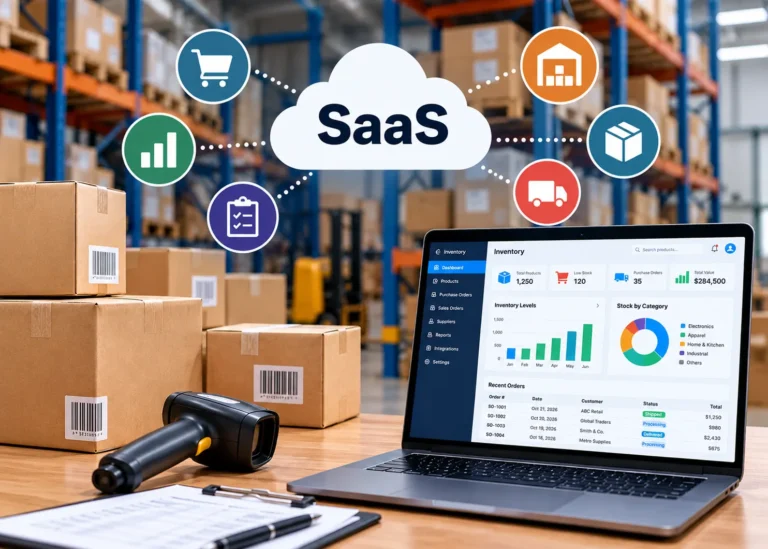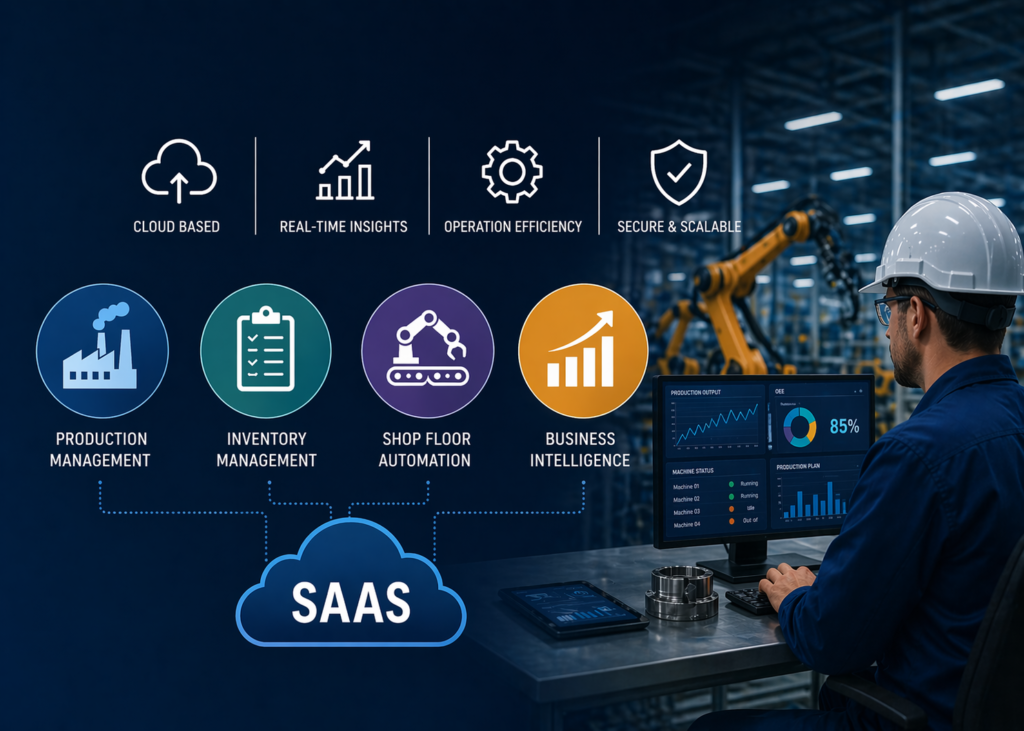
Manufacturing is no longer just machines and assembly lines, it’s about data, speed, and smarter decisions. From supply chain disruptions to rising operational costs and the push toward Industry 4.0, every manufacturer faces pressure to work faster and leaner. That’s exactly where cloud-based SaaS software changes the game.
Unlike traditional on-premise systems that require expensive servers and long implementation cycles, modern SaaS manufacturing platforms run in the cloud, update automatically, and scale with your operation From the very start. Whether you manage a 10-person job shop or a multi-site global plant, there is a purpose-built solution on this list for you.
In this guide, we cover the Top 10 SaaS software for manufacturing companies, evaluated across features, pricing, ease of use, integrations, and real user feedback so you can make a confident decision.
What to Look for in Manufacturing SaaS Software
Before exploring the list, here are the core capabilities that separate truly great manufacturing platforms from the rest:
- Real-time production visibility
- ERP + MES integration
- Supply chain management
- Inventory & BOM control
- Quality & compliance modules
- AI & predictive analytics
- Scalability for growth
- Easy third-party integrations
Best SaaS Software for Manufacturing Companies
1.Oracle NetSuite Manufacturing
Best all-in-one cloud ERP for scaling mid-market manufacturers
Oracle NetSuite is the most widely adopted cloud-native ERP in the world, and its manufacturing edition connects every business function financials, production planning, procurement, inventory, CRM, and supply chain into a single unified platform with real-time dashboards.
NetSuite supports both discrete and process manufacturing workflows, making it a natural fit for mid-market companies scaling fast and needing enterprise-grade visibility without enterprise-level overhead. Its flexible pricing, multi-currency capabilities, and broad partner ecosystem make it the top recommendation for manufacturers looking to grow globally.
| ✔ positives | ✘ negatives |
| • Unified platform for finance, production, and supply chain
• Real-time dashboards and strong business intelligence • Flexible pricing tiers matched to business size • Multi-location, multi-currency, multi-entity support • Large ecosystem of certified implementation partners • Advanced MRP and demand planning built in |
• No free trial or free version available
• Standard plan limits online support to 10 hours • Implementation costs can be significant for complex setups • Better suited to mid-market than very small manufacturers • Customisation beyond core modules requires technical resources |
2.SAP S/4HANA Cloud
Enterprise gold standard for large-scale global manufacturers
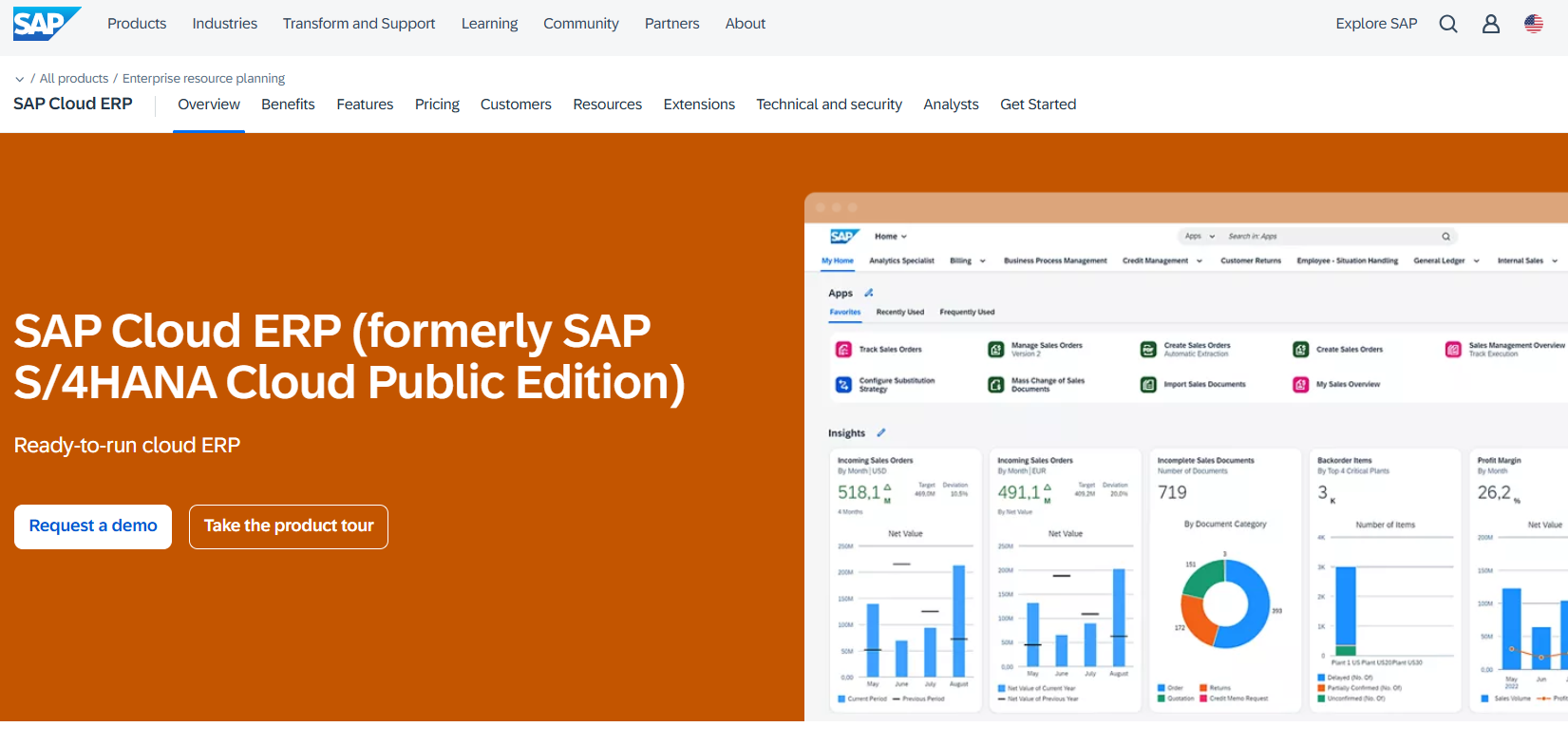
SAP S/4HANA Cloud is the benchmark for enterprise manufacturing software. Built on SAP’s in-memory HANA database, it processes enormous production datasets in real time enabling instant planning, scheduling, and reporting across multi-site global operations.
From procurement and production execution to quality compliance and financial consolidation, SAP covers the full manufacturing lifecycle in a single environment.
It dominates in automotive, aerospace, chemicals, and precision engineering industries. In 2025, SAP’s embedded AI and Copilot tools further elevated the platform’s ability to forecast demand and automate routine workflows.
| ✔ positives | ✘ negatives |
| • Industry-leading depth across all manufacturing modules
• Real-time in-memory analytics and AI-powered forecasting • Strongest global compliance and multi-regulation support • Seamless integration with SAP Ariba, SuccessFactors, and more • Highly scalable for the most complex multi-site operations |
• Very high implementation cost requires certified SAP consultants
• Steep learning curve for teams without prior SAP experience • Not practical for small or mid-sized manufacturers • Customisation beyond standard modules is time-intensive • Ongoing licensing and maintenance costs are significant |
3.Plex Smart Manufacturing Platform
Born on the shop floor + ERP + MES unified in one cloud system
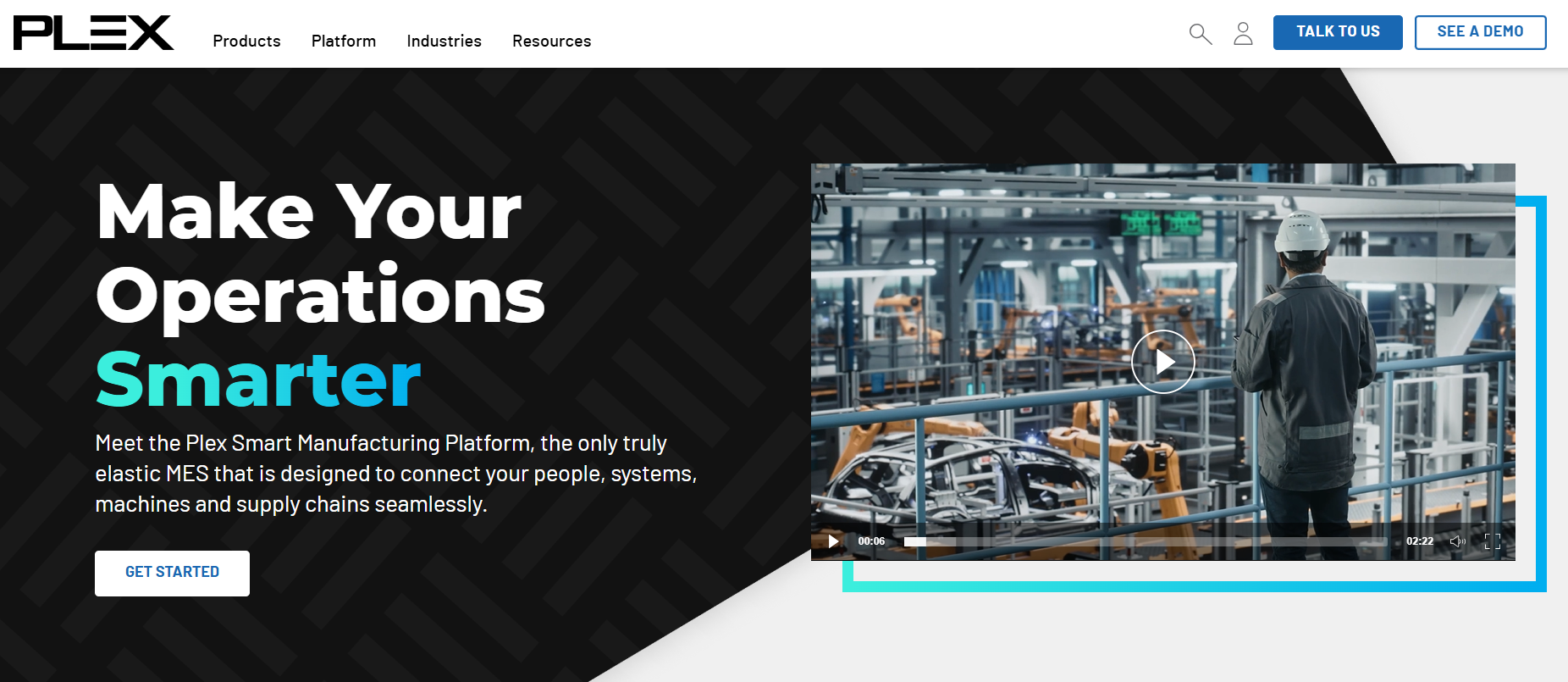
Plex stands apart from generic ERPs because it was built from the ground up specifically for manufacturers not adapted from a financial system. Now part of Rockwell Automation, Plex unifies ERP, Manufacturing Execution System (MES), Quality Management, Supply Chain, and Industrial IoT into a single cloud platform.
It delivers real-time shop floor visibility that most ERP-only systems simply cannot match. Plex is the trusted choice in automotive, food and beverage, aerospace, and electronics manufacturing, and received the IDC 2021 SaaS ERP Customer Satisfaction Award based on exceptional data security and user satisfaction scores.
| ✔ positives | ✘ negatives |
| • Purpose-built for manufacturing — ERP and MES in one unified system
• Real-time shop floor visibility with IoT connectivity • Best-in-class quality management and traceability tools • Strong compliance support for automotive, aerospace, and food & beverage • Multi-language and multi-site capable for global operations |
• Not suitable for non-manufacturing businesses
• Pricing starts at $500/user costly for smaller teams • MRP, routers, and BOMs can feel disconnected in some workflows • Business intelligence tools feel dated compared to newer platforms • Implementation timelines vary for complex environments |
4.Epicor Kinetic
Cloud ERP made for manufacturers, by people who understand manufacturing
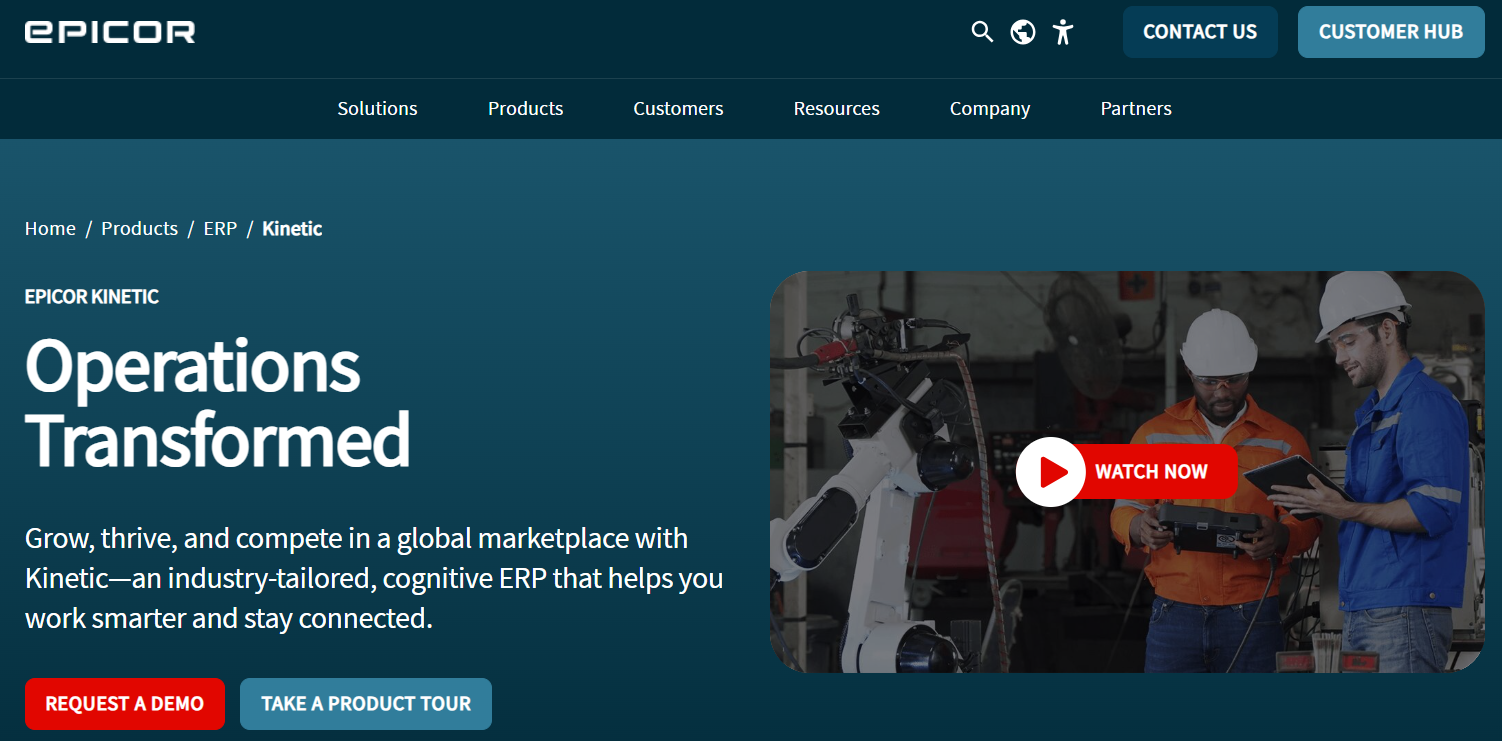
Epicor Kinetic (formerly Epicor ERP) is a cloud-native manufacturing ERP purpose-built for mid-market companies. It is specifically optimised for make-to-order, engineer-to-order, and mixed-mode manufacturing workflows that generic ERPs consistently struggle to handle. Kinetic integrates
MES and IoT capabilities directly into its core, enabling real-time shop floor control alongside business-level planning.
Gartner Peer Insights users describe its discrete manufacturing feature set as ‘likely best in class, even when compared to Oracle and SAP.’ Its modern HTML5 interface and low-code customisation tools allow teams to move fast without heavy IT involvement.
| ✔ positives | ✘ negatives |
| • Excellent for make-to-order, engineer-to-order, and job shop environments
• Modern HTML5 UI with mobile access and low-code customisation • Deep MES and IoT integration for real-time production control • Industry-specific configurations for automotive, aerospace, and electronics • Faster onboarding than SAP or Oracle for mid-market teams |
• Native BI reporting is less robust than NetSuite requires extra tools
• Costs scale up significantly with additional modules and users • Complex reporting customisation requires technical expertise • Some users note the increased cloud focus has created gaps • Not ideal for very large enterprise manufacturers |
5.Microsoft Dynamics 365 SCM
The ultimate choice for manufacturers in the Microsoft ecosystem
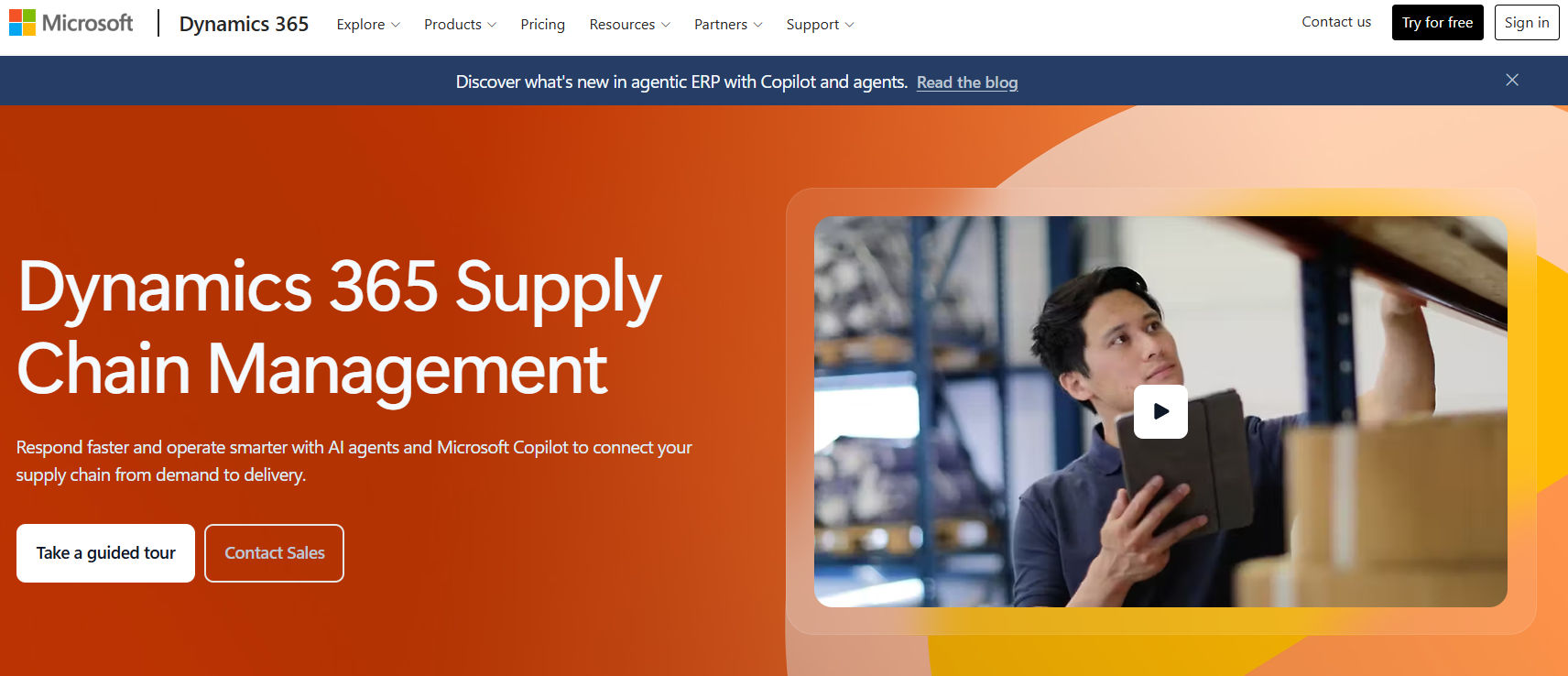
Microsoft Dynamics 365 SCM is a powerhouse for manufacturers deeply embedded in the Microsoft ecosystem. It combines AI-powered demand forecasting, real-time inventory visibility, and automated production scheduling with native integration across Microsoft 365, Teams, Power BI, and Azure.
In 2025, Copilot AI capabilities have further enhanced the platform surfacing recommendations, automating routine workflows, and helping production managers make faster decisions.
For companies already paying for Microsoft subscriptions, D365 SCM is often the most cost-effective path to enterprise-grade manufacturing ERP.
| ✔ positives | ✘ negatives |
| • Best-in-class integration with Microsoft 365, Teams, Power BI, and Azure
• AI Copilot for demand planning, inventory recommendations, and automation • Unified platform for warehouse, procurement, and production control • Scalable for mid-size and enterprise manufacturers alike • Predictive analytics surface real-time operational insights |
• Mobile app experience is less complete than the desktop version
• Requires dedicated training not plug-and-play for non-technical teams • Advanced modules and add-ons increase costs significantly • Limited data storage on lower-tier plans • Complexity can be overkill for manufacturers without Microsoft roots |
6.Acumatica Manufacturing Edition
Flexible cloud ERP with unlimited users and no per-seat pricing penalties
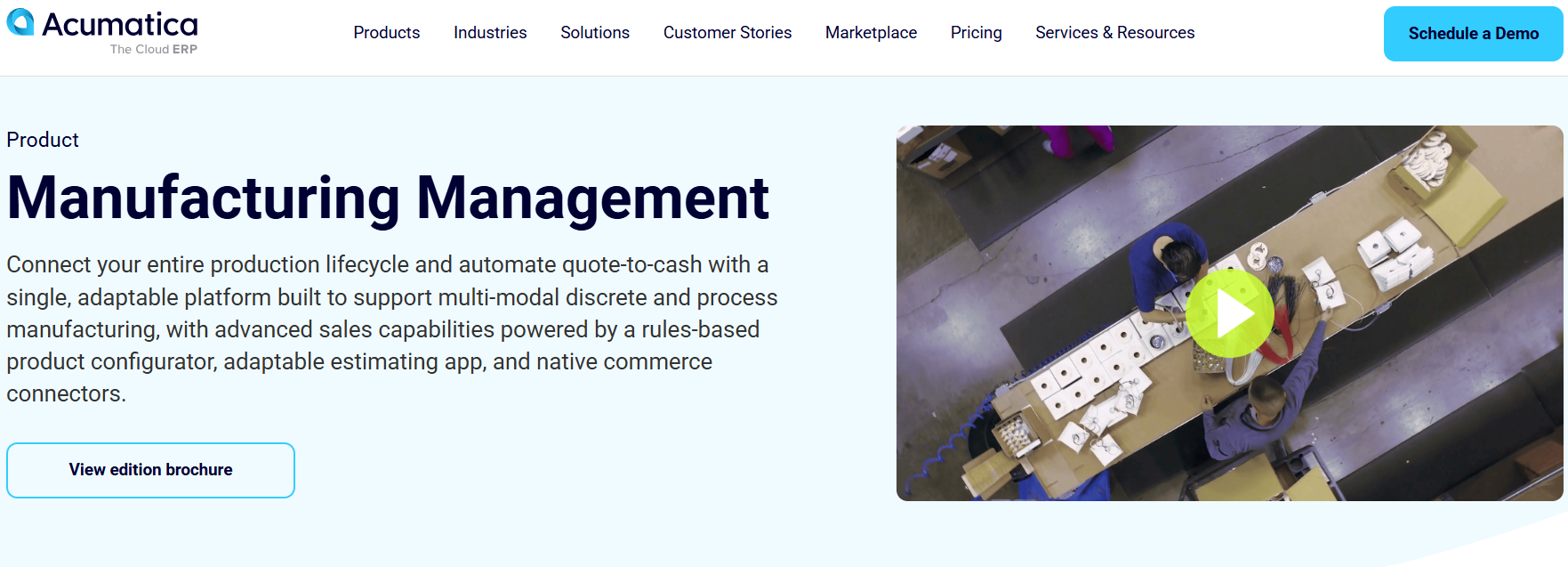
Acumatica’s Manufacturing Edition stands out with a bold differentiator: unlimited user licensing. Unlike SAP, Oracle, or Epicor where costs multiply with every additional seat Acumatica charges based on consumption levels and modules, not headcount. This makes it enormously attractive for manufacturers with large, distributed teams.
The platform supports make-to-order, make-to-stock, and mixed-mode manufacturing with strong modules for production planning, shop floor control, inventory management, and project accounting. Its open architecture makes it easy to customize and connect to existing tools via API.
| ✔ positives | ✘ negatives |
| • Unlimited user access no per-seat pricing penalty
• Strong production planning, BOM, and shop floor control modules • Highly flexible open architecture for customisation and API integrations • Good multi-site and multi-entity support for growing operations • Automated tax filing, billing, and invoicing reduce manual work |
• Analyst ratings slightly lower than tier-1 ERPs for advanced features
• Implementation requires experienced Acumatica VAR partners • Reporting customisation can require technical resources • Less brand recognition in regulated industries vs SAP or Oracle • Consumption-based pricing can be harder to estimate upfront |
7.Odoo Manufacturing
Modular, affordable, and surprisingly powerful for SMB manufacturers
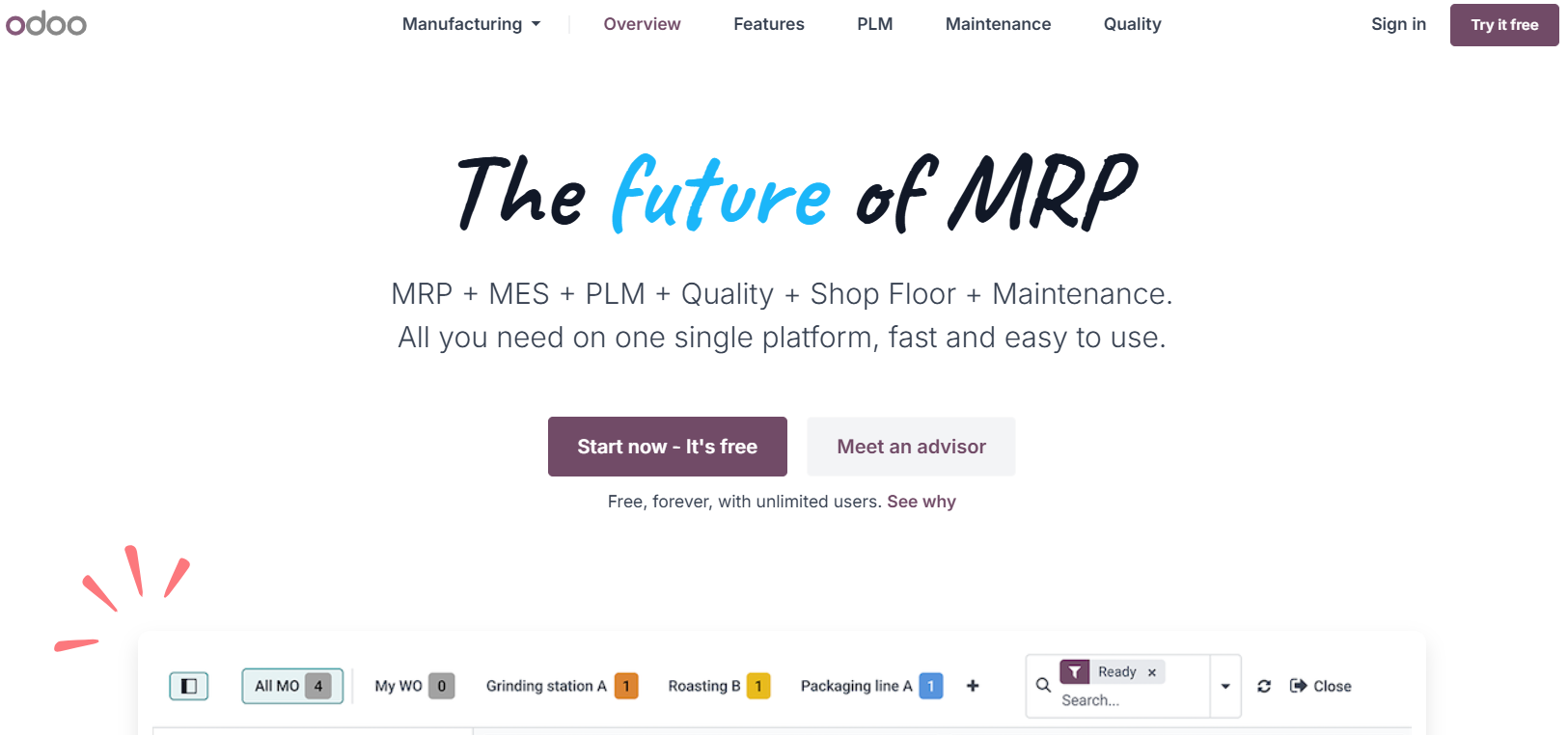
Odoo is a modular, open-source-rooted SaaS platform that has become the go-to choice for small and medium-sized manufacturers who want real capability without enterprise-level pricing. The manufacturing module covers work orders, BOMs, routing, quality checks, maintenance management, MRP, and real-time production reporting all sharing the same underlying database as Odoo’s sales, inventory, accounting, HR, and CRM apps. The result is native integration that eliminates the middleware headaches common in multi-system stacks. Its pay-per-module model means you only pay for what you actually use.
| ✔ positives | ✘ negatives |
| • Affordable pay-per-module pricing only pay for what you need
• Seamless native integration across all Odoo apps (CRM, accounting, HR) • Free Community edition available for basic manufacturing needs • Highly customisable architecture for specific production workflows • Large open-source community and developer ecosystem worldwide |
• Complex initial setup not truly plug-and-play out of the box
• Community support can be inconsistent; paid support recommended • Not ideal for large enterprises with highly complex requirements • High-pricing concerns emerge as advanced modules are added • Custom development can become a long-term dependency |
8.MRPeasy
The highest bang-per-buck MRP system built for small manufacturers
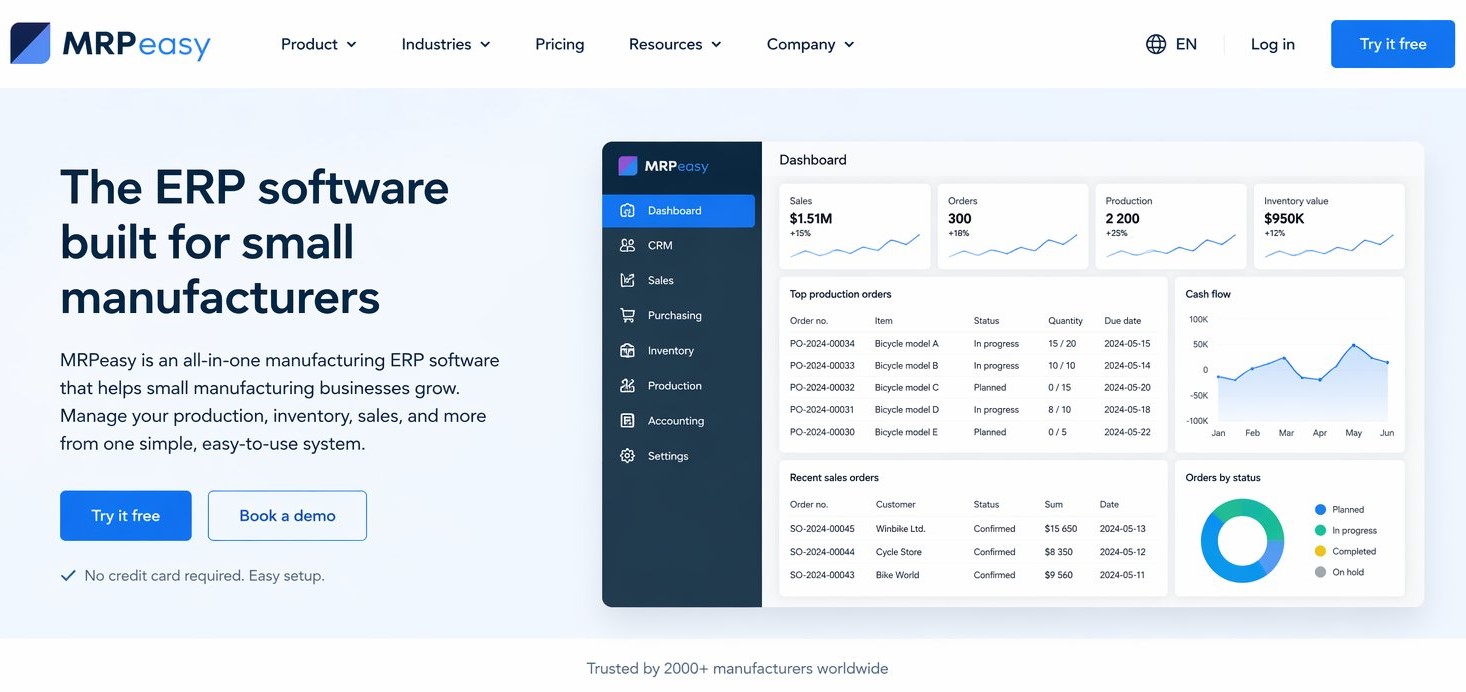
MRPeasy has earned a loyal following among small and micro manufacturers, and the reason is simple: it delivers genuine production planning power at a price point that small businesses can actually afford.
Designed for teams of 10–200 employees, it covers production planning, inventory management, purchasing, CRM, and accounting in a clean, straightforward interface.
It integrates with e-commerce platforms like Shopify, Amazon, and WooCommerce, as well as accounting tools like QuickBooks and Xero. As one manufacturing consultant put it: ‘MRPeasy continues to provide the highest bang per buck for small manufacturers.
| ✔ positives | ✘ negatives |
| • Extremely user-friendly, most users are productive within hours
• Genuine production planning, lot traceability, and actual costing tools • Native integrations with Shopify, Amazon, QuickBooks, Xero, and more • Cloud-based fully accessible 24/7 from anywhere in the world • Very affordable starting at $49/user/month with transparent pricing |
• Not designed for large or enterprise-scale manufacturers
• No phone support, email-only ticketing system • Subcontractor BOM workflows can be limiting in complex setups • Cycle counting and advanced sales reporting need improvement • Recurring order automation is not yet available |
9.SYSPRO ERP
Four decades of manufacturing DNA, now delivered as cloud SaaS
SYSPRO has been serving manufacturers and distributors since 1978 giving it one of the deepest domain expertise profiles of any vendor on this list. This heritage translates into a platform that understands manufacturing processes at a granular level: inventory traceability, production scheduling, supply chain control, and compliance are all baked in from decades of refinement.
The cloud edition brings that manufacturing-first focus to a modern SaaS delivery model, complete with AI-powered bots that identify and eliminate repetitive tasks. Competitively priced compared to tier-1 vendors, SYSPRO is a strong contender for SMB manufacturers who have outgrown generic tools.
| ✔ positives | ✘ negatives |
| • Deep manufacturing domain expertise built over 40+ years
• Best-in-class inventory traceability and supply chain tools • AI bots identify and eliminate repetitive shop floor tasks • User-friendly interface with fast real-time data access • Competitively priced vs SAP, Oracle, and Microsoft |
• No free trial offered
• Information retrieval can be slower in data-heavy environments • Patching and update management can be challenging • Customer support quality varies by region • Less well-known outside manufacturing and distribution sectors |
10.Katana Cloud Manufacturing
The visual, intuitive MRP platform built for modern product brands
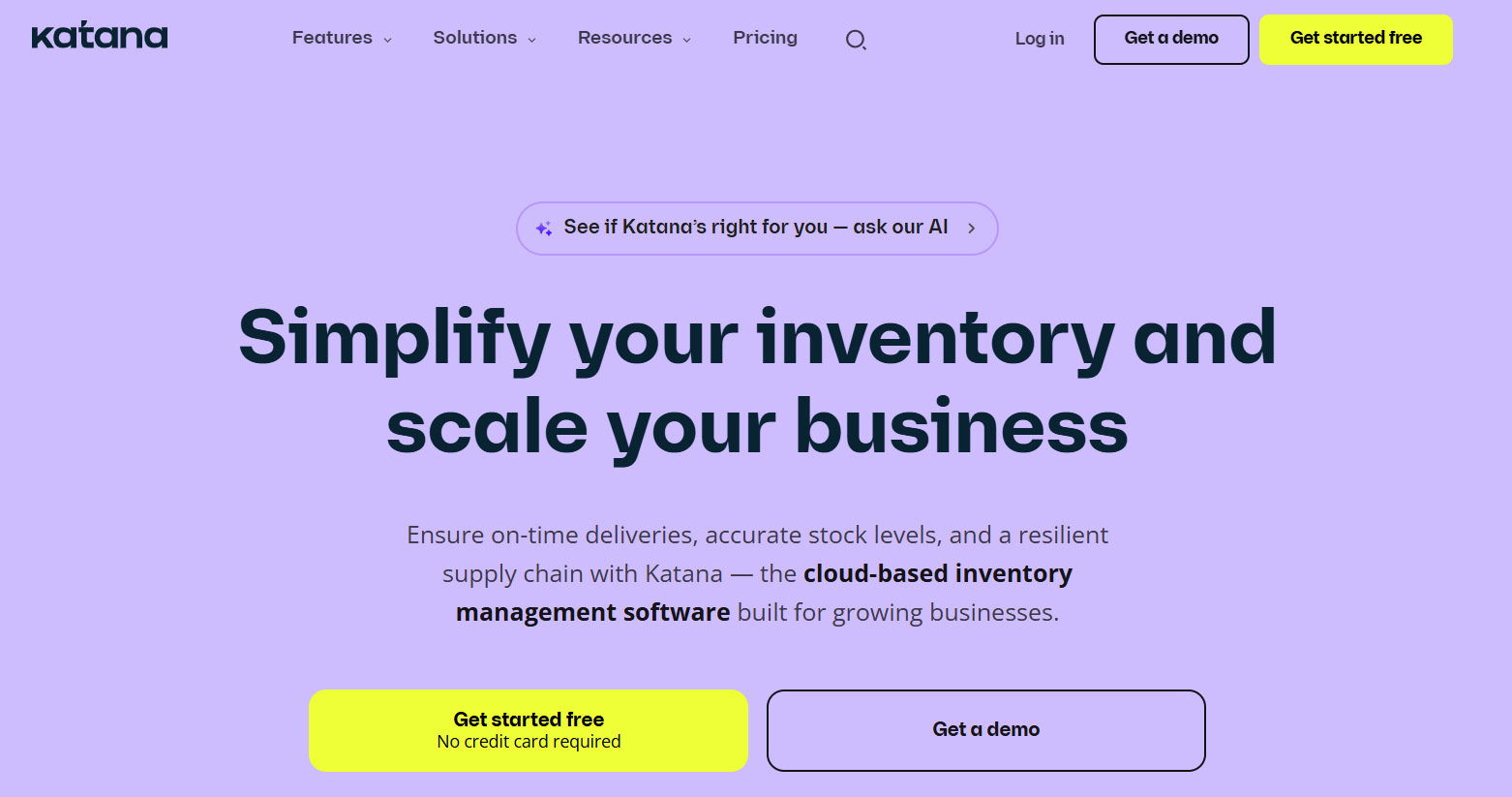
Katana is a modern, visually intuitive SaaS platform designed specifically for small manufacturers, product-based businesses, and direct-to-consumer (DTC) brands. With a clean drag-and-drop interface and native connections to Shopify, WooCommerce, QuickBooks, and Xero, Katana lets you manage production orders, real-time inventory, and sales channel fulfillment from a single screen.
It eliminates the spreadsheet chaos that plagues small product businesses without forcing teams through months of ERP training. Pricing starts at $99/month, making it one of the most accessible professional manufacturing tools available.
| ✔ positives | ✘ negatives |
| • Clean, visual drag-and-drop interface, extremely fast to learn
• Native integrations with Shopify, WooCommerce, QuickBooks, and Xero • Real-time inventory and production order tracking • Affordable starting price from $99/month • Ideal for DTC brands managing both production and e-commerce |
• Not designed for complex enterprise or multi-site operations
• Limited advanced MES and shop floor execution capabilities • Reporting and analytics less powerful than tier-1 ERP platforms • May require additional integrations for warehouse management or CRM • Feature depth may feel limiting as operations grow significantly |
Quick Comparison: All 10 Platforms at a Glance
Use this table to shortlist the right platform based on your size, budget, and feature priorities.
| Software | Best For | Starting Price | ERP+MES | Trial | AI |
|---|---|---|---|---|---|
| Oracle NetSuite | Mid-market / global | Custom | ✔ | ✘ | ✔ |
| SAP S/4HANA Cloud | Large enterprise | Custom | ✔ | ✘ | ✔ |
| Plex Smart Mfg | Discrete & process | $500/user | ✔ | ✘ | ✔ |
| Epicor Kinetic | Mid-market job shops | $175/user/mo | ✔ | ✘ | ✔ |
| Microsoft D365 SCM | Microsoft ecosystem | $180/user/mo | ✔ | ✔ | ✔ |
| Acumatica Mfg | Large distributed teams | Consumption | ✔ | ✔ | Partial |
| Odoo Manufacturing | SMB / flexible | Free / $9.90+ | ✔ | ✔ | Partial |
| MRPeasy | Small (10-200 staff) | $49/user/mo | Partial | ✔ | ✘ |
| SYSPRO ERP | SMB & distributors | Custom | ✔ | ✘ | ✔ |
| Katana Cloud MFG | DTC & product brands | $99/month | ✘ | ✔ | ✘ |
Read also over blog :- How SaaS Tools Help Businesses Automate Daily Operations
How to Choose the Right SaaS Manufacturing Software
With ten strong options on the table, the right choice comes down to these factors specific to your business:
Company Size
SAP, Oracle, and Microsoft D365 are built for complex enterprise operations. Odoo, Katana, MRPeasy, and SYSPRO are better calibrated for SMBs and growing manufacturers.
Industry & Compliance
In automotive, aerospace, or life sciences, prioritise platforms with deep compliance and traceability, Plex, Epicor Kinetic, and QAD stand out here.
Existing Tech Stack
If your team runs Microsoft 365 daily, Dynamics 365 SCM is a natural fit. E-commerce brands benefit most from Katana or Odoo’s Shopify and accounting integrations.
Budget & TCO
Enterprise platforms involve significant licensing, implementation, and training costs. MRPeasy, Odoo, and Katana give you production power at a fraction of the investment.
Implementation Speed
Katana and MRPeasy can be live within days. Odoo within weeks. SAP and Oracle implementations routinely take 6–18 months and require specialist partners.
Growth Plans
If you plan to expand globally or add production sites in 2–3 years, choose a platform with strong multi-entity, multi-currency, and multi-location support From the very start.
FAQ Section
1. What is SaaS software in manufacturing?
SaaS software in manufacturing refers to cloud-based tools that help companies manage operations like production planning, inventory control, supply chain tracking, and workforce management without installing software locally. These platforms improve efficiency, reduce costs, and allow real-time data access from anywhere.
2.How does SaaS improve manufacturing efficiency?
SaaS improves manufacturing efficiency by automating repetitive tasks, reducing manual errors, and providing real-time insights into production and inventory. It also helps teams collaborate better and make faster decisions based on accurate data.
3.What features should you look for in SaaS software for manufacturing?
Important features include inventory tracking, production scheduling, analytics dashboards, cloud access, and system integrations. These features help streamline operations and improve decision-making across manufacturing processes.
4.How to choose the right SaaS software for manufacturing companies?
To choose the right SaaS software, identify your business needs, compare features, check scalability, and review pricing. Selecting software that is easy to use and supports long-term growth is important for manufacturing companies.
5.Is SaaS ERP better than traditional ERP for manufacturers?
Yes, SaaS ERP is often better for modern manufacturers because it is more flexible, cost-effective, and easier to implement than traditional ERP systems. It eliminates the need for heavy infrastructure and allows businesses to scale operations without major investments.
6.Is SaaS software suitable for small manufacturing businesses?
Yes, SaaS software is suitable for small manufacturing businesses because it is cost-effective, easy to implement, and scalable. Small companies can start with basic features and expand as their operations grow.
7.Why are manufacturing companies shifting to SaaS solutions?
Manufacturing companies are shifting to SaaS solutions because they offer flexibility, lower upfront costs, and real-time access to data. These benefits help improve efficiency and support modern manufacturing operations.
8.How much does SaaS software cost for manufacturing companies?
The cost of SaaS software for manufacturing companies varies based on features, number of users, and business size. Most tools follow a subscription model, ranging from affordable monthly plans for small manufacturers to enterprise-level pricing for advanced ERP and production systems. Many platforms also offer flexible pricing tiers and free trials.
Final Thoughts
SaaS manufacturing software has matured dramatically. Whether you are a small product brand managing 50 SKUs or a global industrial manufacturer coordinating multi-site operations, there is a purpose-built cloud solution designed for exactly your situation.
If budget is no constraint and complexity is high Oracle NetSuite and SAP S/4HANA Cloud remain the safest long-term bets. For mid-market manufacturers, Epicor Kinetic and Microsoft Dynamics 365 SCM deliver the best balance of power, usability, and value. For SMBs wanting fast results at a fraction of the cost, Odoo, MRPeasy, and Katana are exceptional choices.
The key is matching the platform’s core strengths to your production model, team size, integration needs, and growth trajectory. Start with a demo, define your must-have modules and remember: the best software is the one your team will actually use.