
AI is changing everything about how cyber threats work. Attackers are using it to move faster, generate more convincing phishing content, find vulnerabilities at scale, and automate attacks that used to require entire teams. At the same time, defenders now need to understand how AI systems themselves can be exploited – through prompt injection, model poisoning, supply chain attacks, and a whole new class of vulnerabilities that traditional cybersecurity training never covered. The ISC2 2025 Cybersecurity Workforce Study found that over one-third of security professionals already see AI as the biggest skills gap on their teams, and that gap is only growing.
That is why AI security certifications matter right now. Not in three years. Now.
In this guide, you will learn what AI security certifications are, which ones are worth your time and money in 2026, and how to pick the right one for your career level. Each certification is broken down by price, difficulty, skills covered, and real-world value – so you can make a confident decision and get started.
What Are AI Security Certifications and Why Do You Need One?
AI security certifications are credentials that validate your ability to understand, assess, and defend artificial intelligence systems. They cover areas like large language model (LLM) threats, prompt injection attacks, model poisoning, AI supply chain security, and how to build safer AI-powered applications.
The difference between AI security and traditional cybersecurity is significant. In traditional security, you protect servers, networks, and code. In AI security, you are protecting systems that learn, generate, and make decisions on their own. That introduces a completely new class of vulnerabilities, from adversarial machine learning to data poisoning to model backdoors.
Employers across financial services, healthcare, government, and tech are actively hiring for AI security roles. The ISC2 2025 Cybersecurity Workforce Study found that cybersecurity professionals actively using AI security tools view the technology as a career catalyst, not a threat. Over one-third of surveyed professionals identified AI as the biggest skills gap on their teams. That gap is your opportunity.
Free vs Paid AI Security Certifications: What You Actually Get
Many people ask if they need a budget to begin, but the truth is you can start without spending money initially. But there is a real difference in what free and paid programs deliver.
What free programs give you: Free options like Microsoft AI Security Fundamentals give you a solid conceptual introduction. You learn the vocabulary, the attack types, and the basic defensive principles. It is enough to understand what AI security is and to decide whether you want to go deeper. The Google Cybersecurity Certificate is technically paid but costs as little as $49 per month, which makes it accessible to almost anyone.
What paid programs give you: Paid certifications, especially hands-on ones like MSec-CAIS and SANS SEC545, give you lab environments where you actually practice breaking and defending real AI systems. You get guided attack scenarios, real tools, instructor expertise, and a credential that hiring managers recognize. There is a major difference between learning about prompt injection and performing it in a real lab environment. Employers know the difference too.
The honest rule of thumb: If you are exploring whether AI security is the right path for you, start free. If you have decided this is your direction and you want a job in the field, invest in a paid certification with hands-on labs. A certificate without lab work is harder to demonstrate in an interview than one where you built actual things and broke actual systems.
Read also over blog : Will AI Take Over Cybersecurity Jobs In 2026?
Quick Comparison of Top AI Security Certifications
| Certification | Price | Level | Best For | Format | Platform |
| Certified AI Security Expert (MSec-CAIS) – Modern Security | $995 | Beginner-Friendly | Security engineers, developers, red teamers, and technical leaders | Self-paced online | Modern Security |
| ISC2 Building AI Strategy Certificate | Approximately $640 | Intermediate | CISOs, security managers, and governance professionals | Self-paced online | ISC2 |
| Google Cybersecurity Professional Certificate | $49/month | Beginner | Students, beginners, and career changers | Self-paced online | Coursera |
| GIAC AI Platform Security (GAIPS) | $9,000+ | Advanced | Enterprise security professionals and red teamers | Instructor-led, 5 days | SANS Institute |
| Stanford Cloud Security (XACS235) | $545 | Intermediate | Cloud security and AI infrastructure professionals | Self-paced online | Stanford Online |
| MSc in Software and Systems Security – University of Oxford | £3,095/module | Advanced | Professionals seeking academic and research-level security expertise | Hybrid, part-time 3-4 years | University of Oxford |
| CompTIA SecAI+ (CY0-001) | $359 | Intermediate to Advanced | Cybersecurity professionals wanting vendor-neutral AI security certification | Exam-based | CompTIA |
| IBM Generative AI for Cybersecurity Professionals | Approximately $147 | Intermediate | SOC analysts and cybersecurity professionals using AI tools | Self-paced online | Coursera / IBM |
| Microsoft AI Security Fundamentals | Free | Beginner | Beginners learning AI security concepts | Self-paced online | Microsoft Learn |
| SANS SEC545: GenAI and LLM Application Security | $8,260 | Advanced | Enterprise security architects and senior engineers | Instructor-led, 5 days | SANS Institute |
The Top 10 AI Security Certifications in 2026
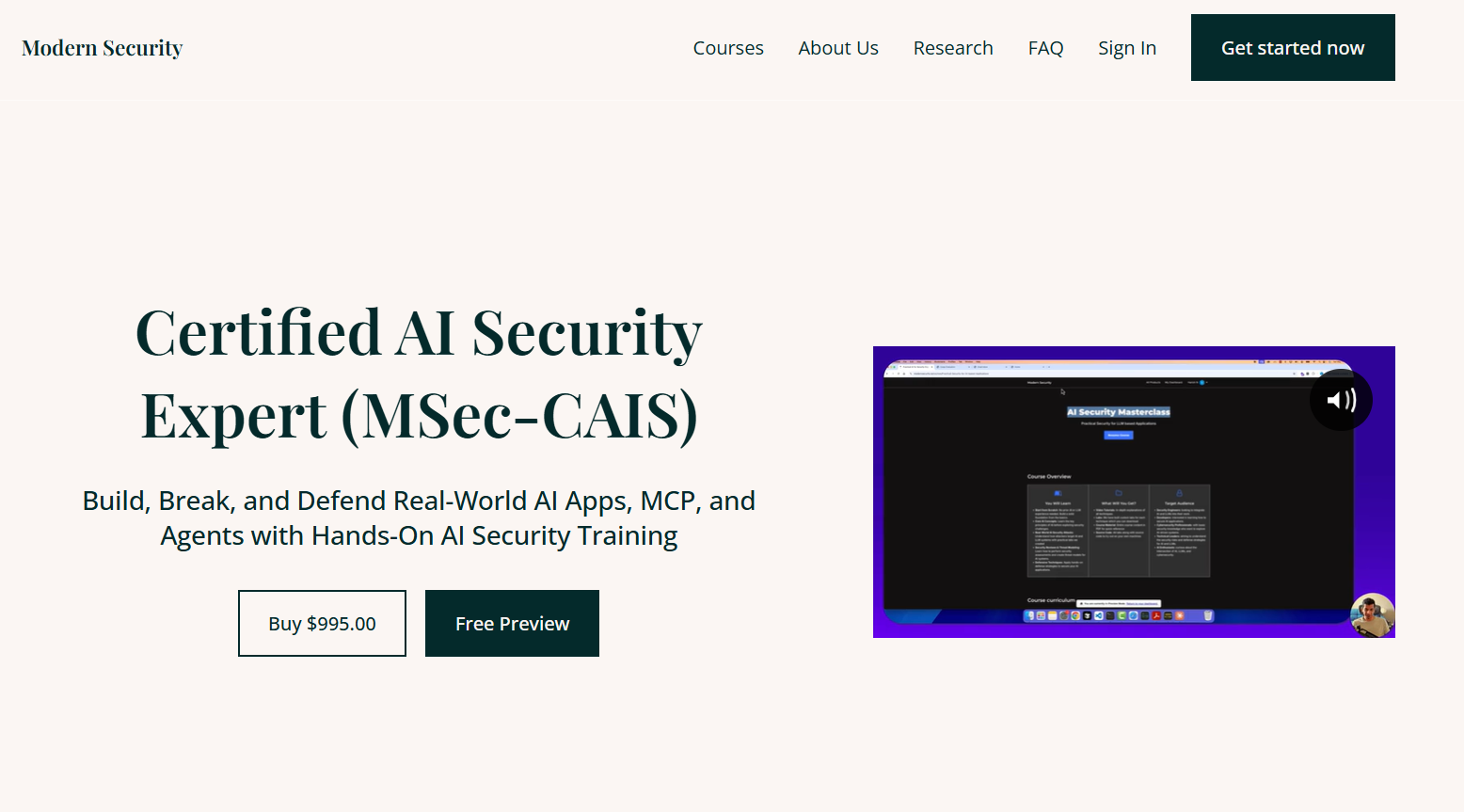
1. Certified AI Security Expert (MSec-CAIS) – Modern Security
Best for: Security engineers, developers, red teamers, and technical leaders who want real hands-on AI security training
Price: $995 (one-time, self-paced)
Level: Beginner-friendly with no AI background required
If I had to recommend one place to start – or even restart – your AI security journey, it is this one.
The AI security certification course from Modern Security, formally called MSec-CAIS, is taught by Harish Ramadoss, a Principal from Trustwave SpiderLabs who later became a founding member of the Security Engineering team at Rippling, where he oversees AI Security and Application Security initiatives. He has presented research at Black Hat, DEF CON, and HITB. That pedigree matters because you are learning from someone who builds and breaks AI systems in production, not someone reading from a textbook.
The course has 38 lessons and covers the complete AI security lifecycle. You start from zero – what LLMs are, how RAG (Retrieval-Augmented Generation) works, what vector databases do, and how agentic systems behave. Then you move into building your own threat model agent, attacking real-world AI applications through hands-on labs, and finally defending them with LLM guardrails, MCP gateways, and secure architecture decisions.
What makes this course stand out:
The labs are the heart of it. You do not just read about prompt injection – you actually attack an essay AI bot the course built for that purpose. You do not just hear about MCP (Model Context Protocol) attacks – you build an MCP server, then break it, then defend it. You work through model backdoor examples pulled directly from Hugging Face. You build a working web security scanner agent powered by an LLM.
By the time you finish, you understand how GenAI applications are constructed from the ground up, how to find and exploit their weaknesses, and how to provide real, actionable security recommendations to engineering teams.
Professionals from AWS, Apple, Netskope, and Genpact have already enrolled. The course is self-paced, and students get a certificate of completion. Discounts are available for students and individual learners – reach out to their team directly at the email on their site.
What you learn:
- LLM fundamentals, embeddings, RAG, vector databases, agentic workflows, and MCP
- Prompt injection, indirect prompt injection, sensitive information disclosure
- AI supply chain attacks, model backdoors, model signing with Sigstore, AIBOM
- Threat modeling AI applications using real-world engineering workflows
- Defensive techniques including LLM firewalls, input/output validation, and agentic security architecture
Who should take it: Anyone who wants to go from zero to genuinely skilled at AI security. The beginner-friendly framing is real – there is no AI background requirement. But experienced professionals will find the offensive and defensive depth genuinely useful.
2. ISC2 Building AI Strategy Certificate
Best for: Cybersecurity professionals who want to lead secure AI adoption in their organizations
Price: Approximately $640 (ISC2 members receive a 20% discount)
Level: Intermediate – foundational cybersecurity knowledge recommended
CPE Credits: 16 upon completion
ISC2, the organization behind CISSP and other leading cybersecurity credentials, launched this certificate in July 2025. It is called the Building AI Strategy Certificate and it consists of six self-paced online courses designed to be completed in approximately 16 hours.
This is not a deeply technical course. It is strategic and governance-focused, which makes it valuable for a different audience – security managers, CISOs, compliance leads, and professionals who need to guide their organization’s AI adoption without necessarily writing the code themselves.
The curriculum covers how AI differs from traditional cybersecurity risks, how to balance AI tools with human decision-making, the impact of AI on the cybersecurity workforce, governance frameworks like the EU AI Act, security risks tied to large language models, and ethical AI deployment strategies.
According to ISC2’s own 2025 survey, 66% of security professionals see AI as a major career development opportunity, and 70% of those already using AI security tools report improved team effectiveness. This certificate positions you to lead that transformation.
What you learn:
- AI fundamentals and their cybersecurity implications
- AI-specific cyberattack patterns and how to defend against them
- Compliance frameworks and AI ethics in organizational contexts
- Strategies for responsible, secure AI adoption at scale
Who should take it: Security managers, governance professionals, and practitioners with foundational cybersecurity knowledge who want credentials to support organizational AI strategy. It pairs well with CISSP or CCSP if you already hold those.
3. Google Cybersecurity Professional Certificate
Best for: Beginners entering cybersecurity for the first time
Price: $49 per month on Coursera (7-day free trial available); most learners finish in 3 to 6 months, bringing total cost to roughly $147 to $294
Level: Beginner – no prior experience or degree required
Platform: Coursera
Learners enrolled: Over 1.2 million
This is the entry point for a lot of people, and there is a good reason for that. Google designed this certificate program specifically for beginners, and it works. The program consists of 8 courses and takes about 6 months at 7 hours per week of study, though faster learners finish in 3 months.
You do not need any background in IT or security to start. The curriculum covers identifying common threats, vulnerabilities, and risks; using tools like Wireshark, tcpdump, and Linux; network security fundamentals; and importantly, how to use generative AI tools to boost your effectiveness as a security analyst.
More than 150 employer partners, including American Express, Deloitte, T-Mobile, and Walmart, officially recognize this certificate when hiring for entry-level roles. Graduates also receive a discounted pathway to the CompTIA Security+ exam, which is one of the most widely recognized entry-level security credentials in the industry.
What you learn:
- Cybersecurity foundations, risk management, and compliance frameworks
- Network security and hands-on experience with Linux and SQL
- Threat detection, incident response basics, and log analysis
- Practical use of AI tools for security workflow automation
Who should take it: Career changers, students, and anyone who wants a low-cost, structured path into cybersecurity. It is not specifically an AI security certification, but its AI-integrated modules and CompTIA Security+ pathway make it a smart first step before pursuing more specialized AI security certifications.
4. GIAC AI Platform Security (GAIPS) via SANS SEC545
Best for: Experienced security practitioners who need to audit and secure GenAI applications and LLM pipelines
Price: $8,260 (SANS SEC545 course) + $999 (GAIPS certification exam) – total investment exceeds $9,000
Level: Advanced
CPEs: 30 upon course completion
Certification availability: GAIPS will be available for general purchase on July 28, 2026. Currently bundled with the SEC545 course purchase.
The SANS Institute is one of the most respected names in cybersecurity training, and their GAIPS certification reflects that reputation. The full name of the course is SEC545: GenAI and LLM Application Security, and it is a 5-day intensive program that leads to the GIAC AI Platform Security certification.
The course starts with GenAI fundamentals – LLMs, embeddings, RAG – and then goes deep into MLSecOps, agentic AI security (including MCP attacks and OAuth security), AI threat modeling using the MAESTRO framework, and how to use AI for offensive threat hunting and incident investigation. The lab environment is extensive, covering real scenarios involving model serialization attacks, AI supply chain vulnerabilities, and SageMaker and AWS Bedrock security.
The GAIPS certification exam itself uses GIAC’s CyberLive format, which replaces traditional multiple-choice questions with performance-based challenges in realistic lab environments. That is a meaningful quality signal – it tests what you can actually do, not just what you can memorize.
The cost is substantial. If you cannot get your employer to sponsor it, this one requires serious financial planning. But if you work in an enterprise environment or regulated industry where GIAC credentials carry weight, the investment is defensible.
What you learn:
- GenAI and LLM security fundamentals and architecture risk assessment
- Agentic system security, MCP attacks, and OAuth misconfigurations
- MLOps workflows, model serialization risks, and AI supply chain hardening
- AI threat modeling and practical offensive and defensive techniques
Who should take it: Senior security practitioners, red teamers, AppSec leads, and cloud security engineers who need to secure GenAI systems in production enterprise environments and want a recognized GIAC credential.
5. Stanford Cloud Security (XACS235)
Best for: Security professionals who want to deeply understand cloud security risks as they apply to AI-hosted environments
Price: $545 per course enrollment (60 days access); $2,725 for the All-Access Plan covering all courses in the Advanced Cybersecurity Program (365 days)
Level: Intermediate – foundational information security knowledge recommended
Time to complete: 10 hours
Credential: Record of Completion from Stanford
Platform: Stanford Online
AI does not live on a laptop. It lives in the cloud. AWS, Azure, and Google Cloud are the infrastructure running the vast majority of AI workloads today, and the security of those environments directly determines whether your AI systems are safe. That is what makes this Stanford course essential for anyone working in AI security.
Cloud Security (XACS235) is part of Stanford’s Advanced Cybersecurity Program and is taught by Professor Dan Boneh, one of the world’s leading applied cryptography researchers, and Neil Daswani, a Co-Director of Stanford’s Advanced Cybersecurity Certification Program and former CISO at multiple organizations. The teaching team also includes industry experts who walk through real-world cloud breaches, explaining root causes and lessons learned.
The course covers cloud infrastructure security, cloud application security, identity and access management (IAM), data protection and key management, security operations and monitoring, incident response, compliance with frameworks like the Cloud Security Alliance’s Cloud Controls Matrix and AWS Well-Architected Framework, and emerging topics including privacy-preserving machine learning.
Optional hands-on labs run on a third-party platform and require an AWS account (a temporary $1 hold applies for verification). Labs are not required to complete the course or earn the credential.
What you learn:
- Cloud-specific threats, the shared responsibility model, and real breach analysis
- Cloud IAM, data encryption, key management systems, and access policy design
- Container and Kubernetes security, bot protection, and cloud configuration best practices
- Cloud compliance frameworks and privacy-preserving AI techniques
Who should take it: Security engineers, cloud architects, DevSecOps practitioners, and AI security professionals who need to understand the cloud environment their AI systems run on. This is a foundational course for anyone pursuing Stanford’s full Advanced Cybersecurity Program.
6. MSc in Software and Systems Security – University of Oxford
Best for: Working professionals worldwide who want a prestigious academic credential in systems security, including AI and cloud security modules
Price: £3,095 per module (approximately $3,900 USD); plus a master’s registration fee of £12,630 (home students) or £21,065 (overseas students). Total program cost varies based on number of modules and time taken.
Level: Advanced – typically requires at least two years of professional experience in software, security, or data engineering
Duration: Part-time; most students complete it in 3 to 4 years
Format: Hybrid – modules are mostly held in-person in Oxford, though some modules may be delivered online. Oxford’s official course information sheet confirms this hybrid delivery model.
Online access: Yes, some modules can be attended online, making this accessible to international professionals who cannot always travel to Oxford for every teaching week.
Application status: Closed for 2026-27 entry; register on the Oxford website to be notified when the 2027-28 cycle opens.
NCSC Certified: Yes – the MSc in Software and Systems Security is certified by the UK National Cyber Security Centre (NCSC) as meeting their standards for a cybersecurity master’s degree.
Oxford’s MSc in Software and Systems Security is a part-time program built specifically for working professionals. You study around your career over two to four years, completing 10 modules covering malware analysis, digital forensics, cloud platform security, secure software design, and AI-related security topics, plus a project and dissertation.
Most modules are a single intensive week held in Oxford, but Oxford officially confirms some modules may be delivered online. Each module involves roughly 150 hours of total work, split between contact hours during the teaching week, pre-study, a follow-up assignment, and self-directed reading.
Class sizes are small deliberately. You get direct interaction with domain experts, not teaching assistants reading from slides. The program is also NCSC certified, which signals to UK government agencies, defense contractors, and regulated industries that it meets verified national cybersecurity education standards.
The Oxford brand opens doors in a very specific way. CISO roles, senior security architecture positions, government agencies, and top-tier consulting firms look at Oxford credentials differently. If long-term career trajectory and prestige are part of your calculation, this program deserves serious consideration.
What you learn:
- Security principles across software design, forensics, and governance
- Cloud platform security, malware analysis, and wireless network security
- Research-grade understanding of current and emerging security threats
- Dissertation-level depth in a security specialization of your choice
Who should take it: Mid-to-senior security professionals anywhere in the world. The hybrid format means you do not need to be based in the UK – you can attend most weeks in Oxford when needed and join some modules online. The financial commitment is significant, so employer sponsorship is worth pursuing if this is your path. Applications for 2027-28 entry open in September 2026.
7. CompTIA SecAI+ (CY0-001)
Best for: Cybersecurity professionals who want a vendor-neutral, industry-recognized certification for AI security skills
Price: $359 USD (single exam voucher); $408 with a retake voucher bundle
Level: Intermediate to Advanced – CompTIA recommends 3 to 4 years of IT experience with 2+ years in hands-on cybersecurity roles
Exam format: 90 questions (multiple-choice and performance-based), 60-minute time limit; passing score of 600 out of 900
Launch date: February 17, 2026
CompTIA SecAI+ is the world’s first vendor-neutral certification specifically designed to validate skills in securing AI systems and applying AI to security operations. It launched in February 2026 as the inaugural certification in CompTIA’s new Expansion Series.
This is not a beginner credential. It builds on top of foundational certifications like Security+, CySA+, and PenTest+. If you already hold one of those, SecAI+ is a natural extension that formally validates your AI security competency.
The exam covers four main domains: securing AI systems (including models, data pipelines, and prompts), leveraging AI for security operations (threat hunting, triage, incident response), AI governance and risk management, and AI-related compliance frameworks like NIST AI RMF, OWASP LLM Top 10, and MITRE ATLAS.
One important thing to understand: the exam tests both conceptual knowledge and performance-based application. There are hands-on scenarios, not just theory questions. That reflects the kind of depth employers are actually looking for.
What you learn:
- How attackers weaponize AI for reconnaissance, phishing, and exploitation
- How defenders use AI for threat hunting, anomaly detection, and automated response
- Securing LLM-based applications, AI pipelines, and AI-integrated tools
- AI governance, risk frameworks, and responsible AI deployment in enterprise environments
Who should take it: Experienced cybersecurity professionals who want a recognized, employer-trusted credential for AI security skills. It is especially relevant if you already hold CompTIA certifications and want to extend into the AI security specialization.
8. IBM Generative AI for Cybersecurity Professionals Specialization
Best for: Cybersecurity professionals and enthusiasts who want to integrate generative AI tools into their existing security workflows
Price: Included with Coursera Plus ($49/month or $239/year); approximately $147 total if completed in 3 months at standard subscription pricing
Level: Intermediate – basic cybersecurity knowledge and foundational generative AI awareness are helpful
Duration: 12 weeks at 5 hours per week (can be completed faster)
Credential: Shareable Coursera certificate and IBM digital badge via Credly
Platform: Coursera
IBM’s Generative AI for Cybersecurity Professionals is a 3-course specialization on Coursera that takes cybersecurity professionals from AI basics to practical, applied generative AI security skills. It is taught by Dr. Manish Kumar, Rav Ahuja, and Antonio Cangiano from IBM’s Skills Network.
The specialization starts with Generative AI fundamentals – what it is, how it differs from discriminative AI, and what the major models and tools look like for text, code, image, audio, and video. Then it moves into prompt engineering techniques (zero-shot, few-shot, and others) using tools including IBM Watsonx Prompt Lab, Spellbook, and Dust.
The security-specific application comes in the third course, where you learn how generative AI tools apply to threat intelligence gathering, report summarization, EDR and SIEM enhancement, incident response automation, and playbook creation. Real-world case studies show how AI-driven models help identify vulnerabilities and respond to attacks.
You graduate with a portfolio of hands-on projects, a shareable certificate, and an IBM-issued digital badge that verifies your achievement on Credly.
What you learn:
- Generative AI fundamentals, including LLMs, diffusion models, and multimodal tools
- Practical prompt engineering for security use cases
- Applying AI to threat detection, incident response, and SIEM/EDR automation
- Identifying and mitigating AI-specific cybersecurity vulnerabilities
Who should take it: Security analysts, SOC professionals, and cybersecurity generalists who want to add generative AI skills to their existing toolkit without needing a deep technical AI background. The IBM badge and Coursera certificate carry real employer recognition across major enterprises.
9. Microsoft AI Security Fundamentals (Microsoft Learn)
Best for: Anyone who wants a free, accessible introduction to AI security concepts, especially those already working in Microsoft environments
Price: Free (Microsoft Learn is free; the Azure AI Fundamentals AI-900 exam costs approximately $99 USD separately)
Level: Beginner
Format: Self-paced online modules on Microsoft Learn
If you are new to AI security and you want to start without spending anything, Microsoft’s AI Security Fundamentals module is one of the most accessible starting points available. It is free, structured, and built on real Microsoft security research.
The module covers how AI security differs from traditional cybersecurity, the three-layer AI architecture model (the data layer, the model layer, and the application layer), and AI-specific attack techniques including jailbreaking, prompt injection, model manipulation, data exfiltration, and overreliance.
It also explains concrete mitigation strategies and security controls for each attack type – content filters, metaprompts, data security practices, grounding techniques, and monitoring approaches. There is a section on AI red teaming that covers how to plan and execute red teaming exercises specifically for LLMs and AI-enabled applications.
For those who want to go further, this module fits within the broader Microsoft Azure AI Fundamentals pathway (AI-900 certification, priced at approximately $99). Note that the AI-900 exam retires on June 30, 2026, and is being replaced by AI-901, so check the Microsoft Learn page for the most current exam information before you register.
Microsoft has also recently launched the Microsoft Certified: Cloud and AI Security Engineer Associate credential (beta), which validates the ability to design, implement, and manage security controls across Azure, hybrid, and AI-enabled environments. That is a more advanced option worth watching as it matures.
What you learn:
- The difference between AI security threats and traditional cybersecurity threats
- Specific AI attack vectors: prompt injection, jailbreaking, data exfiltration
- Security controls and defensive architecture for AI systems
- AI red teaming methodology for LLM applications
Who should take it: Absolute beginners, IT professionals transitioning into security, or anyone in a Microsoft-centric environment who needs to understand AI security risks without spending money to get started.
10. SANS SEC545: GenAI and LLM Application Security (Full Course Detail)
Best for: Security engineers and architects who need enterprise-grade, instructor-led training on securing the full GenAI stack
Price: $8,260 (course only); GAIPS certification exam is an additional $999
Level: Advanced
Duration: 5 days (intensive); 30 CPE credits
Format: Live online and in-person at SANS events
While GAIPS (listing 4) covers the certification angle, the full SEC545 course from SANS deserves its own closer look because the course itself is what delivers the skills.
SEC545 is structured across five days of intensive training. Day one covers GenAI fundamentals and the security risks unique to LLMs. Day two goes into RAG pipelines, embeddings, and how attackers exploit these architectures. Day three covers agentic systems, MCP attacks, OAuth vulnerabilities in AI integrations, and transformer architecture security.
Day four addresses MLSecOps – model serialization vulnerabilities, model signing, and securing cloud-based AI services including Amazon SageMaker and AWS Bedrock. Day five ties everything together with AI threat modeling using the MAESTRO framework and practical use of AI tools for security operations.
The hands-on labs throughout the course are scenario-driven and reflect the kinds of environments security teams actually encounter in the field. The instructor, Ahmed Abugharbia, is the course author and a recognized practitioner in GenAI security.
This is the most expensive option on this list by a significant margin. The investment is justifiable if your employer is paying, if you work in a regulated industry where GIAC credentials are expected, or if you need instructor-led, enterprise-grade training with live interaction.
What you learn:
- Full GenAI security lifecycle from model selection through deployment
- RAG pipeline attacks and supply chain vulnerabilities in AI development
- Agentic AI attack surfaces, MCP exploits, and autonomous system risk
- MLSecOps, model integrity verification, and cloud AI platform security
Who should take it: Senior security practitioners, enterprise security architects, and security teams with budget for intensive professional training. If your organization is deploying GenAI at scale, sending a senior team member through SEC545 is a reasonable investment.
How to Choose the Right AI Security Certification for You
Here is a simple way to think about it:
You are brand new to cybersecurity: Start with the Google Cybersecurity Professional Certificate. It is affordable, beginner-friendly, and gives you a foundation to build on.
You are new to AI security but already work in cybersecurity: The Modern Security MSec-CAIS is your best bet. Hands-on labs, real-world attacks, and a clear path from zero AI knowledge to practical AI security skills.
You want to lead AI security strategy in your organization: ISC2 Building AI Strategy Certificate gives you the governance and compliance vocabulary to do that effectively.
You work in cloud environments and need to secure AI infrastructure: Stanford Cloud Security (XACS235) fills a critical gap that most AI security programs ignore.
You want a vendor-neutral, employer-recognized certification: CompTIA SecAI+ is the most portable credential on this list for AI security specifically.
You want academic depth and prestige: The Oxford MSc in Software and Systems Security is in its own category. Plan for a multi-year commitment.
Your employer will fund advanced training: SANS SEC545 with GAIPS is the highest-depth option available for organizations that need enterprise-grade AI security skills.
You want to integrate AI tools into your existing security workflow: IBM Generative AI for Cybersecurity Professionals on Coursera is practical, affordable, and teaches immediately usable skills.
You want to start today for free: Microsoft AI Security Fundamentals on Microsoft Learn costs nothing and takes a few hours to complete.
Real Jobs That Require AI Security Certifications
Here is how AI security certifications are showing up in actual job postings in 2026. These are the role titles and the credentials employers are asking for.
AI Security Engineer Employers hiring for this role look for demonstrated hands-on skills in LLM security, adversarial ML, and AI pipeline defense. Certifications like MSec-CAIS, GAIC GAIPS, and CompTIA SecAI+ appear regularly in job description requirements and preferred qualifications.
LLM Security Specialist A newer title appearing at companies deploying ChatGPT, Claude, Gemini, and custom models in production. Job postings typically ask for knowledge of OWASP LLM Top 10, prompt injection testing, and RAG pipeline security. Hands-on certifications carry more weight here than theory-based ones.
AI Risk and Compliance Analyst Companies subject to the EU AI Act, financial regulations, and healthcare data laws are hiring specifically for this role. The ISC2 Building AI Strategy Certificate is directly aligned to what these jobs require – governance frameworks, risk assessment methodology, and compliance knowledge.
Cybersecurity Analyst with AI Focus Many traditional analyst roles now include AI-specific requirements in their job descriptions. The Google Cybersecurity Certificate gets you to the interview for entry-level versions of this role. IBM Generative AI for Cybersecurity Professionals strengthens your case for analyst roles that require working with AI-powered SIEM and EDR tools.
Cloud AI Security Engineer This role sits at the intersection of cloud security and AI security. Stanford Cloud Security (XACS235) is one of the few certifications that directly addresses this combination, covering cloud AI infrastructure, container security, and data protection in cloud-hosted AI environments.
Security Architect – AI Systems Senior-level role requiring deep knowledge of secure AI system design. Oxford MSc in Software and Systems Security and SANS SEC545 are the credentials that appear at this level of hiring, typically in financial services, defense, and large technology companies.
AI Security Job Roles and Salary Expectations (2026)
Before you invest in any AI security certification, it helps to know what jobs are actually waiting on the other side and what those jobs pay. AI security is one of the fastest-growing specializations in cybersecurity right now, and salaries reflect that demand.
| Role | What You Do | Entry Level Salary | Experienced Salary |
| AI Security Analyst | Monitor AI systems for threats, investigate incidents, and support security operations teams on AI-related risks | $75,000 – $95,000 | $110,000 – $140,000 |
| LLM Security Engineer | Test large language models for prompt injection, jailbreaking, and data leakage; build guardrails and output filters | $95,000 – $120,000 | $152,000 – $210,000 |
| AI Red Team Specialist | Break AI models through adversarial attacks and prompt manipulation before real attackers do | $100,000 – $130,000 | $160,000 – $230,000 |
| MLSecOps Engineer | Secure the full ML pipeline from data ingestion through deployment, including training data protection and model signing | $90,000 – $115,000 | $140,000 – $195,000 |
| AI Risk and Compliance Analyst | Ensure AI use is legal and compliant with frameworks like EU AI Act and NIST AI RMF; handle risk assessments and audits | $80,000 – $100,000 | $130,000 – $190,000 |
| Cybersecurity Analyst with AI Focus | Handle traditional security analyst work with added AI-specific requirements like AI-powered SIEM and EDR tools | $75,000 – $95,000 | $110,000 – $140,000 |
| Cloud AI Security Engineer | Secure cloud-hosted AI infrastructure, containers, data pipelines, and AI services across AWS, Azure, and GCP | $90,000 – $115,000 | $140,000 – $195,000 |
| AI Security Architect | Design the full secure AI ecosystem for an organization; set standards and lead AI risk management at a strategic level | Not typical at entry level | $200,000 – $280,00 |
Salary figures reflect US-based roles and will vary depending on your location, company size, and industry. Think of these numbers as your floor, not your ceiling. Every year of real experience you add, every certification you earn, and every AI system you learn to defend pushes your value higher. The professionals sitting at the top of these ranges did not start there.
Frequently Asked Questions (FAQs)
1. Which AI security certification is best for beginners in 2026?
For complete beginners, the Google Cybersecurity Professional Certificate and Microsoft AI Security Fundamentals are the best starting points. Both are beginner-friendly, affordable, and teach core cybersecurity and AI security concepts without requiring prior experience.
2. Are AI security certifications worth it for cybersecurity careers?
Yes, AI security certifications are becoming increasingly valuable because companies now need professionals who understand LLM security, prompt injection, AI threat modeling, and AI risk management. Many employers actively look for certifications when hiring for AI security engineer, MLSecOps, and AI compliance roles.
3. What skills do AI security certifications teach?
Most AI security certifications teach skills such as prompt injection testing, AI threat detection, model poisoning prevention, AI governance, LLM security, AI supply chain security, cloud AI protection, and secure deployment of generative AI systems. Advanced programs also include hands-on labs and real-world attack simulations.
4. Which AI security certification has the best hands-on training?
The Certified AI Security Expert (MSec-CAIS) by Modern Security and SANS Institute SEC545 are considered some of the best hands-on AI security training programs. They include practical labs for prompt injection attacks, AI application testing, model security, and AI threat defense techniques.
5. Can I learn AI security without a cybersecurity background?
Yes, several beginner-friendly AI security certifications are designed for people with no prior cybersecurity experience. Programs like the Google Cybersecurity Professional Certificate and Microsoft AI Security Fundamentals help learners build foundational security and AI knowledge step by step.
6. What jobs can you get after earning an AI security certification?
AI security certifications can help you qualify for roles such as AI Security Analyst, LLM Security Engineer, AI Red Team Specialist, MLSecOps Engineer, Cloud AI Security Engineer, and AI Risk & Compliance Analyst. Salaries for experienced professionals in these roles can exceed $200,000 annually in the US market.
Final Thoughts
The AI security certifications landscape changed dramatically between 2024 and 2026. New credentials launched, existing programs added AI-specific modules, and organizations started including AI security requirements in job descriptions that previously would never have mentioned it.
This is not a trend. It is a structural shift in how security works. AI systems are now part of the attack surface. Understanding how to protect them is a core security skill, not a niche specialty.
The certifications on this list represent the best available options for building real, validated AI security expertise in 2026 – from free beginner modules to advanced instructor-led programs to prestigious academic degrees. Pick the one that fits where you are right now, and start.
The only wrong move is waiting.