So you built a SaaS product. The features work, onboarding is solid, and you genuinely believe it solves a real problem. But then… crickets.
Nobody warns you about this part. Building the product is the easier half. Getting people to find it, try it, and stick around is where most small SaaS businesses quietly struggle.
The global SaaS market is projected to grow from $315.68 billion in 2026 to $1.13 trillion by 2032. That growth is not reserved for big players. But you do need the right SaaS marketing strategies to claim your share.
This guide covers 15 proven strategies that work in 2026, backed by real data.
Table of Contents
ToggleWhat Makes SaaS Marketing Different
With SaaS, you sell a subscription, not a one-time product. Churn is your enemy. Expansion revenue is your opportunity. A customer who stays 36 months is worth dramatically more than one who cancels after three. That changes how you think about every marketing decision.
Keep this mindset as you read through the strategies below.
1. Build a Content Marketing Engine First
If you only pick one SaaS marketing strategy from this list, make it content marketing. Top-performing SaaS companies now attribute 41% of their qualified pipeline to organic search and content, according to FirstPageSage 2026 data. Paid acquisition has dropped to just 26% for those same companies.
Content compounds. A blog post you write today can bring leads 18 months from now without spending another dollar. Paid ads stop the moment your budget does.
Start by creating content around the problems your ideal customers are searching for, not your features. Help them understand their options. Build trust before they see a pricing page.
2. Invest in SaaS SEO From Day One
SEO and content go together, but SEO deserves its own spot because small SaaS businesses regularly underestimate how long it takes and how much it pays off.
SEO-sourced leads convert at a 51% MQL-to-SQL rate, compared to just 26% for PPC traffic. Nearly double the quality, at a fraction of long-term cost.
Focus on three keyword types: bottom-of-funnel searches where buyers compare options right now, problem-aware searches from people who know they have a problem but have not evaluated solutions yet, and comparison keywords from people deciding between your product and a competitor.
Honest reality check: SEO takes 7 to 12 months before meaningful compound returns show up. Start anyway. The best time was last year. The second best is today.
3. Offer a Free Trial or Freemium Plan Strategically
Nothing lowers the buying barrier like removing upfront payment. But how you structure your free offering changes conversion numbers dramatically.
In 2026, 57% of SaaS products use a free trial as the primary landing point for new customers. The most common trial length is 14 days. The median free-to-paid conversion rate is 8%, but free trials requiring a credit card upfront convert at around 30%, roughly five times higher than those that do not ask for one.
For freemium, most B2B SaaS companies see 2% to 5% of free users convert to paid. Exceptional products with well-calibrated feature gating reach 7% to 10%.
Pick your model based on your product type and audience. If your product delivers clear and immediate value, a 14-day trial with optional card entry is usually the stronger choice.
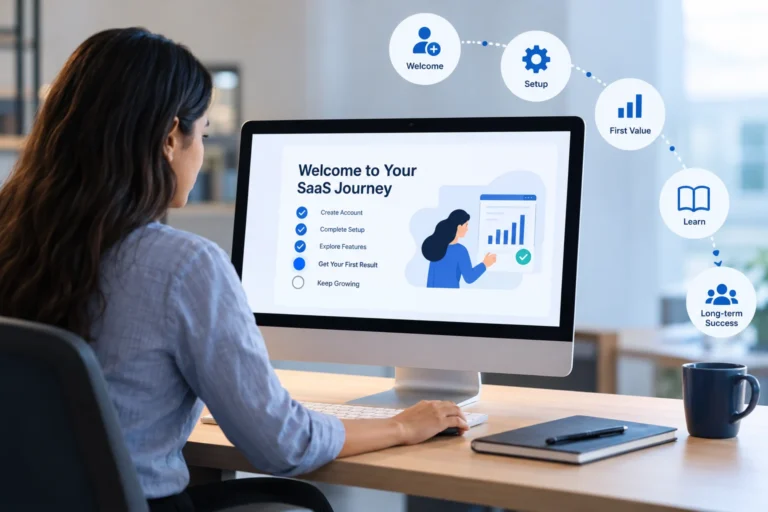
4. Nail Your Onboarding Experience
Getting a trial signup is only half the battle. If users never experience your product’s core value in the first session, they leave and never return.
This is the “aha moment,” the point where a user genuinely sees why they need your product. Your onboarding job is to get them there as fast as possible.
Sales-assisted product-qualified leads convert at 17.4% on average, compared to just 4.6% for pure self-serve, according to ICONIQ Capital 2026 data. The difference is activation.
Walk new users through the one action that delivers the most value. Send triggered emails when users go quiet. Offer short video walkthroughs for complex setups. Think of onboarding as your most important marketing channel.
5. Build a Customer Referral Program
Referred customers are not just cheaper to acquire. They are better customers. They show 37% higher retention after year one, churn 18% less than average, and are four times more likely to refer additional customers themselves.
Referral programs typically cost 5% to 10% of a SaaS company’s marketing budget to run, which is minimal compared to paid acquisition.
Two-sided incentives (rewards for both the referrer and the new user) increase participation by 85%. Credit-based rewards like account credits or extended trials outperform cash rewards by 18% in SaaS. Triggering referral prompts right after an “aha moment” drives 60% higher participation.
Tools like GrowSurf or FirstPromoter can get you running without heavy development work.
6. Use Email Marketing for Every Stage of the Funnel
Email remains one of the highest-ROI channels in SaaS, particularly because you can trigger messages based on what users actually do inside your product.
The key is behavioral triggering. Generic newsletters go to everyone on a schedule. Behavioral emails reach the right users at the perfect time.
High-impact triggered emails: a welcome sequence walking new trial users through core value day by day, a reactivation email when someone has not logged in for seven days, an upgrade email when a free user hits a feature limit, and a win-back campaign 30 days after a canceled subscription.
Tools like Customer.io or ActiveCampaign handle most of this without requiring a developer.
7. Run Targeted Paid Advertising
Organic channels win long-term, but paid advertising generates pipeline fast and lets you test messaging before committing to content.
One notable 2026 shift: LinkedIn ROI (113%) now exceeds Google Ads (78%) for B2B SaaS, despite higher cost per click. For small SaaS businesses targeting other businesses, this matters.
Google Search Ads work for high-intent keywords. LinkedIn Ads work for precise job title and company targeting. Retargeting works extremely well because SaaS buying cycles are longer, and warm visitors deserve follow-up.
Keep your paid budget tight and data-driven. If a campaign is not producing trial signups at an acceptable cost, cut it fast.
8. Leverage Social Proof and Customer Reviews
In 2026, buyers check G2, Capterra, and Trustpilot before they trust your homepage. For small SaaS businesses, social proof is one of the most cost-effective conversion tools you have, because your happy customers already have it. You just need a system to capture it.
Ask every satisfied customer to leave a G2 or Capterra review. Send them a direct link. Build case studies with a clear before-and-after structure: specific problem, your solution, measurable result. Add testimonials on your landing pages and pricing page where purchase hesitation peaks.
Five genuine, specific reviews will outperform fifty vague ones every time.
9. Prioritize Customer Retention and Reduce Churn
Most SaaS marketing content focuses almost entirely on acquisition. But you can grow fast and still shrink if churn is high enough.
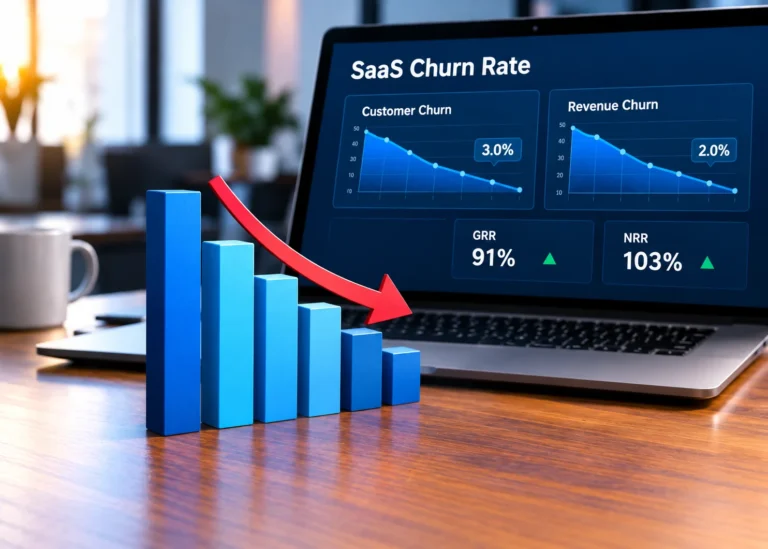
SMB-focused SaaS businesses face 3% to 7% monthly churn rates, translating to 31% to 58% annual churn. At the high end, you are replacing more than half your customers every year just to stay flat.
Companies with top-quartile Net Revenue Retention above 110% grow 2.3 times faster than peers at 95% to 100% NRR, according to KeyBanc Capital Markets 2026 data.
Identify which product behaviors correlate with long-term retention and build onboarding around driving those. Create even a simple customer health score so you spot at-risk accounts before they cancel. Retention is not just a customer success job. It is a marketing job.
10. Try Product-Led Growth to Reduce Sales Dependency
Product-led growth (PLG) means your product itself is the primary driver of customer acquisition, conversion, and expansion. Slack, Notion, and Figma are famous examples, but PLG works for small SaaS too.
The core idea: let users experience value before they talk to a salesperson. Then trigger upgrade conversations based on usage signals rather than arbitrary timelines.
PLG SaaS companies grow at two times the rate of sales-led companies at the same stage, according to OpenView Partners data. The efficiency gains come from lower CAC, faster activation, and better product-market fit signals.
For small SaaS businesses, PLG often starts with simply removing friction from your signup flow and tracking which in-product actions predict whether a user will upgrade.
11. Build an Affiliate or Partner Program
Affiliate marketing gives you promoters who only get paid when they deliver results. For small SaaS businesses with limited marketing budgets, this is highly capital-efficient.
SaaS affiliate programs work especially well because of recurring subscriptions. Rather than a one-time finder’s fee, many SaaS programs pay a recurring commission for as long as the referred customer stays. This motivates affiliates long-term.
Sustainable recurring commission ranges sit at 20% to 40% of monthly subscription value. Target affiliates who already serve your ideal customers: bloggers, newsletter writers, YouTube creators, and consultants in your niche.
Platforms like PartnerStack or FirstPromoter handle tracking, payouts, and affiliate dashboards without custom development.
12. Use Video Marketing and Product Demos
People buy software they understand. Video is the fastest way to make a complex product feel simple.
You do not need a production studio. A clear 2-minute product demo showing exactly what problem you solve will outperform a polished brand video with no specific message every time.
Use video on your homepage hero section to improve first impressions. Publish tutorial videos on YouTube, where they rank in search and attract qualified traffic from people actively learning skills your product supports. Short product videos on LinkedIn get strong organic reach for B2B audiences.
One video, one message. Do not try to show everything in a single demo.
13. Get Active in Community and Influencer Marketing
Your potential customers are gathering in Reddit communities, Slack groups, LinkedIn groups, and niche forums right now, discussing the exact problems your product solves.
Community marketing is not about promotional spam. It is about showing up as a genuinely helpful participant until you become known as someone who deeply understands the space. That reputation converts into inbound traffic and word-of-mouth that no ad can replicate.
For influencer marketing, prioritize credibility over follower count. A B2B software reviewer with 15,000 trusted LinkedIn followers will drive more qualified trials than a general tech influencer with 500,000 passive ones. Micro-influencers in the $500 to $2,000 per placement range are often accessible for small SaaS businesses and deliver strong results when the audience alignment is right.
14. Use Account-Based Marketing for High-Value Accounts
If you sell to mid-market or enterprise customers, Account-Based Marketing (ABM) is one of the highest-leverage strategies available. Instead of casting a wide net, you identify your top 20 to 50 target accounts and market to them with personalized, coordinated campaigns.
ABM makes sense when annual contract values exceed roughly $10,000. Below that, the resource investment typically does not pencil out.
Key ABM tactics for smaller teams: personalized outreach referencing the specific company’s situation, custom landing pages built for specific industries, targeted LinkedIn Ads shown only to employees at your target accounts, and coordinated sequences across email and LinkedIn.
The critical mistake is running too many accounts at your highest-touch tier. Cap Tier 1 at 20 to 50 accounts max. Beyond that, the personalization breaks down and the whole strategy loses its advantage.
15. Track the Right Metrics and Reallocate Regularly
None of the strategies above help you if you are making decisions based on the wrong data. Vanity metrics like page views and social followers feel good but rarely connect to revenue.
The metrics that actually matter for SaaS marketing:
CAC by channel shows what you are spending to acquire each customer per marketing source. This is how you know where to increase the budget and where to cut.
CAC Payback Period is how many months to recover what you spent to acquire a customer. The median across B2B SaaS is now 18 months in 2026, per OpenView benchmarks.
Trial-to-Paid Conversion Rate shows how well your free experience converts into paying customers. Even a few percentage points of improvement here changes revenue trajectory significantly.
Net Revenue Retention (NRR) measures whether your existing customer base is growing or shrinking. Anything above 100% means expansion revenue outpaces churn. Top performers hit 110% or higher.
Run a monthly attribution review and reallocate 10% to 20% of your budget toward your best-performing channels consistently.
Where to Start
If all 15 strategies feel overwhelming, here is a practical starting point:
Early stage: focus on content marketing, SEO, and your free trial experience. These compound over time and cost the least relative to long-term return.
With early customers: add referral programs, email automation, and customer retention work. These amplify what you already have.
With proven revenue: layer in paid advertising, video marketing, ABM for high-value accounts, and affiliate programs to accelerate what is already working.
Conclusion
SaaS marketing in 2026 is not about doing everything at once. It is about picking the right strategies for where you are right now, executing them consistently, and letting the data tell you what to do next.
The 15 SaaS marketing strategies in this guide are not theories. They are backed by real benchmarks from real companies. Content and SEO build long-term traffic you own. Free trials and great onboarding turn visitors into paying customers. Referral programs and email automation keep your best users close. Retention work ensures the customers you worked hard to acquire actually stay.
Small SaaS businesses have one real advantage over larger competitors: speed. You can test a new strategy this week, learn from it next week, and double down the week after. Large companies often take months to make the same moves.
Use that speed. Start with two or three strategies from this list. Measure what they produce. Cut what does not work and pour energy into what does. That cycle, done repeatedly and honestly, is what separates the SaaS companies that grow from the ones that stay stuck.
The market is growing. Your customers are out there searching for a solution like yours right now. The only question is whether they find you or your competitor first.