Every startup begins with ambitious goals, but as the team grows, keeping everyone aligned becomes increasingly difficult. Founders usually understand the company’s priorities, but individual teams may not always see how their daily tasks support those broader goals. That is exactly the problem the Objectives and Key Results (OKR) framework was designed to solve.
According to Google, OKRs helped the company maintain alignment while scaling from a small startup into one of the world’s largest technology companies. Since then, businesses of all sizes have adopted the framework because it creates a clear connection between strategic goals and measurable outcomes.
The challenge is not creating OKRs. The real challenge is keeping them updated, visible, and actionable as your team expands. Spreadsheets may work for a small team, but they quickly become difficult to manage when multiple departments, weekly check-ins, and changing priorities come into play. That is where dedicated OKR software becomes valuable.
What OKR Software Actually Does (And When You Need It)
OKR stands for Objectives and Key Results, a goal-setting framework developed at Intel in the 1970s by Andy Grove and later popularized by Google. An Objective is the ambitious, qualitative thing you want to achieve. Key Results are the two to five measurable numbers that tell you whether you got there.
OKR software exists to solve one specific problem: keeping that structure visible and current without a human having to chase it manually every week. A good OKR platform gives you:
- A shared home for company, team, and individual objectives
- Automated check-ins so progress updates don’t rely on someone’s memory
- Dashboards that show leadership where things stand without a status meeting
- A way to see how daily work actually ladders up to the bigger goal
If your team is under ten people and you’ve never run a single OKR cycle, honestly, start with a spreadsheet template first. Prove the framework works for your culture before you pay for it. Once you’re past your first or second quarter, or once check-ins start slipping because nobody “owns” updating the sheet, that’s when a dedicated OKR SaaS tool starts paying for itself.
Read also over blog : What Is SaaS? Everything You Need to Know in 2026
A Real OKR, Set Up in Practice
Here’s how that structure actually looks once it’s inside one of these tools, using a goal a lot of early-stage SaaS teams are chasing right now:
Objective: Become the go-to OKR tool for early-stage startups Key Result 1: Grow active teams from 200 to 500 Key Result 2: Reach a 4.5+ average rating on G2 Key Result 3: Get 50% of new signups from word-of-mouth referrals rather than paid channels
In a tool like Tability, that Objective would sit at the top of a workspace with each Key Result tracked as its own progress bar, and an Initiatives Kanban board underneath breaking KR2 down into concrete work like “respond to every G2 review within 48 hours” or “add a review prompt to the in-app upgrade flow.” In Mooncamp, the same structure would show up on the strategy map, with a visual line connecting the company-level Objective down to whichever team owns each Key Result, so a founder can click into KR1 and immediately see which team is behind without asking anyone directly.
That’s really the whole value of dedicated OKR software in one example: the Objective stays inspiring and untouched all quarter, while the Key Results and Initiatives underneath update constantly and visibly, without a founder having to chase five people every Monday to find out where things stand.
Top 7 OKR SaaS Tools
1. Lattice
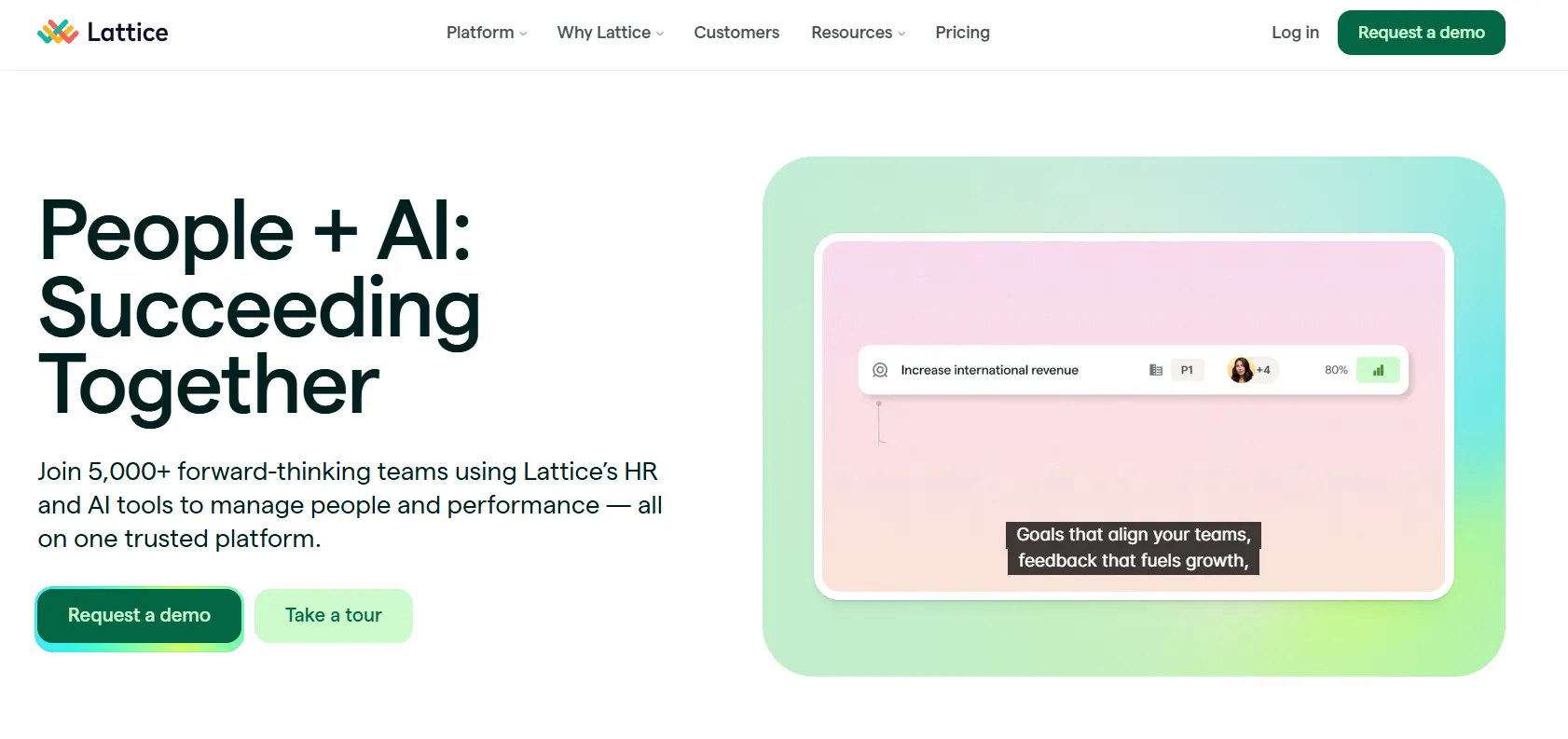
Best for: Teams looking for a complete performance management platform with built-in OKRs.
Lattice is where I’d point a startup that already knows it wants performance reviews, continuous feedback, and 1:1 meeting tools alongside goal tracking, rather than a standalone OKR tracker. It bundles OKRs and goals into its Talent Management plan alongside feedback and praise, performance reviews, and 1-on-1 agendas with notes.
Key features:
- Team and individual OKR tracking tied directly to performance reviews
- Confidence levels, so team members can flag how likely they are to hit a Key Result before it becomes a surprise
- Slack and Microsoft Teams integrations for updates inside existing workflows
- Add-on modules for engagement surveys and compensation planning
Pricing: Lattice’s Talent Management plan (which includes OKRs and goals) starts at around $11 per user/month billed annually, with optional add-ons like Engagement priced separately. There’s no permanent free tier, though a trial is available.
Where it fits: HR-led or leadership-led teams that want performance cycles and goal tracking connected in one system. If you just want a lightweight OKR tracker and nothing else, Lattice can feel heavier than what an early-stage startup needs.
2. Profit.co
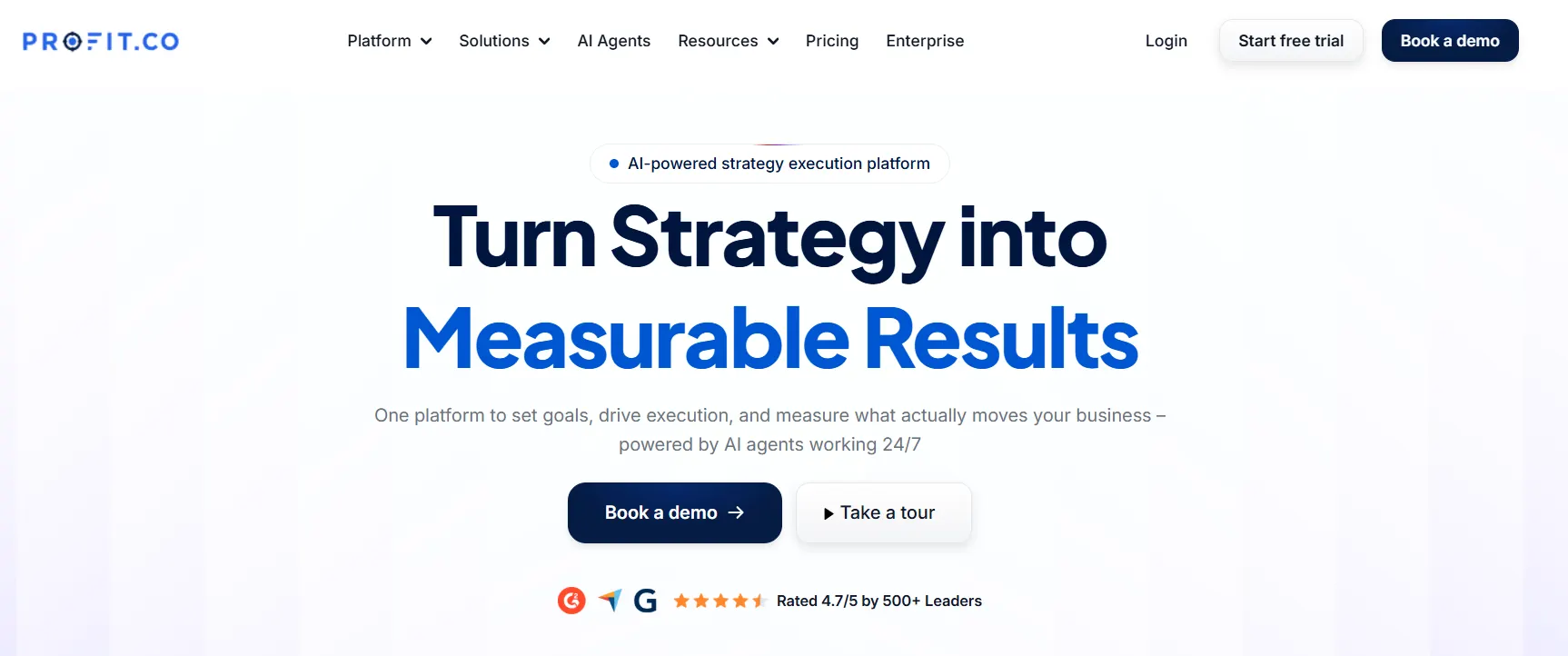
Best for: startups that want OKRs, task management, and performance reviews under one roof
Profit.co markets itself as an AI-enabled strategy execution platform, and in practice that means it goes well beyond simple goal tracking. It bundles OKR management with task management, performance reviews, employee engagement, and even balanced scorecard support for teams that want to connect OKRs to broader business strategy.
Key features:
- Cascading OKRs from company level down to individual contributors
- Automated check-in alerts so nobody has to manually chase status updates
- Real-time dashboards for OKR attainment and team alignment
- A strategy roadmap layer that connects long-term vision to quarterly initiatives
Pricing: Plans start at roughly $7 per user/month, with custom enterprise pricing for larger deployments and modules like performance management priced separately.
Where it fits: Teams that specifically want OKRs and performance management combined, and are comfortable with a slightly steeper learning curve. Reviewers consistently praise Profit.co’s responsive support team, though several also mention that the interface can feel dense given how many features are packed in.
Read also over blog : The 10 Best SaaS Demand Generation Agencies in 2026
3. Oboard
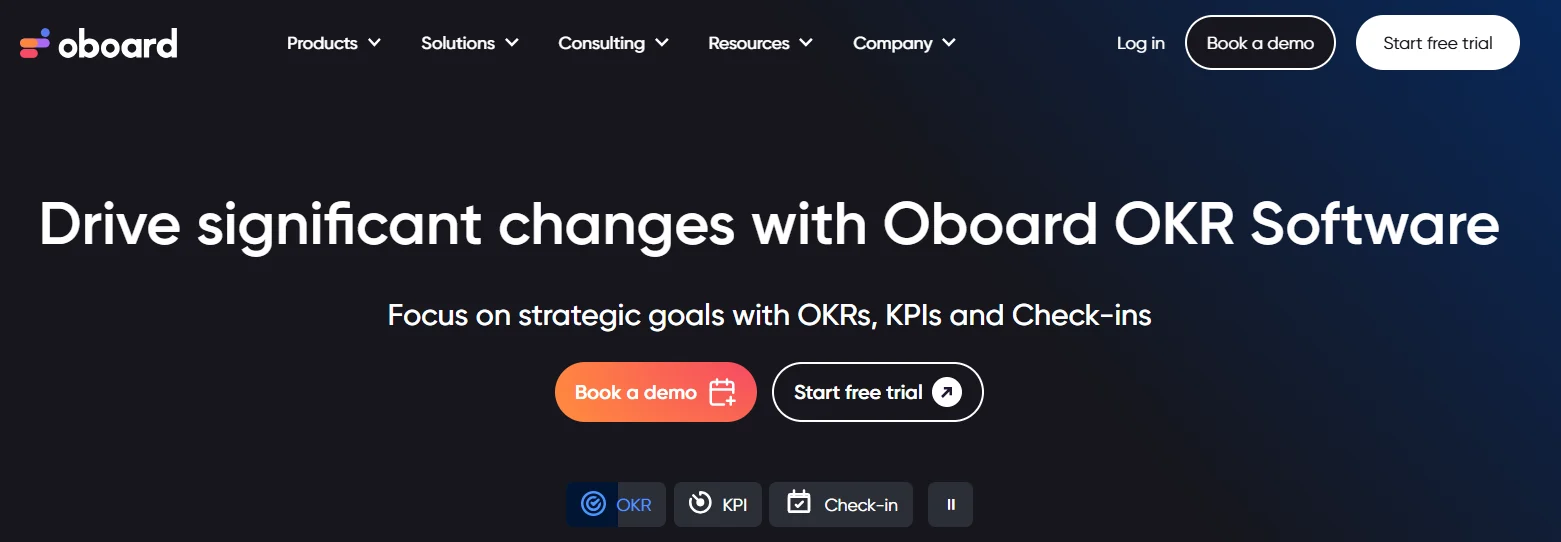
Best for: startups already living inside Jira, Confluence, or Salesforce
If your team already runs its sprints in Jira, Oboard solves a specific and very real problem: it lets you link OKRs directly to Jira epics and tasks, so goal progress updates itself based on what your engineering or product team is already shipping, instead of living in a separate tool nobody remembers to open.
Key features:
- Direct integration with Jira, Confluence, monday.com, and Salesforce
- JQL-based reporting for teams that already think in Jira query language
- Real-time dashboards that can be shared with executives or exported as PDFs
- A public API and dedicated OKR consulting/onboarding support
Pricing: Free for teams of 10 or fewer users inside a Jira workspace. For larger teams, pricing scales from roughly $0.09 to $1.50 per user/month for the Jira version, and from about $6 per user/month for the standalone web app.
Where it fits: Engineering- and product-led startups that don’t want a separate OKR tool competing for attention against tools their team already lives in. Outside a Jira or Confluence-based stack, Oboard’s advantage mostly disappears, so it’s a poor fit for non-technical or ops-heavy teams.
4. Tability
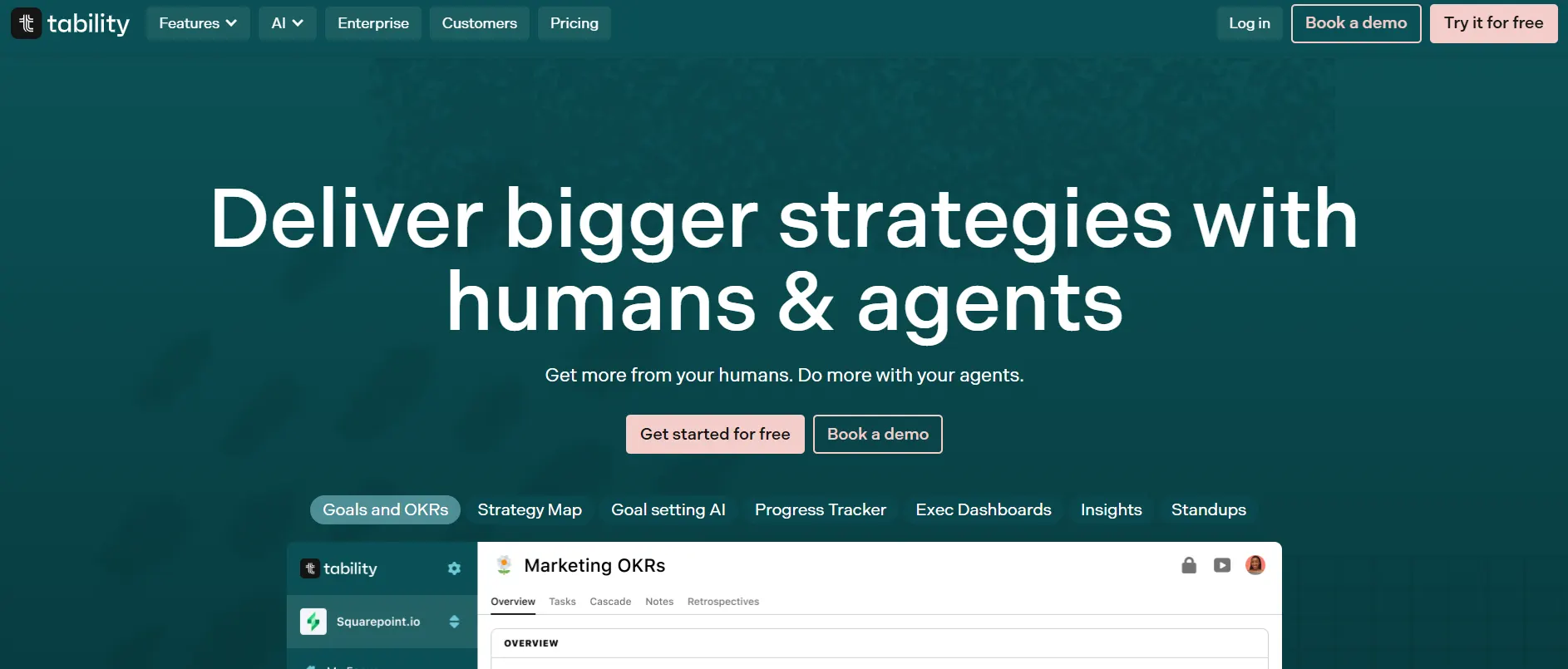
Best for: startups running their very first OKR cycle
Tability was built by two ex-Atlassians specifically for startups and small teams that want to get OKRs live fast without a lengthy setup process. Where some platforms need weeks of configuration, Tability is designed to get a team from signup to an active weekly check-in cadence within days.
Key features:
- AI-assisted goal drafting, useful when a team has never written a proper Key Result before
- A Kanban-style initiatives board that links daily work to specific OKRs
- A visual strategy map showing how team goals connect to company-level objectives
- Automated weekly check-in nudges
Pricing: Plans start at around $6 per user/month, typically with a free trial (a credit card may be required depending on the current offer).
Where it fits: Small, fast-moving teams that want to build the habit of weekly OKR check-ins without enterprise-level process overhead. It intentionally skips deeper capabilities like formal performance reviews or KPI/balanced-scorecard layers, so teams that outgrow lightweight tracking may need to migrate to a more full-featured platform after a few cycles.
5. Mooncamp
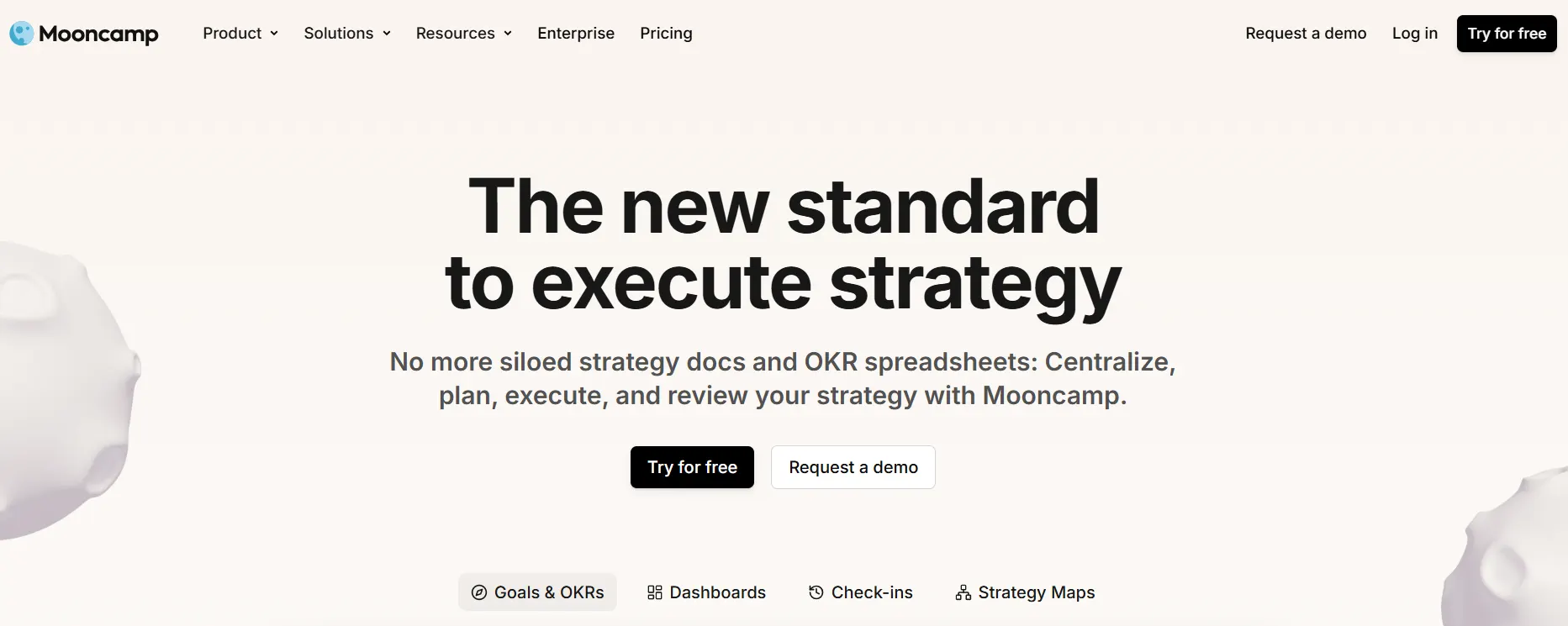
Best for: startups that want a clean, modern OKR platform without unnecessary bloat
Mooncamp has become one of the most recommended migration paths for teams that were previously on Microsoft Viva Goals, which Microsoft officially retired at the end of December 2025. Mooncamp offers a genuinely strong Microsoft Teams integration, along with connections to Power BI and Planner, which makes the transition smoother for teams already inside the Microsoft ecosystem, though it works just as well for teams that were never on Viva Goals in the first place.
Key features:
- Flexible goal hierarchies for company, team, and individual OKRs without forcing a rigid structure
- A visual strategy map that shows how every objective cascades through the organization
- Native check-in workflows for weekly or biweekly updates
- Integrations including Slack, Microsoft Teams, Asana, Jira, Salesforce, and Power BI
Pricing: Plans start at around $8.30 per user/month.
Where it fits: Startup and product teams that want a dedicated OKR tool with a modern interface, without bundling in performance reviews they don’t need yet. The tradeoff is that Mooncamp doesn’t yet ship a built-in AI layer, and its integration library, while solid, is narrower than some larger enterprise suites.
6. Peoplebox
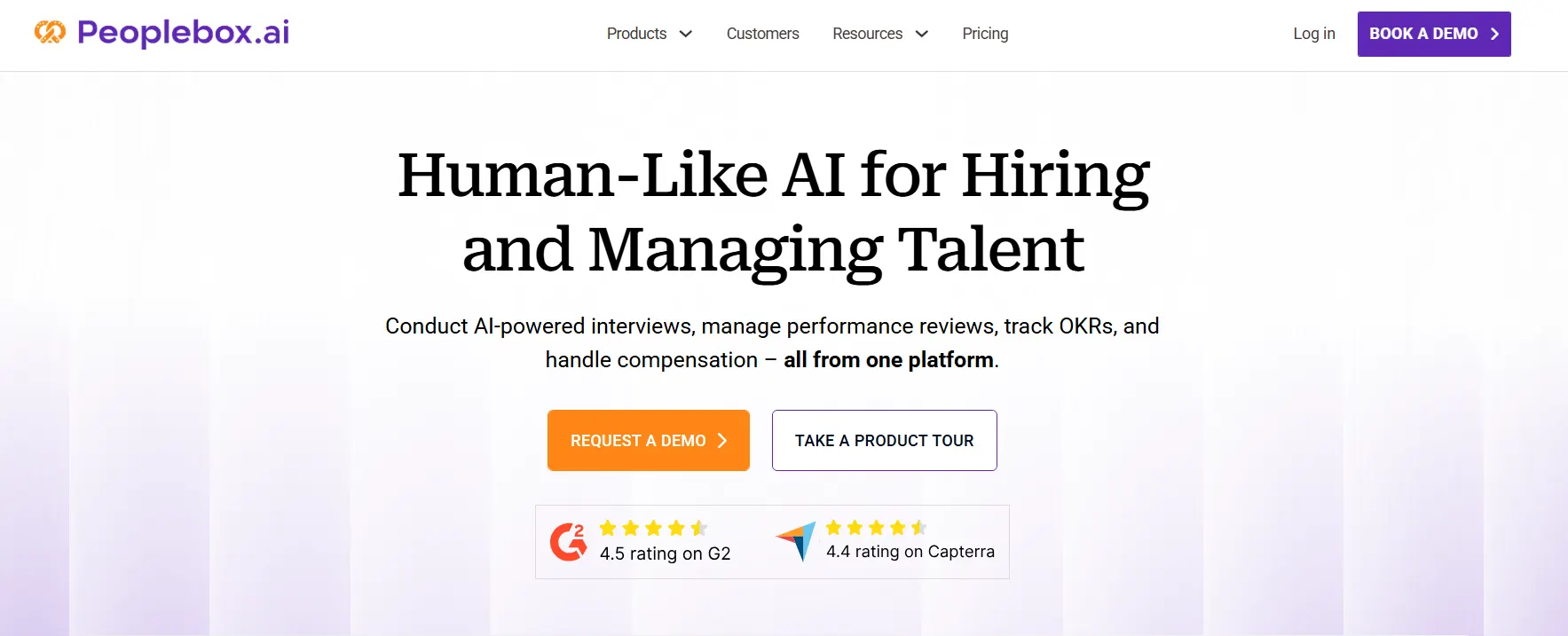
Best for: startups that want OKRs connected to structured business reviews
Peoplebox positions itself around a specific workflow: OKRs that feed directly into recurring weekly or monthly business reviews, run inside Slack or Microsoft Teams rather than a separate app. Companies including Disney and Razorpay are listed among its customers, which gives some indication of how it scales past the early startup stage.
Key features:
- OKR tracking combined with 360-degree performance reviews and pulse surveys
- 50-plus native integrations, including Slack, Jira, Google Calendar, and Salesforce
- AI-assisted goal creation and cascading/aligned goal structures
- Business review workflows that run without leaving Slack or Teams
Pricing: The OKR platform starts at around $8 per user/month, with a full suite (including performance reviews and engagement features) priced from roughly $12 to $15 per user/month.
Where it fits: Scaleups and mid-market teams that specifically want leadership-ready reporting and a recurring review cadence built around OKRs. Some reviewers note that editing goals isn’t always intuitive without HR support, and full pricing transparency requires a demo for larger plans.
7. Loach.app
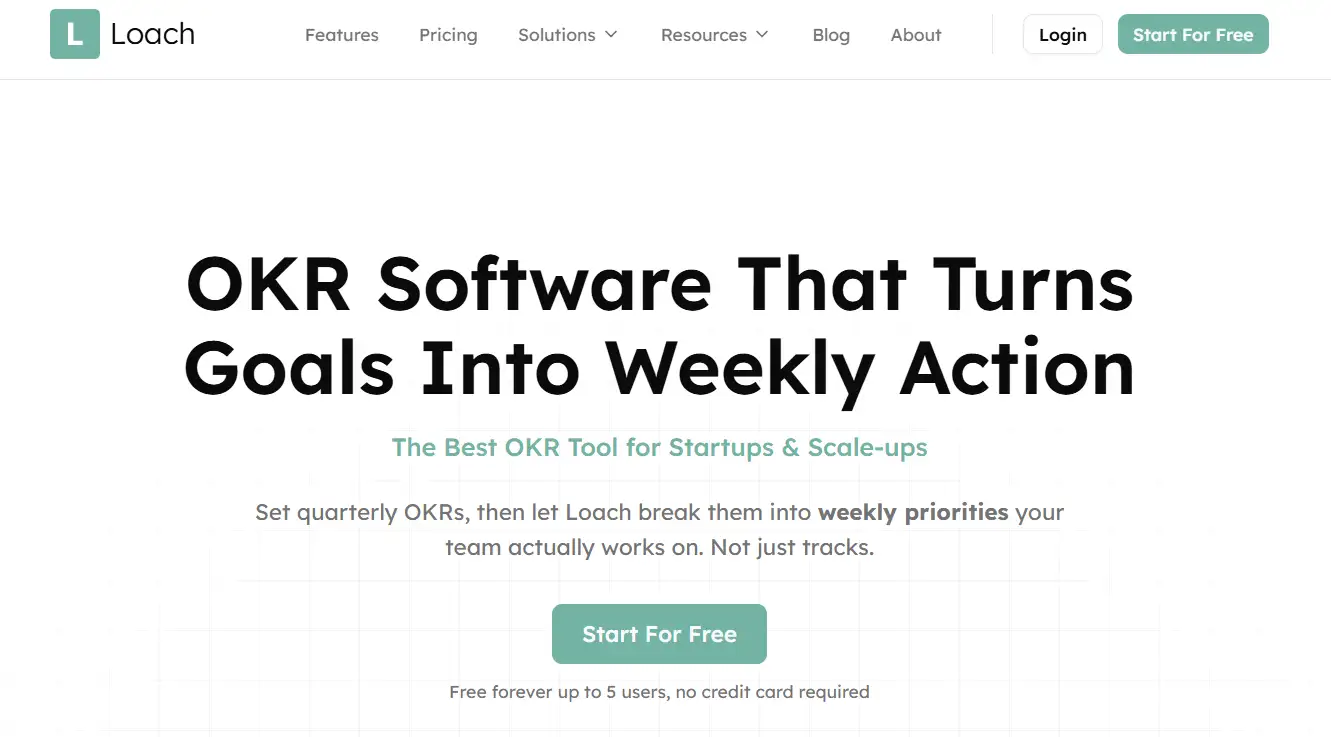
Best for: early-stage startups that need OKRs turned into weekly action, not just tracked
Loach is the one tool on this list built exclusively for startups and scale-ups, and it shows. Its whole premise is that most OKR tools are good at tracking progress but bad at telling a team what to actually work on this week. Loach tries to close that gap by walking teams through breaking quarterly OKRs into concrete weekly priorities from day one.
Key features:
- An OKR wizard that helps first-time teams set objectives and key results without a steep learning curve
- Weekly check-ins built around sharing wins and blockers, not just percentage updates
- A Kanban-style planning board for turning OKRs into weekly tasks
- Real-time progress insights designed to take a few minutes to review, not a full status meeting
Pricing: Free for up to 5 users. Paid plans scale from there for larger teams.
Where it fits: Very early-stage startups (roughly 5 to 20 people) that have never run OKRs before and want a tool that guides them through the process rather than assuming they already know how. It’s intentionally lightweight, so fast-scaling teams may eventually need a more feature-rich platform once they’re managing OKRs across multiple departments.
Read also over blog : Top 7 SaaS PR Agencies for B2B SaaS Companies in 2026
Quick Comparison
| Tool | Starting Price | Key Integration | Best For |
| Lattice | ~$11/user/mo | Slack, Microsoft Teams | OKRs bundled with performance management |
| Profit.co | ~$7/user/mo | Broad third-party integrations | OKRs + tasks + performance in one platform |
| Oboard | Free (≤10 users, Jira) / ~$6/user/mo (web) | Jira, Confluence, Salesforce | Jira- and Confluence-first teams |
| Tability | ~$6/user/mo | Slack, AI goal drafting | Fast-moving teams running their first OKR cycle |
| Mooncamp | ~$8.30/user/mo | Microsoft Teams, Power BI | Clean, dedicated OKR platform, strong Microsoft Teams fit |
| Peoplebox | ~$8/user/mo | Slack, Microsoft Teams | OKRs tied to structured business reviews |
| Loach | Free (≤5 users) | Kanban planning board | Very early-stage startups new to OKRs |
How to Choose the Right OKR SaaS Tool for Your Startup
A few questions I’d actually ask before picking one:
Do you need OKRs alone, or OKRs plus performance management? If you’re not running formal performance reviews yet, a dedicated tool like Tability, Loach, or Mooncamp will feel lighter than Lattice or Peoplebox, which bundle in a lot more.
Where does your team already work? If your engineers live in Jira all day, Oboard removes an entire adoption problem by meeting them there. If your team is Slack-first, Peoplebox’s Slack-native check-ins matter more than a standalone dashboard.
Can your team realistically keep up the habit? The tools that actually work long-term are the ones with automated weekly check-ins and clear ownership per Key Result, not the ones with the longest feature list. A tool nobody updates by week three isn’t better than the spreadsheet it replaced.
What’s your actual budget per seat? Most of the startup-friendly options on this list land between $6 and $11 per user/month, which is a very different budget conversation than the custom enterprise pricing you’ll hit with larger suites.
If you’re still building out your broader startup software stack, it’s worth reading through how to choose the right CRM for your business alongside this, since your CRM and your OKR tool will end up telling two different but connected stories about the same quarter. And if you’re earlier in the journey and still validating your product itself, our guide on finding good niche SaaS ideas covers how to test an idea before you build around it.
Frequently Asked Questions
Do startups actually need dedicated OKR software, or is a spreadsheet enough?
A spreadsheet works fine for the first cycle or two, especially under ten people. Once check-ins start slipping or leadership can’t get a clear read on progress without asking around, that’s the signal to move to dedicated OKR software.
What happened to Microsoft Viva Goals?
Microsoft officially retired Viva Goals on December 31, 2025, after freezing new feature development in December 2024. Existing customers were advised to migrate to a third-party OKR platform, which is part of why tools like Mooncamp have picked up a lot of former Viva Goals users.
Is free OKR software good enough for a real startup?
For very small teams, yes. Oboard’s Jira plugin is free for up to 10 users, and Loach is free for up to 5. Once you scale past that, you’ll likely need a paid tier for deeper reporting and check-in automation.
How is OKR software different from project management software?
OKR software tracks whether the work is moving your strategy forward. Project management software tracks whether the work itself is getting done. Most growing teams eventually need both, since a team can complete every task on a board and still miss the actual objective behind it.
What’s the difference between an OKR and a KPI?
A KPI measures the ongoing health of the business, things like churn or monthly revenue that you track continuously. An OKR measures a specific change you’re trying to make happen this quarter. Some platforms on this list, like Profit.co and Mooncamp, deliberately let you track both side by side so you can see leading indicators next to the outcomes they’re supposed to drive.
How much does OKR software typically cost for a startup?
Most of the startup-oriented tools in this guide fall between $6 and $11 per user/month, with a few offering free tiers for very small teams (Oboard for up to 10 users on Jira, Loach for up to 5 users). Tools that bundle in full performance management, like Lattice or Peoplebox’s full suite, tend to sit at the higher end of that range or beyond.
How long does it take to roll out OKR software?
For a startup, it should take days, not weeks. Tools built specifically for fast rollout, like Tability and Loach, are designed to get a team from signup to a live first check-in cycle within a few days. If a platform’s onboarding is dragging past a couple of weeks, that’s usually a sign it’s more tool than an early-stage team actually needs yet.
Does OKR software work well for fully remote teams?
Yes, and it’s arguably where it matters most. Without a shared office, remote teams lose the casual hallway conversations that used to keep everyone aligned. OKR software replaces that with a visible, always-on dashboard, so a distributed team can see how their work ladders up to company goals without needing another status meeting to explain it.
Can OKR software integrate with Slack or Microsoft Teams?
Most of the tools on this list do. Peoplebox and Mooncamp both run check-ins and business reviews natively inside Slack or Microsoft Teams, and Lattice, Tability, and Profit.co all offer Slack or Teams integrations for updates and notifications, so teams aren’t forced into yet another tab.
Should a team of under 10 people bother with OKR software at all?
It’s worth trying the framework on a free plan before committing to anything paid. Loach’s free tier (up to 5 users) and Oboard’s free Jira plugin (up to 10 users) both let a very small team test whether OKRs actually fit how they work, without any upfront cost.
What’s the biggest mistake startups make when adopting OKR software?
Treating the software as the solution instead of the habit. The tool only works if someone owns each Key Result and the team actually shows up for weekly check-ins. A platform with automated reminders and clear ownership assignment (most of the tools above handle this) removes the excuse, but it can’t force the discipline on its own.
Conclusion
Choosing the right OKR software is not about finding the platform with the most features. It is about selecting a tool that your team will actually use every week. For most startups, ease of adoption, simple workflows, and consistent check-ins deliver far more value than a long list of advanced capabilities.
If you are just getting started, lightweight tools like Tability and Loach make it easy to build strong OKR habits. Teams that already work in Jira may benefit most from Oboard, while companies looking to combine goal tracking with performance management should explore Lattice, Peoplebox, or Profit.co. If you want a dedicated OKR platform with a clean interface and flexible goal management, Mooncamp is another excellent option.
Before making a decision, take advantage of free plans or trial periods whenever they are available. The right platform should fit naturally into your team’s existing workflow, encourage regular progress updates, and give everyone a clear understanding of how their work contributes to company goals. With the right tool in place, OKRs become a practical system for improving alignment, accountability, and sustainable growth.