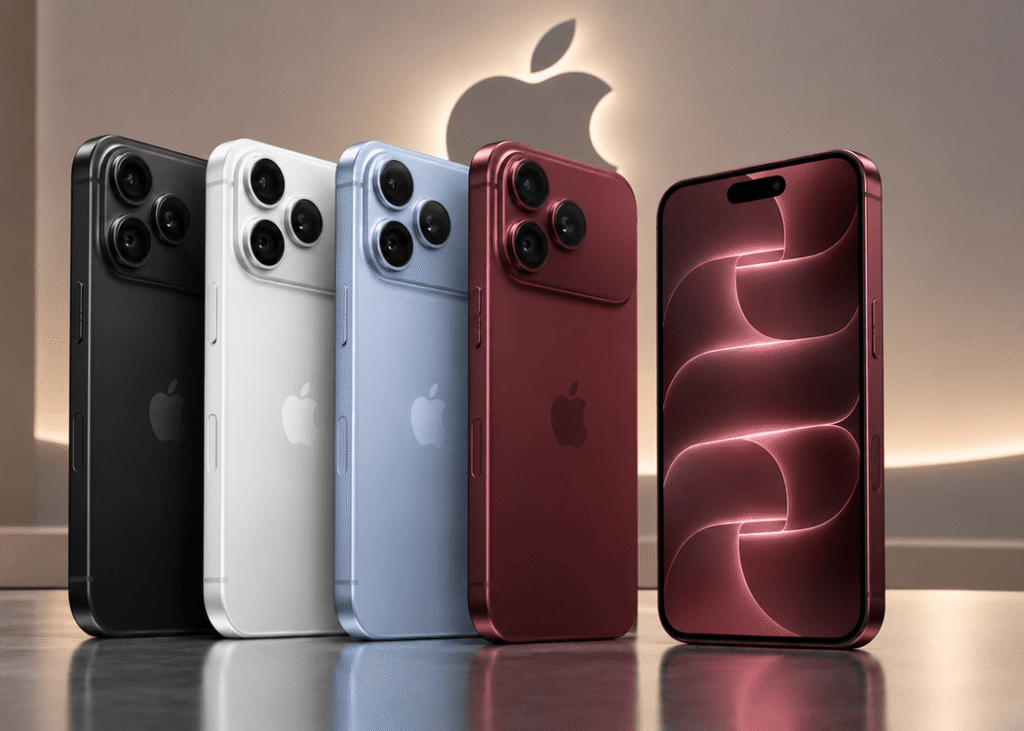
Apple has officially unveiled its latest lineup of products at its September 2026 event, with the iPhone 18 Pro and iPhone 18 Pro Max taking center stage. The new Pro models bring upgrades across the camera, design, performance, battery life, connectivity, and artificial intelligence. Apple has also introduced a new variable-aperture camera, the A20 Pro chip, improved thermal management, and new AI features through iOS 27 and Siri AI.
The event was not only about the new Pro iPhones. Apple also introduced iPhone Duo, its first foldable iPhone, along with Apple Watch Series 12, Apple Watch Ultra 4, and AirPods 5. These products bring new features in areas such as multitasking, health tracking, fitness, audio, translation, and AI. Together, the announcements show how Apple is expanding its product ecosystem while introducing new ways for users to interact with its devices.
Table of Contents
ToggleApple September 2026 Event: What Did the Company Launch?
Apple’s latest event brought several products together rather than focusing exclusively on the iPhone. The iPhone 18 Pro and iPhone 18 Pro Max represent Apple’s traditional high-end smartphone lineup, while iPhone Duo introduces a completely new form factor.
The company also refreshed its smartwatch lineup with Apple Watch Series 12 and Apple Watch Ultra 4. Both watches receive Apple’s new Health Sensing System, higher-frequency heart-rate and heart-rate variability measurements, and a new readiness experience. AirPods 5 also received a significant upgrade, bringing Active Noise Cancellation to Apple’s open-ear design alongside improved sound, Siri AI integration, and Live Translation.
This makes the event important from a broader perspective. Apple is simultaneously expanding its smartphone lineup, entering foldables, improving health technology, and making artificial intelligence more deeply connected across its products.
The iPhone 18 Pro and Pro Max, however, remain at the center of the launch.
iPhone 18 Pro and iPhone 18 Pro Max
The new iPhone 18 Pro and iPhone 18 Pro Max are designed for users who want Apple’s most powerful conventional iPhone experience. Instead of making a single major change, Apple has upgraded almost every major component of the devices.
The new Pro models come in black, silver, glacier, and the new burgundy finish. Apple is also offering storage configurations ranging from 256GB to 2TB, giving buyers more flexibility depending on how they use their phones.
The iPhone 18 Pro starts at $1,199 in the United States, while the iPhone 18 Pro Max starts at $1,299. Pre-orders begin September 12, with availability beginning September 18 in more than 65 countries and regions. Apple says another 20 countries and regions will receive the devices from September 25.
For global buyers, availability and pricing will vary by market, taxes, storage configuration, and local regulations. The U.S. prices are therefore useful as a global reference point rather than a universal retail price.
Key iPhone 18 Pro Highlights
- 48MP Fusion Main camera with variable aperture
- New Pro camera controls
- A20 Pro chip built using 2nm technology
- Redesigned vapor chamber for improved sustained performance
- Up to 36 hours of video playback on iPhone 18 Pro
- Up to 45 hours of video playback on iPhone 18 Pro Max
- Redesigned Dynamic Island
- New Siri AI and Apple Intelligence features
- Wi-Fi 7, Bluetooth 6, and Thread support
- New C2 cellular modem system
- Up to 2TB storage
- New Burgundy finish
iPhone 18 Pro Design
Apple has retained the premium appearance of the Pro iPhone while concentrating many of the biggest changes internally. The new colors give the lineup a slightly different identity, particularly the new burgundy option.
The more important changes are found beneath the exterior. Apple has redesigned the internal architecture to accommodate a more powerful processor, a larger and more capable thermal system, and updated battery technology.
The company has also redesigned the Dynamic Island. Rather than simply increasing its size or adding another visual element, Apple has made it smaller while creating room for more information. The updated Dynamic Island can display up to three Live Activities at the same time while continuing to support Face ID for unlocking, authentication, purchases, and app sign-ins.
That means users can potentially keep track of multiple real-time activities without constantly switching between applications.
The iPhone 18 Pro Camera Is One of the Biggest Upgrades
Photography is one of the areas where Apple has made its most noticeable technical change.
The iPhone 18 Pro and iPhone 18 Pro Max introduce a new 48MP Fusion Main camera with variable aperture. Apple describes it as the most advanced camera system it has built for an iPhone, and the variable-aperture system is particularly important because it introduces physical aperture control to the iPhone.
The camera uses six laser-cut blades that can smoothly transition between different aperture settings. The iPhone can automatically adjust the aperture depending on lighting and the desired depth of field, while users can manually select aperture settings when they want more creative control.
The main camera can open to ƒ/1.48, which can help in low-light situations by allowing more light to reach the sensor. It can also use ƒ/1.8 for portraits and narrow to ƒ/4 when users want more depth of field, such as when photographing groups of people.
This is an important distinction from simply increasing megapixels. A higher-resolution sensor can provide more detail, but aperture control changes how the camera itself behaves when capturing an image.
New Pro Camera Controls
Apple has also introduced a new Pro controls experience in the Camera app.
Users can manually adjust settings such as aperture, shutter speed, and white balance. A histogram is also available to help users evaluate exposure. This gives photographers and creators more control over the final image without requiring a dedicated camera.
For someone who simply wants to point and shoot, the automatic system continues to handle the difficult decisions. For more experienced photographers, however, the new controls provide another layer of creative flexibility.
Apple is also improving Photographic Styles with new texture and grain controls. This allows users to create a more personalized appearance instead of relying only on traditional filters or presets.
Better Low-Light Photography
Low-light photography is another area where the variable aperture can make a practical difference.
When the environment becomes darker, the camera can widen the aperture automatically to allow more light into the system. Combined with Apple’s new computational imaging pipeline and sensor improvements, this is designed to produce sharper and more detailed photographs in challenging lighting conditions.
The new system also helps with group photographs by allowing the aperture to narrow when more depth of field is useful.
That makes the variable-aperture camera more than a feature aimed only at professional photographers. It can also improve how the camera handles everyday situations automatically.
iPhone 18 Pro Video Improvements
Apple continues to position the iPhone as a serious video-production device.
The iPhone 18 Pro can apply Cinematic effects after recording to videos captured at up to 60 frames per second. Time-lapse recording also supports 4K and Dolby Vision HDR.
Apple has also upgraded Audio Mix with new algorithms designed to produce higher-quality voices and isolate music more effectively. These changes are particularly relevant to content creators who record interviews, social media videos, travel content, and other material directly on their phones.
The combination of variable aperture, manual camera controls, computational photography, improved audio processing, and advanced video formats makes the iPhone 18 Pro a more flexible production tool.
Apple Reference Image Could Change How We Think About Photo Authenticity
One of the less obvious but potentially significant announcements is Apple Reference Image.
The feature is designed to help establish what a camera actually captured at the moment a photograph was taken. The new Main camera can sign the sensor data associated with the pixels it captures, while Private Cloud Compute develops that information into an unalterable reference image.
Users can view this reference image alongside the main photograph in the Photos app. This makes it possible to compare the original camera reference with an edited version and determine whether changes were made.
Apple is also planning support for the SynthID standard to help identify images generated or edited using AI.
As generative AI makes it easier to create realistic photographs and modify existing images, establishing image provenance is becoming increasingly important. This could be useful for photographers, journalists, publishers, businesses, and ordinary users who want to understand whether an image represents what the camera originally captured.
A20 Pro Powers the iPhone 18 Pro
The new camera system needs a powerful processor behind it, and Apple has introduced the A20 Pro chip for the iPhone 18 Pro lineup.
A20 Pro is built using a 2-nanometer process and includes a six-core CPU, seven-core GPU, and a dual 16-core Neural Engine. Apple says the chip has 50 percent more memory bandwidth than A19 Pro, while the new GPU is up to 40 percent faster than the previous generation.
The Neural Engine is particularly important because Apple’s AI ambitions require more processing to happen locally on the device.
A20 Pro has 32 Neural Engine cores in total and is designed to deliver twice the AI processing power of A19 Pro. That additional processing can be used for Apple Intelligence, computational photography, gaming, and other demanding workloads.
This means the chip upgrade is not simply about benchmark performance. It is also part of Apple’s larger transition toward AI-powered personal computing.
New Vapor Chamber Improves Sustained Performance
One challenge with powerful mobile processors is heat.
A phone may be able to deliver excellent performance for a short period, but demanding workloads such as gaming, video rendering, photography processing, and AI can keep the processor under pressure for much longer.
Apple has therefore redesigned the thermal system in the iPhone 18 Pro.
The new vapor chamber has three times more surface area than the previous generation used in the iPhone 17 Pro. Apple says the redesigned system can provide up to a 40 percent improvement in sustained performance compared with the previous generation.
This could be particularly noticeable for people who use their iPhone for long gaming sessions, professional video editing, AI applications, or other processor-intensive tasks.
Battery Life Is a Major Focus
Battery life is another area where Apple is making a substantial change.
eSIM-only versions of the iPhone 18 Pro can provide up to 36 hours of video playback, while the iPhone 18 Pro Max can provide up to 45 hours under Apple’s stated testing conditions.
The iPhone 18 Pro can reach around 50 percent charge in approximately 15 minutes using wired charging, while wireless charging can reach around 50 percent in approximately 30 minutes.
The Pro Max receives an even larger battery-focused upgrade. Apple says five minutes of wired charging can provide around seven hours of video playback, while the company estimates up to 30 hours of usage on a full charge under its newer usage model.
For people who rely heavily on their phones throughout the day, these improvements could be more meaningful than a small increase in processing speed.
iOS 27 and the New Siri AI
The hardware is only one part of Apple’s 2026 iPhone story.
The iPhone 18 Pro models arrive with iOS 27, Apple Intelligence, and the new Siri AI.
Siri AI is designed as a much more capable version of Apple’s traditional voice assistant. Rather than simply responding to isolated commands, it can use personal context and information across supported apps to understand what the user needs.
For example, Siri AI can work with information from messages, emails, photos, and other content. It can also understand what is displayed on the screen and take actions based on that information.
Apple is also introducing a Siri mode inside the Camera app. This allows Siri to understand what the camera is looking at and provide information or take action based on what the user sees.
That could make the camera itself a gateway to information rather than simply a tool for taking photographs.
Apple Intelligence Expands Further
Apple Intelligence is also becoming more deeply integrated into everyday applications.
Apple’s new features include Spatial Reframing, Extend, and an upgraded Clean Up for photos. Image Playground can now create more photorealistic imagery, while Safari’s Notify Me feature can monitor web pages for changes such as product restocks or price drops.
Apple is also emphasizing privacy.
The company’s AI system uses a combination of on-device processing and Private Cloud Compute. The goal is to keep sensitive processing on the device when possible while using Apple’s cloud infrastructure for more demanding workloads.
Siri AI begins rolling out in beta with iOS 27. Apple says additional language support will follow, meaning availability will vary depending on language, region, and device.
iPhone Duo: Apple’s First Foldable iPhone
While the iPhone 18 Pro is the headline traditional smartphone, the iPhone Duo could be the most important new product from the entire event.
Apple has finally entered the foldable smartphone market.
iPhone Duo is the company’s first foldable iPhone and introduces a design that can transform from a compact phone into a much larger display.
When closed, it has a 5.4-inch outer display. When opened, the device reveals a 7.6-inch inner display, which Apple says is its largest iPhone display ever.
The inner display uses a special nano-texture finish designed to reduce glare and reflections. Both displays support ProMotion, Always-On functionality, and up to 3,000 nits of peak outdoor brightness.
This gives users a device that can remain relatively compact when closed but provide a much larger workspace when opened.
iPhone Duo Key Highlights
- Apple’s first foldable iPhone
- 5.4-inch outer display
- 7.6-inch inner display
- Grade 5 titanium construction
- ProMotion and Always-On displays
- Up to 3,000 nits peak outdoor brightness
- 48MP Fusion Main camera
- 48MP Fusion Ultra Wide camera
- A20 Pro chip
- Split View multitasking
- Touch ID integrated into the side button
- Up to 2TB storage
- Starts at $1,999 in the U.S.
iPhone Duo Design and Durability
Apple has built iPhone Duo from Grade 5 titanium, with a mirror-polished finish. It is available in Star White and Night Sky.
The foldable hinge is made from more than 100 components and is designed to control the opening and closing motion while supporting the center of the display.
Apple has also focused heavily on durability. The outer display uses Ceramic Shield 2, while the device has an IP68 rating for water and dust resistance. The inner display uses additional protective layers designed specifically for the folding structure.
The authentication system is different from the Pro models as well. iPhone Duo integrates Touch ID into the side button, allowing authentication whether the phone is open or closed.
iPhone Duo Changes How iOS Works
The foldable hardware would not be particularly useful if iOS simply behaved like it does on a conventional iPhone.
Apple has therefore redesigned parts of iOS 27 specifically for iPhone Duo.
When the device is open, users can take advantage of the larger screen for multitasking. Split View allows two apps to appear side by side, while users can also open two windows of the same application, such as Safari.
The larger display can also be used for conversations with Siri AI while viewing information on the other side.
Apple has redesigned the Home Screen, navigation, Dynamic Island, and other interface elements so that content can respond as the device folds, rotates, and changes between displays.
This is where iPhone Duo becomes more than a conventional iPhone with a folding screen. Apple is attempting to make the hardware and software work together as a single experience.
iPhone Duo Camera
The camera system on iPhone Duo is also designed around its folding structure.
The device features a 48MP Fusion Main camera with an optical-quality 2x Telephoto and a 48MP Fusion Ultra Wide camera. The main camera includes sensor-shift optical image stabilization and is designed to perform well in low-light environments.
The foldable design creates several camera experiences that are not possible on a traditional iPhone.
Users can use the outer display as a preview while taking a photograph with the rear camera. This makes it possible to take high-quality selfies using the main camera while still seeing the composition.
Apple also introduced features such as Smart Take, Duo Preview, Kid Cue, and Duo FaceTime. Smart Take uses on-device AI to recognize when people are ready for a photograph, while Kid Cue can use animations to attract a child’s attention toward the camera.
The device also supports 4K 120fps Dolby Vision recording on the main camera.
iPhone Duo Performance and Battery
iPhone Duo is powered by the same A20 Pro family used in the iPhone 18 Pro models.
Because a foldable phone has different thermal requirements, Apple has developed a custom vapor chamber and a dual-battery architecture for the device. The company says this combination provides strong sustained performance while maintaining all-day battery life.
The device supports wired and wireless fast charging, and the dual-battery design uses the internal space available on both sides of the foldable structure.
iPhone Duo starts at $1,999 in the United States and is available with 256GB, 512GB, 1TB, and 2TB storage options. Pre-orders begin October 16, with availability beginning October 23.
Apple Watch Series 12
Apple’s smartwatch lineup also received a major update.
The Apple Watch Series 12 introduces a new Health Sensing System designed to provide more frequent heart-rate and heart-rate variability measurements. The system supports a new Readiness experience that provides users with information about their body’s capacity to take on the day.
The new S11 chip powers the watch and also enables new Audio Intelligence features that Apple says can help users remember important moments from conversations and stay alert to important sounds.
Apple is also redesigning the Health app on iPhone, with a new Longevity section and Health Age feature designed to provide additional context around health measurements.
This continues Apple’s shift toward making the Apple Watch more than an activity tracker. The company increasingly sees the watch as a health, fitness, safety, and personal-information device.
Apple Watch Series 12 Highlights
- New Health Sensing System
- More frequent heart-rate measurements
- Improved heart-rate variability tracking
- New Readiness experience
- Health Age feature
- S11 chip
- Up to 24 hours of everyday battery life
- Faster charging
- New case materials and finishes
Apple Watch Ultra 4
For athletes and outdoor users, Apple introduced the Apple Watch Ultra 4.
The Ultra 4 uses the same new Health Sensing System and S11 chip while adding features designed for demanding outdoor use.
Apple says it can track outdoor workouts for up to 45 hours and provides its most accurate on-device GPS in a sports watch. It also includes the new readiness experience and higher-frequency heart-rate and HRV measurements.
The Ultra 4 starts at $799 in the United States and is positioned as Apple’s high-end sports and adventure smartwatch.
Apple Watch Ultra 4 Highlights
- New Health Sensing System
- S11 chip
- Improved GPS accuracy
- Readiness insights
- Higher-frequency heart-rate and HRV measurements
- Up to 45 hours of extended outdoor workout tracking
- Titanium construction
- Starts at $799 in the U.S.
AirPods 5
Apple also introduced AirPods 5, bringing Active Noise Cancellation to its open-ear AirPods design.
Apple says the new AirPods use a new multiport acoustic architecture and next-generation Adaptive EQ to improve sound quality. The new ANC system can remove up to 50 percent more external noise compared with AirPods 4 with Active Noise Cancellation, according to Apple’s testing.
The AirPods also integrate with Siri AI, allowing users to interact with the assistant without reaching for their iPhone. Users can even respond to Siri using head gestures.
Another important feature is Live Translation, which uses Apple Intelligence and compatible devices to help users communicate across supported languages.
AirPods 5 starts at $129 in the U.S., while the version with a Wireless Charging Case costs $149. Availability begins September 18.
The Bigger Apple Intelligence Story
When all of these announcements are considered together, Apple’s strategy becomes clearer.
AI is no longer being presented as a feature that belongs only to the iPhone.
Siri AI works on iPhone. Apple Intelligence features extend into photography and Safari. Apple Watch gains Siri AI and Audio Intelligence. AirPods gain hands-free access to Siri and Live Translation. iPhone Duo uses on-device AI for some of its new camera experiences.
Apple is therefore building an ecosystem where intelligence can move between devices.
The company’s emphasis on personal context is also important. Instead of treating AI as a separate chatbot, Apple is attempting to make it understand the information users already have and the actions they are already performing.
That could eventually change how people interact with Apple products.
iOS 27 Brings the New Hardware Together
iOS 27 is the software foundation behind much of Apple’s new hardware.
For iPhone 18 Pro users, it introduces Apple Intelligence improvements, Siri AI, new photography tools, Notify Me in Safari, additional personalization options, and iPhone Handoff.
iPhone Handoff allows users with supported carriers to switch between two iPhone models while keeping the same phone number.
For iPhone Duo, iOS 27 has been adapted to support the foldable display, multitasking, new navigation behavior, and different screen configurations.
For Apple Watch users, watchOS 27 brings Siri AI to the wrist and supports the new health and intelligence features introduced with the latest watches.
Apple says iOS 27 will be available as a free software update on September 14.
Global Availability
Apple is launching the iPhone 18 Pro and iPhone 18 Pro Max across a broad international market.
Pre-orders begin September 12, with availability from September 18 in more than 65 countries and regions. The initial launch includes markets such as the United States, United Kingdom, Canada, Australia, Brazil, China, France, Germany, India, Japan, Mexico, Singapore, South Korea, Türkiye, the UAE, and Vietnam.
iPhone Duo follows a slightly different schedule because of its new form factor. Pre-orders begin October 16, with availability beginning October 23.
Pricing will vary around the world because of local taxes, duties, currency conversion, and regional configurations, so readers should check Apple’s local store for the final price in their country.
What Is Actually New in the iPhone 18 Generation?
The biggest change in the iPhone 18 Pro is not one individual specification.
The combination of the variable-aperture camera, A20 Pro processor, new thermal architecture, improved battery system, redesigned Dynamic Island, faster connectivity, and Siri AI creates a much broader upgrade.
The camera is particularly significant because Apple is giving users more physical control over photography while still relying heavily on computational imaging.
The A20 Pro is equally important because it provides the processing foundation for both conventional applications and Apple’s growing AI capabilities.
The iPhone 18 Pro Max is especially focused on battery life, making it the better choice for users who prioritize a larger screen and longer endurance.
Then there is iPhone Duo, which represents an entirely different direction.
iPhone 18 Pro, iPhone 18 Pro Max or iPhone Duo?
The three phones are aimed at different types of users.
The iPhone 18 Pro is the most balanced choice for people who want Apple’s latest professional camera system, powerful performance, and new AI features in a traditional smartphone design.
The iPhone 18 Pro Max is aimed at users who want the largest conventional Pro iPhone and the strongest battery life Apple offers in this form factor.
The iPhone Duo is for people who want something fundamentally different. Its larger inner display makes it more suitable for multitasking, media consumption, gaming, productivity, and situations where a conventional smartphone screen may feel limiting.
Its $1,999 starting price also places it in a very different category from the traditional Pro models.
Conclusion
Apple’s September 2026 event brought significant upgrades across its product lineup. The iPhone 18 Pro and iPhone 18 Pro Max stand out with their new camera system, A20 Pro chip, improved battery life, better thermal performance, and expanded AI capabilities through iOS 27 and Siri AI.
The new iPhone Duo is another major highlight, marking Apple’s entry into the foldable smartphone market. With its large inner display, compact outer screen, titanium design, and foldable-focused iOS experience, it gives users a completely different way to use an iPhone.
Overall, Apple is moving beyond yearly hardware upgrades and building a more connected ecosystem around AI, photography, health, and productivity. With the iPhone 18 Pro lineup, iPhone Duo, Apple Watch Series 12, Apple Watch Ultra 4, and AirPods 5, this year’s event could become one of Apple’s more important product launches in recent years.