Table of Contents
ToggleIntroduction
Artificial intelligence is changing cybersecurity faster than most people expected. In 2026, AI-powered tools can already detect threats, monitor suspicious activity, stop phishing attacks, and automate security tasks that once required entire teams of analysts. Because of this rapid growth, many professionals and students are now asking questions like “Will AI Take Over Cybersecurity” and “Will AI Take Over Cybersecurity Jobs.” Some people believe AI could fully replace cybersecurity experts, while others think it will simply become a powerful assistant for security teams.
The reality is more practical than the fear spreading online. AI is improving cybersecurity operations, but it still depends heavily on human expertise, strategic thinking, and real-world experience. At the same time, cybercriminals are also using AI to launch smarter attacks, making skilled cybersecurity professionals even more important. Understanding how AI and human experts work together is the key to understanding the future of cybersecurity.
Why AI Is Growing So Fast in Cybersecurity
Cybersecurity teams deal with massive amounts of security data every day. Large organizations receive thousands of alerts, login attempts, suspicious files, phishing emails, and malware warnings continuously. Human analysts alone cannot process all this information fast enough anymore.
This is one of the biggest reasons businesses started investing heavily in AI-powered cybersecurity solutions.
Modern AI systems can:
- Detect unusual behavior in real time
- Identify malware patterns quickly
- Analyze network traffic continuously
- Automate repetitive security tasks
- Prioritize serious threats
- Reduce false alerts
- Predict possible attack patterns
AI helps organizations improve speed and efficiency. Instead of manually reviewing every alert, cybersecurity professionals can focus on high-priority threats and complex investigations.
Another major reason for AI adoption is the cybersecurity talent shortage. Many companies struggle to hire experienced cybersecurity professionals in 2026. AI tools help security teams manage workloads more efficiently without overwhelming employees.
That is why industries like finance, healthcare, cloud computing, eCommerce, and government agencies continue adopting AI-driven cybersecurity systems rapidly.
Will AI Take Over Cybersecurity Jobs?
This is currently one of the biggest concerns in the cybersecurity industry.
Many students, beginners, and even experienced professionals worry that AI automation could replace cybersecurity careers in the future. Searches related to “Will AI Take Over Cybersecurity jobs” continue increasing because people see AI tools performing tasks that humans previously handled manually.
But the truth is far more balanced.
AI is replacing repetitive tasks, not the entire cybersecurity workforce.
Today, AI can:
- Filter security alerts
- Scan logs automatically
- Detect suspicious login activity
- Analyze malware signatures
- Generate threat summaries
These tasks used to consume a huge amount of analyst time.
However, cybersecurity involves much more than automation.
Human cybersecurity experts still handle:
- Incident response
- Security strategy
- Threat hunting
- Ethical decisions
- Risk assessment
- Compliance management
- Leadership communication
- Advanced investigations
AI can support these responsibilities, but it cannot fully replace human judgment, creativity, and experience.
Most organizations now prefer cybersecurity professionals who understand how to work alongside AI tools effectively. Instead of eliminating jobs completely, AI is changing skill requirements across the industry.
Which Cybersecurity Jobs Will Change the Most?
Some cybersecurity roles will experience more AI-driven changes than others.
Entry-Level SOC Analyst Roles
Security Operations Center analysts often spend hours monitoring dashboards and reviewing alerts. AI now automates much of this repetitive work.
This means basic monitoring tasks may become less manual over time. However, analysts who learn advanced investigation skills, cloud security, and threat hunting will remain highly valuable.
Malware Analysis
AI tools can identify known malware patterns and suspicious files extremely fast. Basic malware classification is becoming more automated.
Still, advanced malware research and reverse engineering require experienced human experts.
Compliance Monitoring
AI helps organizations automate compliance checks, reporting, and policy monitoring. This reduces manual administrative work for some security teams.
Threat Intelligence
AI can collect and organize threat intelligence faster than humans. But cybersecurity experts still need to verify information accuracy and understand attacker motivations.
Why Human Cybersecurity Experts Still Matter
AI looks powerful during demonstrations, but real-world cybersecurity is much more complicated.
Cyberattacks constantly evolve. Attackers adapt quickly and behave unpredictably. Human experts understand business context, emotional manipulation, and real-world risks better than AI systems.
For example:
- AI may detect suspicious behavior but misunderstand the actual risk level
- AI systems can generate false positives
- AI can make incorrect assumptions
- Attackers can manipulate AI models
- AI cannot fully understand company priorities during a crisis
Cybersecurity also requires strong communication and leadership skills.
During ransomware attacks or data breaches, organizations need professionals who can:
- Coordinate teams
- Make quick decisions
- Explain risks clearly
- Handle legal concerns
- Protect customer trust
AI cannot replace human leadership during high-pressure security incidents.
This is one of the biggest reasons cybersecurity professionals will continue playing a major role in the future.
Cybercriminals Are Also Using AI
One important thing many people forget is that hackers now use AI too.
Cybercriminals are becoming more advanced because AI helps them automate attacks, create convincing scams, and scale operations faster.
AI-Generated Phishing Emails
Modern phishing emails look much more realistic than before. AI helps attackers create messages with:
- Better grammar
- Personalized content
- Convincing business language
- Professional formatting
This makes phishing attacks harder to detect.
Deepfake Scams
Attackers now use AI-generated audio and video to impersonate executives, employees, and customer support teams.
Some businesses have already lost money because employees trusted fake AI-generated voices.
Automated Vulnerability Discovery
AI tools help attackers scan systems faster and identify weak points automatically.
AI-Powered Social Engineering
Hackers use AI chatbots and language models to manipulate victims more effectively.
Because cybercriminals are also improving with AI, organizations need experienced cybersecurity professionals more than ever.
AI Is Becoming a Cybersecurity Assistant
The best way to understand AI in cybersecurity is to think of it as a highly advanced assistant.
AI handles:
- Speed
- Automation
- Pattern recognition
- Data analysis
- Continuous monitoring
Humans handle:
- Judgment
- Investigation
- Creativity
- Strategy
- Ethical decisions
- Complex problem-solving
This combination works far better than humans or AI working alone.
Most cybersecurity teams already use AI-powered security tools daily. But experienced professionals still supervise these systems and make final decisions.
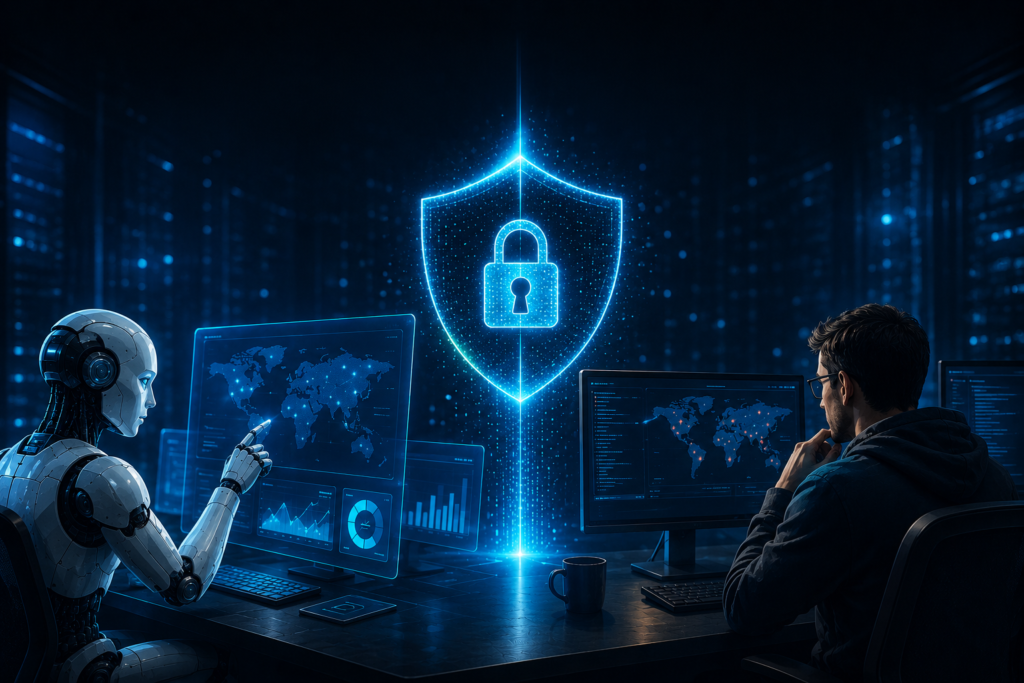
The future of cybersecurity is not humans versus AI.
It is humans working with AI.
Real Ways Companies Use AI in Cybersecurity Today
Many people think AI cybersecurity is still experimental, but businesses already use it widely.
Threat Detection
AI systems monitor networks continuously and detect suspicious activity quickly.
Traditional security systems relied heavily on fixed rules. AI systems can identify unusual patterns even when attacks do not match known signatures.
Endpoint Protection
AI-powered endpoint security tools monitor devices such as:
- Laptops
- Servers
- Smartphones
- Workstations
If malware behaves suspiciously, AI tools can isolate affected systems automatically.
Cloud Security
Cloud infrastructure creates massive amounts of security data. AI helps organizations monitor cloud environments for:
- Unauthorized access
- Misconfigurations
- Identity threats
- Data exposure
Fraud Detection
Banks and financial institutions use AI to identify suspicious transactions and account activity instantly.
Security Automation
Organizations now automate repetitive tasks including:
- Log analysis
- Alert prioritization
- Threat correlation
- Vulnerability scanning
This allows cybersecurity teams to focus on higher-level responsibilities.
The Biggest Risks of AI in Cybersecurity
AI improves cybersecurity, but it also creates serious risks.
AI Hallucinations
Generative AI sometimes produces incorrect answers confidently.
In cybersecurity, inaccurate recommendations can create dangerous situations.
Over-Reliance on Automation
Some companies trust AI too much without proper human oversight.
Blind automation can lead to missed threats or incorrect responses.
Data Privacy Risks
AI systems often process sensitive company data.
Organizations must ensure AI tools protect customer information properly.
AI Model Manipulation
Attackers can manipulate AI systems using:
- Adversarial attacks
- Poisoned training data
- Prompt injection techniques
This is becoming a growing cybersecurity concern in 2026.
Bias and Inaccuracy
AI models depend heavily on training data. Poor-quality data can produce weak security decisions.
That is why human validation remains extremely important.
What Skills Cybersecurity Professionals Need in 2026
Cybersecurity careers are not disappearing, but skill requirements are evolving quickly.
Professionals who adapt to AI-driven cybersecurity environments will have stronger career opportunities.
Important skills include:
- AI security knowledge
- Cloud security
- Threat hunting
- Incident response
- Security automation
- Risk management
- Communication skills
- Ethical hacking
- Penetration testing
- Programming basics
The most successful cybersecurity professionals in 2026 will combine technical expertise with AI awareness.
How Students and Beginners Should Prepare
If you want to build a cybersecurity career, AI should not scare you.
Instead, you should learn how to use it properly.
Focus on learning:
- Networking fundamentals
- Linux systems
- Cloud security
- Threat analysis
- AI security concepts
- Security tools
- Incident response
- Programming basics
Many beginners make the mistake of depending completely on AI tools without understanding cybersecurity fundamentals first.
Strong foundational knowledge still matters.
AI works best when skilled professionals know how to guide and verify its output.
Will AI Fully Replace Cybersecurity Experts in the Future?
Right now, full replacement looks very unlikely.
Cybersecurity constantly changes because attackers constantly adapt. Human creativity, strategic thinking, and decision-making remain extremely difficult to automate completely.
AI will continue improving rapidly, but cybersecurity is not only about detecting threats.
It also involves:
- Human behavior
- Business operations
- Ethics
- Crisis management
- Leadership
- Trust
- Communication
These areas still require human expertise.
The future of cybersecurity is not humans versus AI. It is humans working with AI.
Organizations still need experts who can:
- Investigate advanced threats
- Make strategic decisions
- Validate AI outputs
- Manage incidents
- Understand business risks
- Secure AI systems themselves
The cybersecurity industry is moving toward collaboration between humans and intelligent systems, not complete replacement.
The cybersecurity professionals who continue learning AI-related skills will likely become even more valuable in the coming years.
My Thoughts on Will AI Take Over Cybersecurity Jobs
Personally, I do not think AI will completely take over cybersecurity jobs anytime soon. No way near that level in 2026 or even in the next few years. Cybersecurity is not only about tools and automation. It also needs human thinking, fast decisions, real-world experience, and understanding how attackers actually behave.
Yes, AI is changing the industry very fast. It can automate repetitive work, analyze threats faster, and make security operations cheaper for companies. Because of this, some basic or repetitive cybersecurity roles may change in the future, just like what happened in parts of the IT industry.
Some companies may reduce small manual tasks, and a few entry-level jobs could get affected over time.
But that does not mean cybersecurity jobs are disappearing.
Today, many people already use AI LLMs like OpenAI ChatGPT, Anthropic Claude, and other AI tools for normal daily work such as:
- Writing emails
- Creating reports
- Fixing grammar mistakes
- Generating code
- Researching information
- Summarizing documents
Even these AI tools themselves mention that AI can make mistakes and users should always verify the output before using it. Most AI platforms show warnings that responses may contain inaccurate or misleading information.
So if people still need to double-check AI answers for simple everyday tasks, then cybersecurity becomes a completely different level.
In cybersecurity, even one wrong AI decision can create serious problems like:
- Data breaches
- Financial loss
- System downtime
- Privacy issues
- Ransomware attacks
That is why companies still need skilled cybersecurity professionals who can investigate threats, validate AI outputs, make critical decisions, and respond during emergencies.
So there is no reason to worry about AI replacing cybersecurity professionals in the near future. Instead of fearing AI, people should focus on learning how to work with AI tools effectively. Professionals who understand both cybersecurity and AI will probably become even more valuable in the coming years.
The future is not AI replacing humans.
The future is humans using AI to work smarter, faster, and more efficiently.
Frequently Asked Questions (FAQs)
Will AI take over cybersecurity completely in the future?
No, AI is unlikely to fully replace cybersecurity professionals. AI can automate repetitive tasks and improve threat detection, but human experts are still needed for decision-making, incident response, strategy, and handling complex cyberattacks.
Will AI take over cybersecurity jobs in 2026?
AI will not completely take over cybersecurity jobs in 2026. However, it may reduce some repetitive entry-level tasks like alert monitoring and log analysis. Cybersecurity professionals who learn AI-related skills will continue to stay valuable.
Is cybersecurity still a good career after AI?
Yes, cybersecurity remains one of the best career options even with AI growth. As cyber threats continue increasing, businesses still need skilled professionals to secure systems, investigate attacks, and manage security risks.
Which cybersecurity jobs are most affected by AI?
Roles involving repetitive monitoring and manual analysis may experience the biggest changes. This includes some SOC analyst tasks, compliance monitoring, and basic malware analysis. Advanced cybersecurity roles still require human expertise.
Can AI stop cyberattacks automatically?
AI can detect and respond to some cyber threats automatically, but it cannot stop every attack without human involvement. Cybercriminals constantly create new attack methods that still require human investigation and strategic response.
Are hackers using AI in cyberattacks?
Yes, cybercriminals now use AI for phishing emails, deepfake scams, automated vulnerability scanning, and social engineering attacks. This is one reason why skilled cybersecurity professionals remain important.
What skills should cybersecurity professionals learn in 2026?
Cybersecurity professionals should focus on cloud security, AI security, threat hunting, incident response, networking, Linux, ethical hacking, and security automation to stay competitive in the industry.
Should beginners worry about AI replacing cybersecurity careers?
No, beginners should not panic about AI replacing cybersecurity careers. Instead, they should focus on learning cybersecurity fundamentals and understanding how AI tools work in modern security environments.
How is AI helping cybersecurity teams?
AI helps cybersecurity teams by automating repetitive tasks, detecting threats faster, analyzing large amounts of data, reducing false alerts, and improving overall security efficiency.
What is the future of AI in cybersecurity?
The future of AI in cybersecurity is collaboration between humans and AI systems. AI will continue assisting with automation and threat detection, while human experts will handle strategy, leadership, investigations, and complex decision-making.
Conclusion
So, will AI take over cybersecurity in 2026? The answer is no. AI is not replacing cybersecurity professionals completely, but it is changing how the industry works. Security teams now use AI to automate repetitive tasks, detect threats faster, and improve response times. At the same time, cybercriminals are also using AI to launch more advanced attacks, which increases the need for experienced cybersecurity experts.
The future of cybersecurity will depend on collaboration between humans and AI, not competition between them. Professionals who learn AI-related cybersecurity skills, understand modern threats, and adapt to new technologies will continue staying valuable in the industry. Instead of fearing AI, cybersecurity experts should focus on learning how to work alongside AI, because that is where the industry is heading in 2026 and beyond.