I remember the first time one of my clients called me in a panic. They had been ranking #1 on Google for almost two years. Traffic was steady. The phone was ringing. Then, almost overnight, something changed. Their organic clicks dropped by nearly 30%, but their Google Search Console still showed them sitting at position one.
What happened? AI Overviews.
Google had started showing an AI-generated answer right at the top of the search results page, before any organic links. Users were getting their answers directly from the AI summary and not clicking through to any website, including my client’s. My client was still “ranking,” but they were invisible where it actually mattered.
That experience pushed me to look for a tool that tracked AI search visibility specifically. After testing several options over the past few months, I kept coming back to one: ZipTie AI. In this article, I want to walk you through exactly why I chose ZipTie AI for search analytics and performance tracking, what it actually does, and who it genuinely helps.
Table of Contents
ToggleWhat Is ZipTie AI, Exactly?
ZipTie AI is a cloud-based AI search monitoring and analytics platform. It was built by Tomasz Rudzki, Bartosz Goralewicz, and Sebastian Skowron, the same team behind Onely, which is a well-respected technical SEO agency. That background matters because it means the tool was built by people who understand what SEO professionals actually need, not just what looks good on a product page.
The core problem ZipTie solves is simple to understand: traditional SEO tools like Ahrefs, SEMrush, and even Google Search Console track keyword rankings, backlinks, and organic traffic. They do that very well. But they cannot tell you whether your brand appears inside an AI-generated answer on Google, ChatGPT, or Perplexity. That is a completely different kind of visibility, and it is becoming more important every month.
ZipTie tracks exactly that. It monitors three major AI search platforms:
- Google AI Overviews, which are the AI-generated summary boxes appearing above the organic results on Google
- ChatGPT, including its browse and web search features
- Perplexity, the AI-native search engine gaining significant traction among professional and research-oriented users
The central question ZipTie answers for you is: when someone asks an AI about your product category, your service area, or a problem your brand solves, does the AI mention you, cite you, or recommend you, or does it send that user straight to your competitor?
Read also over blog :- Claude vs ChatGPT: Honest Review After Daily Use
Why AI Search Analytics Matters More Than Ever in 2026
Let me give you some real context before we talk about ZipTie’s features. A study by Seer Interactive found that AI Overviews triggered on roughly 16.5% of all Google queries overall, and for non-branded searches that number climbed even higher, reaching between 12% and nearly 17% depending on the category. The same research noted that as AI Overviews become more common, organic results get pushed further down the page and out of the user’s initial view.
Here is what made that research hit home for me personally: ranking number one in organic results only guarantees an AI citation about 22% of the time. You can do everything right in traditional SEO and still be completely invisible in the AI answer that the user actually reads.
This is not a future problem. AI-powered search already sent over a billion referral visits in a single month in 2025. Businesses that are not tracking their AI search visibility right now are flying blind in a growing portion of their market.
This is the gap that led me to start taking why choose ZipTie AI search analytics seriously as a question. And after using it firsthand with multiple clients, here is what I found.
Key Features That Make ZipTie AI Stand Out
1. The AI Success Score: Your Single Most Important Metric
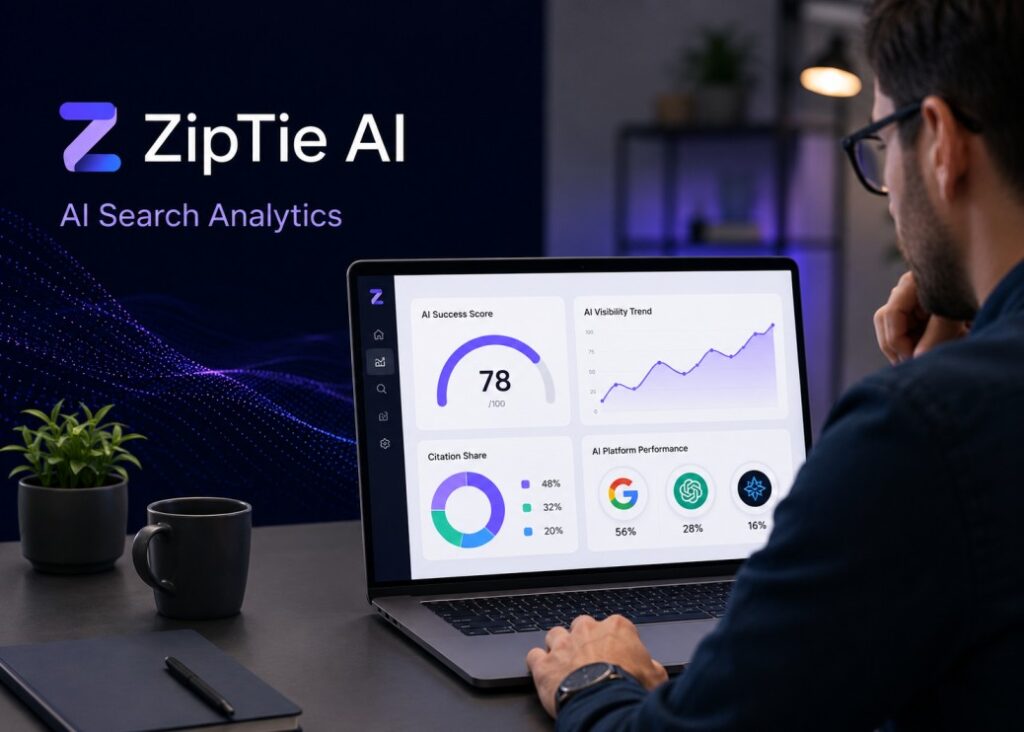
One of the first things I noticed about ZipTie is that it does not just dump raw data on you. It gives you an AI Success Score for every query you track. This score blends four signals together: how often your brand is mentioned, whether your domain gets cited as a source, where your brand appears within the answer (near the top or buried at the end), and the sentiment of the mention.
That final point is more important than it may seem. An AI can technically mention your brand while framing it negatively or as a cautionary example. Without sentiment tracking, you would see the mention and think everything is fine. ZipTie catches that nuance.
The AI Success Score also helps you prioritize. Instead of trying to improve your visibility across hundreds of queries at once, you can see which ones have the most upside potential and start there. That kind of focused prioritization saves serious time in real agency workflows.
2. Real Browser Capture, Not API Approximations
This is a technical point that makes a meaningful practical difference. ZipTie uses actual browser technology to query AI search platforms and capture what users see, including the full answer text and a downloadable screenshot of the result. Some competing tools simulate AI responses using older language model API calls instead of checking what real users actually encounter.
Why does that matter? Because the AI Overview a real user sees on Google may look quite different from what an API call returns. ZipTie’s approach gives you accuracy. When you show a client that their brand did or did not appear in an AI Overview, you can back it up with a screenshot of exactly what users saw.
3. Citation Share Tracking: The Metric Traditional Tools Cannot Touch
Citation Share measures the percentage of relevant AI answers in which your domain appears as a cited source. This single metric tells you more about your AI search authority than almost any other number.
Based on what ZipTie’s research framework identifies, a Citation Share above 35% in your niche signals dominant visibility, while anything below 15% means you face a real risk of being displaced by competitors in AI-generated answers. I started tracking this for one of my e-commerce clients and found their Citation Share sitting at 8%. That single data point immediately justified a content overhaul project that would have been hard to sell otherwise.
4. Competitive AI Benchmarking
ZipTie shows you which competitors AI platforms favor for your target queries, how their AI Success Score compares to yours, and exactly which pages get cited when they appear. This is competitive intelligence that simply does not exist anywhere else.
Well-known SEO professionals including Lily Ray and Aleyda Solis have publicly cited ZipTie for this specific capability. Lily Ray describes it as her go-to tool for monitoring client inclusion in AI Overviews, praising its accuracy, especially in health-related queries where citation integrity matters most. Aleyda Solis recommends it specifically for identifying which organic keywords generate AI Overviews, a signal that directly shapes content strategy.
5. Content Optimization Recommendations That Are Actually Specific
Most tools give you generic advice like “add more detail” or “improve your content quality.” ZipTie analyzes the actual pages winning AI citations for your tracked queries, then compares them against your content. It identifies missing entities, thin explanatory sections, and weak evidence areas, then produces a page-specific brief for your writers.
Pages that contain unique data points not found in competitor content show a 68% higher probability of being cited as a primary source in AI answers. ZipTie helps you find those gaps and fill them with real, original substance.
6. Query Discovery Assistant
Setting up tracking manually for every possible query variation would take forever. ZipTie’s Query Discovery Assistant takes your seed keywords and expands them into dozens of conversational variations that reflect how real users phrase questions to AI assistants. A seed keyword like “cloud migration services” might generate 50 natural language variations covering everything from beginner-level questions to highly specific technical queries.
You can also import keywords directly from Google Search Console, which makes the initial setup significantly faster for existing clients.
7. Google Search Console Integration and Indexing Health Monitor
ZipTie connects to Google Search Console to pull your existing performance data as a baseline. It also added an Indexing Health Monitor in Q3 2025 that alerts you to crawl errors, sitemap issues, and technical problems that might suppress both traditional and AI search visibility. The connection between indexing health and AI citation performance is real: if Google cannot properly crawl and understand your content, AI models also struggle to reference it accurately.
How the ZipTie AI Search Performance Tool Works in Practice
I want to give you a concrete example of how this plays out in a real project because the workflow makes the value much clearer than a feature list does.
Imagine an IT services company offering cloud migration and managed infrastructure. Here is how ZipTie fits into their SEO workflow:
- You set up tracked queries like “best cloud migration company for mid-size businesses,” “DevOps automation services for SaaS,” and “managed IT services for cloud infrastructure.”
- ZipTie runs the first report and shows that for all three queries, two competitors appear consistently in Google AI Overviews while your domain appears zero times.
- The Content Optimization brief identifies that winning pages all contain original benchmark data, specific technology stack references such as AWS, Terraform, and Kubernetes, and structured service breakdowns that AI can parse and summarize cleanly.
- You rewrite the relevant service pages with those specific elements added.
- ZipTie continues monitoring the same queries over the following four to six weeks and shows you whether your Citation Share and AI Success Score actually improved.
That feedback loop from diagnosis to measurable outcome is something traditional SEO has never been able to provide for AI-generated results. Agencies like Seer Interactive have deployed ZipTie across hundreds of client queries, with some setups monitoring over 7,800 searches weekly, which demonstrates that the platform scales well for enterprise use.
ZipTie AI Pricing: What You Are Actually Paying For
ZipTie offers three paid plans. Each AI search check covers three platforms simultaneously: Google AI Overviews, ChatGPT, and Perplexity.
| Plan | Price | AI Search Checks / Month | AI Data Summaries | Content Optimizations | AI Platforms Covered | Best For |
| Basic | $69/month | 500 | 5 | 10 | Google AI Overviews, ChatGPT, Perplexity | Small websites, bloggers, and startups |
| Standard | $99/month | 1,000 | 50 | 100 | Google AI Overviews, ChatGPT, Perplexity | Growing businesses and SEO teams |
| Pro | $159/month | 2,000 | 100 | 200 | Google AI Overviews, ChatGPT, Perplexity | Agencies, larger websites, and multi-brand SEO work |
ZipTie also offers a 14-day free trial with full feature access and 10,000 trial credits, so you can test the platform on real queries before committing to a paid plan. Credits renew monthly and unused trial credits expire after the trial period ends.
One honest note on pricing: the credit-based billing can be tricky to estimate in advance, especially if your query volume fluctuates. For smaller agencies or solo consultants, it helps to map out your approximate monthly query monitoring needs before choosing a plan.
Who Should Really Use ZipTie AI Search Analytics
ZipTie is not the right fit for everyone, and I think being honest about that is more useful than overselling it.
It works best for:
- SEO professionals and content strategists who want to understand why certain pages get cited in AI answers and what specific changes will improve AI inclusion, not just traditional rankings.
- Digital marketing agencies managing multiple client brands that need competitive AI visibility benchmarking across different industries and regions.
- SaaS and IT services companies whose buyers increasingly use ChatGPT or Perplexity to research vendors before ever visiting a website. If your brand does not appear in those AI responses, you are losing opportunities your Google Analytics will never even show you.
- Marketing managers who need to build the business case for AI-optimized content and want metrics like AI Success Score and Citation Share to report AI search performance to leadership.
If you are still building foundational SEO, fixing crawl errors, and earning your first backlinks, I would focus on traditional tools first. ZipTie delivers real value when you have the team and process to act on what it shows you.
Being Honest: Where ZipTie Has Limitations
No tool is perfect, and ZipTie is no exception. Here are the real limitations worth knowing:
- It does not track downstream conversions. ZipTie measures citation rates and AI Success Scores, not whether those citations actually drove traffic, leads, or revenue. You need to correlate ZipTie data with Google Analytics to understand business impact.
- Platform coverage is currently limited to three AI engines. If you need to monitor Grok, Gemini, DeepSeek, or Mistral responses, ZipTie does not cover those yet, though expanded platform tracking is on their 2026 roadmap.
- Sentiment analysis is still maturing. The current algorithm handles clearly positive and clearly neutral mentions well, but nuanced criticism in AI responses is still being improved. An AI response that mentions a limitation of your product while still citing you as a source counts as a citation without fully penalizing the criticism in the score.
Processing speed during peak hours can slow down. High demand and Google’s evolving anti-scraping measures mean some users experience delays in report generation, particularly during busy period
ZipTie is useful for understanding how your brand appears in AI-generated answers, but it should not be treated as a complete SEO, analytics, or revenue tracking platform. It works best when used alongside Google Search Console, Google Analytics, and traditional SEO tools.
These are real trade-offs, not deal-breakers. But they are worth knowing before you set your expectations.
ZipTie AI vs Traditional SEO Tools: They Solve Different Problems
The single most important concept to understand about ZipTie is that it does not replace Ahrefs, SEMrush, or Google Search Console. It adds a layer those tools were never designed to handle.
| Comparison Point | Traditional SEO Tools | ZipTie AI |
| Main Purpose | Track website performance in traditional search | Track brand visibility in AI-generated search answers |
| Search Area Covered | Google organic search results and standard SERPs | Google AI Overviews, ChatGPT, and Perplexity |
| What They Measure | Rankings, clicks, impressions, CTR, backlinks, and SEO issues | AI search checks, brand appearance, AI data summaries, and content optimization opportunities |
| Example Tools | Google Search Console, Ahrefs, SEMrush | ZipTie AI |
| Main Focus | Traditional SEO performance | AI search visibility |
| Useful For | Improving organic rankings, traffic, backlinks, and technical SEO | Understanding whether your brand appears in AI answers |
| Problem They Solve | “How is my website performing in Google Search?” | “Is my brand visible when AI tools answer search-like questions?” |
| Biggest Limitation | They do not fully show how your brand appears inside AI-generated answers | It does not replace keyword tracking, backlink analysis, or Search Console data |
| Best Use Case | SEO tracking, keyword monitoring, backlink research, and site performance analysis | AI visibility tracking, prompt testing, and AI-focused content optimization |
| Ideal Strategy | Use for regular SEO performance | Use with SEO tools to cover AI search visibility |
| Final Role | Core tool for traditional SEO | Extra layer for AI search performance |
Running one without the other in 2026 means you have a blind spot in either your traditional search performance or your AI search performance. For serious SEO and content teams, both categories of tools together give you a complete picture of where you actually stand in modern search.
Read also over blog :- Top 10 Free Rank Tracker Tools for Improving SEO Performance
Final Words : Is ZipTie AI Worth It?
After using ZipTie across multiple client accounts and tracking real improvements in AI citation performance, my honest answer is yes, for the right team and situation, it is absolutely worth it.
The reason why choose ZipTie AI search analytics comes down to this: it gives you visibility into a part of search that no other tool currently covers well. As AI Overviews trigger on a growing share of Google queries and users increasingly turn to AI assistants for product research, vendor comparisons, and information discovery, the brands that understand and optimize their AI search presence will have a real advantage over those that do not.
If your content and marketing team can act on AI visibility insights, ZipTie delivers a clear competitive edge. The 14-day free trial is long enough to run real queries against your actual brand and see what the data looks like before committing any budget.
The bottom line: why choose ZipTie AI search performance tool is not really about the features list. It is about the fact that search has changed, and ZipTie is one of the few tools built specifically to help you succeed in the version of search that your users are actually using today.
Frequently Asked Questions
What is ZipTie AI and what does it actually do?
ZipTie AI is a cloud-based monitoring and analytics platform built specifically for AI-generated search results. It tracks how and when your brand appears in Google AI Overviews, ChatGPT, and Perplexity, providing data that traditional SEO tools do not capture.
Does ZipTie replace tools like SEMrush or Ahrefs?
No. ZipTie is a complementary tool. Traditional SEO tools track keyword rankings and organic performance in standard search results. ZipTie tracks brand visibility inside AI-generated answers, which is a different kind of visibility that traditional tools are not built to measure.
Why Choose ZipTie AI Search Analytics tool?
Choose ZipTie AI because it helps you understand how your brand appears in AI-driven search results. It tracks brand mentions, citations, competitor visibility, and content gaps across platforms like ChatGPT, Perplexity, and Google AI Overviews. This gives businesses better search analytics insights and helps improve their content strategy for stronger online visibility.
How much does ZipTie AI cost?
ZipTie AI pricing starts at $69 per month for the Basic plan. It also offers a Standard plan at $99 per month and a Pro plan at $159 per month. Each plan includes AI search tracking across platforms like Google AI Overviews, ChatGPT, and Perplexity, with different limits for AI search checks, data summaries, and content optimizations. ZipTie also offers a 14-day free trial.
Why choose ZipTie AI search performance tool?
Choose ZipTie AI because it helps you track how your brand appears in AI-driven search results, not just traditional Google rankings. It gives insights into brand mentions, citations, competitor visibility, and content gaps across AI search platforms. This helps businesses improve search performance, strengthen online visibility, and prepare their SEO strategy for the future of AI search.
What is the AI Success Score in ZipTie?
The AI Success Score is ZipTie’s composite metric that combines mention frequency, citation presence, answer placement, and sentiment for each tracked query. It helps you prioritize which queries to optimize first and gives you a clear way to report AI search performance progress over time.
Who built ZipTie AI?
ZipTie AI was built by Tomasz Rudzki, Bartosz Goralewicz, and Sebastian Skowron, the team behind Onely, a respected technical SEO agency. That background gives the tool strong credibility and practical reliability in professional SEO workflows.