Your SaaS pricing model can determine whether your business grows steadily or struggles to convert and retain customers. Even the best software can lose potential revenue if its pricing doesn’t match how customers perceive its value. That’s why choosing the right pricing structure is just as important as building the right product.
According to McKinsey’s 2026 B2B Pricing Survey, 65% to 85% of organizations expect to adopt generative AI or agentic AI in their pricing processes within the next one to three years, signaling a major shift in how businesses design pricing strategies and capture customer value. As pricing evolves beyond traditional subscription models, selecting the right pricing structure can directly influence customer acquisition, retention, and long-term revenue growth.
Table of Contents
ToggleWhat Is a SaaS Pricing Model, and Why It Matters More Than Your Feature List
A SaaS pricing model is the structure you use to charge customers for access to your software, whether that is a flat monthly fee, a price per user, a price per unit of usage, or some blend of all three. It is different from your SaaS pricing strategy, which is the broader thinking behind why you charge what you charge and how that price maps to the value a customer gets.
Here is the part most founders miss: pricing is not a finance decision, it is a product decision. Your pricing model shapes who buys your product, how they use it, and whether they expand their spend over time or quietly churn. A tool priced entirely by seat count will attract a different buyer than one priced by usage, even if the underlying software does the exact same job. Get the model wrong, and no amount of feature development or content marketing will fix the leak in your funnel.
If you’re new to SaaS and want to understand the fundamentals before diving into pricing, our complete guide to SaaS explains how the Software as a Service delivery model works, its key benefits, and real-world examples.
The 8 Main Types of SaaS Pricing Models
These are the core types of SaaS pricing models in active use across the market today. Most companies do not pick just one. They combine two or three into a hybrid structure, which I will cover at the end of this section.
1. Flat-Rate Pricing
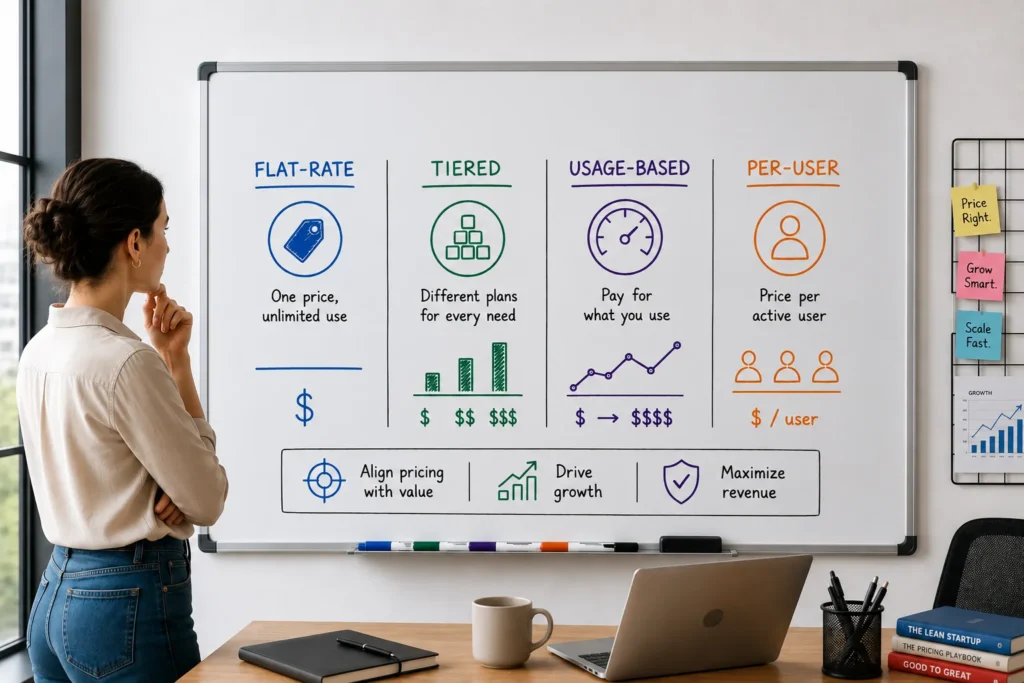
Flat-rate pricing charges a single fixed fee for the entire product, regardless of how many people use it or how much they use it. Basecamp is the classic example here: one price, unlimited users, unlimited projects.
This model works well when your product has one clear use case and a predictable, low-variance cost to serve. The upside is simplicity. Customers know exactly what they will pay, and your sales team has almost nothing to negotiate. The downside is that flat-rate pricing caps your revenue per account. A team of 3 and a team of 300 pay the same amount, which leaves real money on the table with larger customers.
Pros
- Simple and easy for customers to understand
- Predictable recurring revenue
- Straightforward billing and sales process
Cons
- Limits revenue from larger customers
- One price may not fit all customer segments
- Less flexibility as businesses grow
2. Tiered Pricing
Tiered pricing is probably the most familiar structure in SaaS pricing plans today. You offer two to four packages (commonly labeled something like Starter, Growth, and Enterprise), each bundling a different set of features, usage limits, or support levels at a different price point.
The strength of tiered pricing is that it lets you serve very different buyer segments from a single product, without building separate products for each. A solo freelancer and a 200-person marketing team can both find a plan that fits. The risk is decision fatigue. If your tiers are not clearly differentiated, or if you have too many of them, buyers freeze at the pricing page instead of picking one.
Pros
- Appeals to different customer segments
- Encourages customers to upgrade
- Balances affordability with scalability
Cons
- Too many tiers can confuse buyers
- Poorly designed plans reduce conversions
- Requires regular pricing optimization
3. Usage-Based Pricing (Pay-As-You-Go)
Usage-based pricing, sometimes called pay-as-you-go pricing or usage-based billing, charges customers based on how much of the product they actually consume, whether that is API calls, data processed, emails sent, or compute time. Twilio and Snowflake both built their businesses on this model.
This is the fastest-growing pricing category in SaaS right now. A 2026 SaaS pricing trends report from Stripo Research found that 42% of software products now offer a usage-based option, and separate industry data cited by BetterCloud shows 80% of buyers say usage-based pricing aligns better with the actual value they get from a product. The tradeoff is real, though: usage-based bills are less predictable for the buyer, and unexpected spikes in consumption can trigger what the industry now calls “bill shock,” a term that shows up constantly in 2026 SaaS cost management reports.
Pros
- Customers pay only for what they use
- Revenue grows with customer usage
- Ideal for AI, API, and cloud products
Cons
- Monthly bills can be unpredictable
- Usage spikes may cause bill shock
- Requires accurate usage tracking
4. Per-User (Per-Seat) Pricing
Per-user pricing, also called per-seat pricing, charges a fixed amount for every individual who gets access to the software. Slack and most CRM platforms built their early growth on this model, and it remains the dominant approach in the market. Zylo’s 2026 SaaS Pricing Trends report found that per-seat billing is still expected to remain the primary way enterprises pay for software through 2026, even as usage-based adoption grows in parallel.
Per-seat pricing is easy for buyers to understand and easy for finance teams to budget against. Its biggest weakness has become obvious over the past two years: it punishes products where value does not scale with headcount. A tool that gets more valuable with more usage but not more users, especially AI-powered tools, does not fit neatly into a per-seat structure, which is a big reason the market is shifting.
Pros
- Easy to calculate and budget
- Revenue increases as teams grow
- Familiar pricing model for B2B buyers
Cons
- Can discourage adding more users
- Doesn’t always reflect actual product value
- Less suitable for AI or automation tools
5. Freemium Pricing
Freemium pricing gives away a limited version of the product for free, with the goal of converting a percentage of those free users into paying customers over time. Dropbox, Slack, and Canva all used freemium as a core growth engine.
The economics here depend entirely on volume and conversion rate. A 2026 benchmark study from ChartMogul, based on 200 B2B software products surveyed by Kyle Poyar in partnership with ProductLed, found that freemium-to-paid conversion is bimodal rather than evenly distributed: about a quarter of products convert below 2.5% of free users within six months, another quarter convert between 10 and 15%, and the median sits around 8%, a number that almost no single company actually hits. Freemium can be a powerful growth loop, but it only works at real scale, which is why it is rarely recommended for narrow, niche B2B products with a small addressable market.
Pros
- Attracts a large number of users
- Supports product-led growth
- Low barrier to trying the product
Cons
- High infrastructure costs for free users
- Low conversion rates for many products
- Requires a large addressable market
6. Feature-Based Pricing
Feature-based pricing ties your price to which specific capabilities a customer unlocks, rather than usage volume or seat count. You often see this layered inside tiered plans, where the Starter tier gets basic reporting and the Enterprise tier gets advanced analytics, single sign-on, and API access.
This model rewards you for continuing to build genuinely differentiated features, since each new capability becomes a potential upsell. The risk is gating features that customers consider “should be included,” which creates frustration and hurts trust in your pricing page more than almost any other pricing mistake.
Pros
- Encourages upgrades to premium plans
- Rewards ongoing product innovation
- Customers pay for advanced capabilities
Cons
- Can frustrate users if essential features are locked
- Hard to decide which features belong in each plan
- Requires continuous feature differentiation
7. Value-Based Pricing
Value-based pricing sets your price according to the measurable value or outcome a customer receives, rather than your cost to deliver the product. This is the model behind the newest wave of “outcome-based” AI pricing. Zendesk, for example, prices its AI resolution agent at roughly $1.50 to $2.00 per automated conversation resolved, tying the price directly to work completed rather than seats or raw usage.
Value-based pricing is the hardest model to execute well because it requires a clear, trusted way to measure the outcome you are charging for. Get the value metric wrong, and customers will dispute every invoice. Get it right, and it is the most defensible pricing model there is, because you only earn more when the customer wins more.
Pros
- Aligns pricing with customer outcomes
- Supports premium pricing
- Creates strong long-term customer relationships
Cons
- Difficult to measure customer value accurately
- Billing disputes can occur if metrics are unclear
- More complex to implement than traditional models
8. Hybrid Pricing
A hybrid pricing model combines two or more of the structures above, typically a base subscription plus usage-based overages. This is quickly becoming the market default rather than the exception. Atlassian is a good real-world case: its plans combine a subscription base, bundled AI credits, and consumption-based overage charges once a customer exceeds those credits within a single contract.
Research from OpenView cited in recent 2026 SaaS pricing coverage found that companies running hybrid pricing models report roughly 38% higher revenue growth compared to companies using a single, unblended pricing model. The hybrid approach solves the predictability problem of pure usage pricing while still capturing extra revenue from your heaviest users, which is why it is becoming the go-to SaaS monetization structure for AI-enabled products specifically.
Pros
- Combines the strengths of multiple pricing models
- Balances predictable revenue with scalability
- Adapts well to different customer needs
Cons
- More complex pricing structure
- Harder for customers to understand initially
- Requires more sophisticated billing systems
SaaS Pricing Models at a Glance
| Pricing Model | Best For | Example Company | Main Strength | Main Risk |
| Flat-rate pricing | Single-use-case products with predictable cost to serve | Basecamp | Simple to understand and sell | Caps revenue from larger accounts |
| Tiered pricing | Products serving several buyer segments at once | Most CRM and project tools | Serves small and large customers from one product | Too many tiers cause decision fatigue |
| Usage-based pricing | Products where cost to serve scales with consumption | Twilio | Aligns price with actual value delivered | Unpredictable bills can cause “bill shock” |
| Per-user pricing | Collaboration tools where value grows with headcount | Slack | Easy for buyers to budget against | Punishes products where value isn’t tied to seats |
| Freemium pricing | High-volume products with a fast time-to-value | Dropbox, Canva | Strong top-of-funnel growth loop | Only works economically at real scale |
| Feature-based pricing | Products with clearly differentiated capability tiers | Common inside tiered SaaS plans | Rewards continued feature development | Gating expected features erodes trust |
| Value-based pricing | Outcome-driven tools, especially AI features | Zendesk AI agent | Most defensible, scales with customer’s win | Needs a clean, disputable-proof value metric |
| Hybrid pricing model | AI-enabled and enterprise products with variable usage | Atlassian, Microsoft Copilot | Balances predictability with expansion revenue | More complex to explain and bill accurately |
SaaS Pricing Examples: How Real Companies Price Their Products
Looking at real SaaS pricing examples makes these categories much less abstract:
- Basecamp uses flat-rate pricing: one price, unlimited users.
- Slack uses per-user pricing layered inside tiered plans.
- Twilio uses pure usage-based billing, charged per message or call.
- Dropbox and Canva built freemium engines that convert a small percentage of a very large free user base.
- Zendesk and Salesforce Agentforce now price AI features on a value-based, per-resolution or per-conversation basis.
- Microsoft Copilot runs a hybrid model: a flat per-user base subscription plus additional credits for usage spikes.
- Atlassian blends subscription, bundled AI entitlements, and consumption overages in one hybrid contract.
Notice that almost none of the fastest-growing companies use a single, pure model anymore. That is the clearest trend in software pricing models heading into the second half of 2026.
How to Choose a SaaS Pricing Model for Your Business
There is no single best pricing model, only the model that fits how your product delivers value. A few questions I walk through with every client before recommending a structure:
Does value scale with the number of users, or with consumption? If a tool gets more valuable the more people use it together (think collaboration software), per-user pricing usually makes sense. If value scales with volume processed (emails sent, API calls, data stored), usage-based pricing fits better.
Is your buyer price-sensitive at the top of funnel, or do they need to feel the product first? Freemium and low-friction free trials work best when your product has a fast time-to-value and a large addressable market. Complex, high-ACV enterprise software rarely benefits from freemium.
Can you measure your value metric cleanly and defend it on an invoice? Value-based and usage-based pricing only work if your billing system can track the metric accurately and your customer can audit it themselves. If you cannot explain the bill in one sentence, do not build the model around it yet.
What does your competitive set already train buyers to expect? If every competitor in your category prices per seat, moving to pure usage-based pricing is a bigger buyer education job than most early-stage teams can afford. This is where a genuinely useful SaaS pricing comparison against three or four direct competitors, not just a glance at their pricing page, pays off before you commit to a structure.
For most startups, the practical, low-risk starting point is a simple tiered model with two to three plans, then layering in usage-based add-ons once you understand your customers’ actual consumption patterns. That is the best SaaS pricing model for startups in the vast majority of cases I have worked on, not because it is the most sophisticated option, but because it is the easiest one to explain, sell, and adjust as you learn.
The Metrics That Tell You If Your Pricing Model Is Working
Picking a pricing model is only half the job. You need to track a small set of numbers to know if it is actually working for your business, not just for a handful of loud customers on your sales calls.
Monthly recurring revenue (MRR) and annual recurring revenue (ARR) are your baseline growth numbers, but on their own they hide whether growth is coming from new customers or from existing customers expanding.
Customer acquisition cost (CAC) measures what it costs, fully loaded across marketing and sales, to land one new paying customer. A 2026 industry analysis from SaaSHero puts average B2B SaaS CAC at around $1,200, ranging from $100 to $500 for self-serve products up to $5,000 or more for enterprise deals closed by a sales team.
Customer lifetime value (CLV), paired against CAC, is the single most important ratio for judging whether your pricing model is sustainable. A 2026 benchmark analysis of more than 900 B2B SaaS companies by Optifai puts the median LTV to CAC ratio at roughly 3.2 to 1, with top-quartile companies reaching 4 to 1 or higher. Anything meaningfully below 3 to 1 usually means your price, your acquisition cost, or your retention needs work before you scale spend further.
Churn rate is where pricing model choice shows up most directly. Benchmarks vary widely depending on the segment. Mid-market SaaS companies commonly run 1.5 to 3% monthly churn, while SMB-focused products often run 3 to 5% monthly, according to 2026 B2B SaaS benchmark data compiled by Churnfree from more than 900 companies. A useful gut check I give clients: do not multiply monthly churn by 12 to estimate annual churn, since churn compounds. Five percent monthly churn works out to roughly 46% annual churn, not 60%, once you calculate it correctly.
Net revenue retention (NRR) tells you whether your existing customer base is growing or shrinking in dollar terms, independent of new sales. A 2026 study from Optifai puts median B2B SaaS NRR at 106%, with enterprise segments reaching 115 to 125% thanks to expansion revenue, while SMB-focused products typically sit closer to 90 to 105%. Pricing models built around usage or seat expansion, rather than flat fees, are usually what drive NRR above 110%.
No pricing model can succeed without measuring the right performance indicators. By tracking MRR, ARR, CAC, CLV, churn, and NRR consistently, you’ll know whether your pricing strategy is driving sustainable growth or needs adjustment. For a deeper explanation of these KPIs, calculation formulas, and industry benchmarks, read our complete guide to Essential SaaS Metrics.
Common SaaS Pricing Mistakes to Avoid
A few patterns show up again and again when I audit pricing pages, and they are worth naming directly.
Copying a competitor’s pricing structure without copying their cost structure or customer base. A pricing model that works for a company with a $50,000 average contract value rarely translates cleanly to a product selling at $50 a month.
Under-pricing early and never correcting it. A 2026 SaaS pricing statistics report noted that 73% of SaaS providers raised prices by an average of 12% over a recent 12-month window, and 79% of IT leaders reported encountering a price increase at renewal in the past year. If you never revisit your price as your product matures, you are almost certainly leaving revenue on the table compared to the rest of the market.
Gating features customers consider table stakes. This is the fastest way to generate support tickets and one-star reviews, and it erodes trust in every tier above the one where the gate sits.
Building usage-based billing before your billing infrastructure can actually support it. Usage-based and value-based pricing both require accurate, auditable metering. If your invoices do not match what customers can see in their own dashboard, disputes and churn follow quickly.
Ignoring the psychology of your pricing page. Small changes, like how many tiers you show, which one you visually anchor as the recommended plan, and whether pricing is public at all, measurably change conversion. Serge Salager, an expert cited in Software Oasis’s 2026 pricing statistics roundup, put it simply: visible, transparent pricing builds the trust that drives self-service conversion, particularly as more buyers research and decide before ever talking to a salesperson.
SaaS Pricing Model FAQs
- What is the best SaaS pricing model for startups? For most early-stage SaaS companies, a simple tiered pricing model with two to three plans is the safest starting point. It is easy to explain, easy to sell, and easy to adjust once you understand real usage patterns, before you layer in usage-based add-ons.
- What is the difference between flat-rate and tiered pricing? Flat-rate pricing charges one fixed price for the entire product regardless of usage or user count. Tiered pricing offers multiple packages at different price points, each unlocking a different set of features or limits, so different customer segments can self-select the plan that fits them.
- What is the difference between tiered and usage-based pricing? Tiered pricing charges a fixed fee per plan, chosen upfront. Usage-based pricing charges based on actual consumption after the fact, such as API calls or data processed, which makes it more variable but often better aligned with the value a customer actually gets.
- How do SaaS companies price their products? Most SaaS companies price around one core structure, flat-rate, tiered, per-user, usage-based, freemium, feature-based, or value-based, and then adjust that structure as they learn how customers actually use the product. A growing share now combines two or more of these into a hybrid model rather than relying on a single approach.
- What is a good SaaS pricing strategy for B2B companies? A strong B2B SaaS pricing strategy starts by identifying the value metric that scales with the value your product delivers, whether that is seats, usage, or outcomes, then pricing against that metric rather than against your cost to build the feature.
- What is usage-based pricing in SaaS? Usage-based pricing, also called pay-as-you-go or consumption-based pricing, charges customers according to how much of the product they use rather than a flat fee. It is one of the fastest-growing SaaS pricing models heading into 2027.
- What is freemium pricing and does it work for B2B SaaS? Freemium pricing offers a limited free version of the product to attract a wide user base, then converts a percentage of those users to paid plans. It works best at scale with a large addressable market and a fast time-to-value, and is generally less effective for narrow, high-touch B2B products.
- How do I know if my SaaS pricing model is working? Track your LTV to CAC ratio, monthly churn rate, and net revenue retention together. A healthy B2B SaaS business typically runs an LTV to CAC ratio of 3 to 1 or better and net revenue retention above 100%, meaning existing customers are expanding faster than they are churning.
- What are the most common SaaS pricing mistakes? The most common mistakes are copying a competitor’s pricing without matching their cost structure, under-pricing early and never adjusting, gating features customers expect to be included, and building usage-based billing before the metering infrastructure can support it accurately.
- Is per-seat pricing going away in SaaS? No. Per-seat pricing remains the most widely used SaaS pricing model in 2026, but its share is declining as usage-based, value-based, and hybrid models grow, particularly for AI-enabled products where value does not scale cleanly with headcount.
Final Thoughts
The pricing model you choose shapes the entire trajectory of your SaaS business, from who buys your product to how much they spend as they grow with you. There is no universal right answer, only the model that matches how your product actually creates value for the people paying for it. Start simple, watch your churn and expansion numbers closely, and be willing to evolve your structure as your product and your customer base mature, the way nearly every company named in this guide has done.
If pricing changes are part of a bigger growth push, pairing them with a solid content marketing strategy and the right account management software to track expansion revenue will make the transition much smoother. And if your pricing overhaul touches how you manage customer relationships day to day, it is worth revisiting how to choose the right CRM for your business at the same time.
Pricing is never “set and forget.” Review your pricing every 6–12 months, monitor customer behavior, and adjust your model as your product evolves. Small pricing improvements often have a bigger impact on revenue than adding new features.