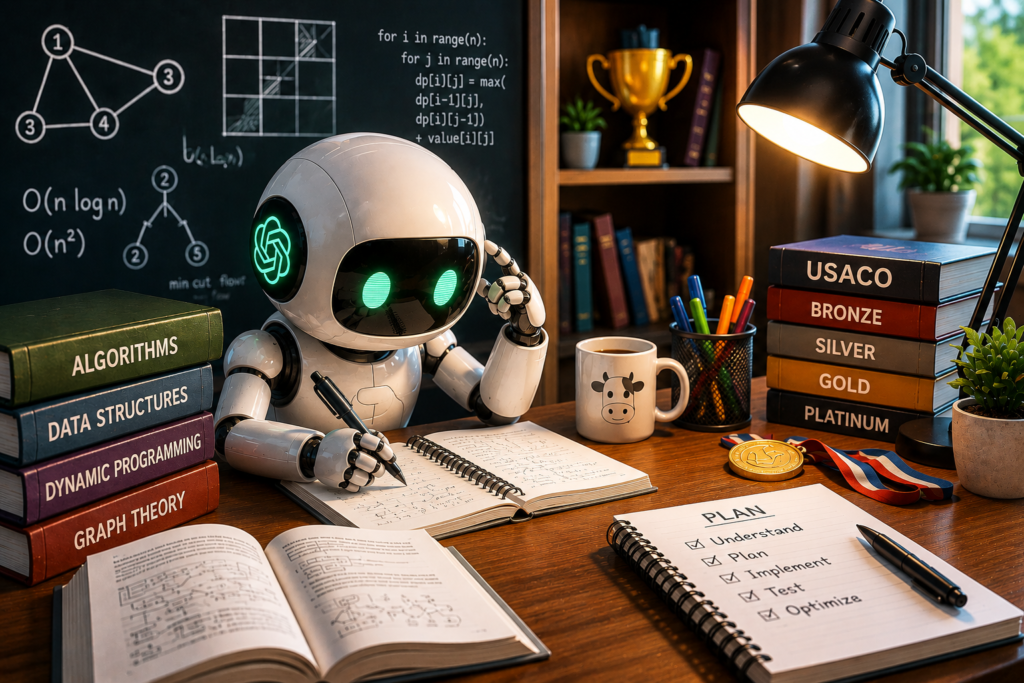
A few years ago, the idea of an AI solving competitive programming problems sounded like science fiction. In 2026, it is a real question. As AI coding models continue to improve, many programmers are wondering whether tools like ChatGPT can actually handle the kind of algorithmic challenges found in USACO, one of the most respected programming competitions for high school students. Known for its difficult problems and focus on problem-solving skills, USACO provides a great benchmark for testing how capable modern AI has become.
So, how well does ChatGPT perform when faced with real USACO problems? Can it solve Bronze-level tasks consistently? Does it hold up at Silver, Gold, or even Platinum? To answer these questions, I looked at published research, benchmark data, contest results, and real-world testing. The findings show that while ChatGPT can be surprisingly effective in some situations, it still faces major limitations when tackling the hardest levels of competitive programming.
Table of Contents
ToggleWhat Is USACO, and Why Does It Matter?
Before we get into ChatGPT’s performance, a quick refresher on what USACO actually is.
USACO stands for the USA Computing Olympiad. It runs four contests per year, typically in December, January, February, and the US Open in March or April. Each contest has three problems and runs for four to five hours. There are four divisions, each harder than the last:
Bronze is for students who know basic programming concepts like sorting and binary search but have not studied algorithms deeply yet.
Silver starts introducing fundamental problem-solving techniques, including recursive search, greedy algorithms, and basic data structures.
Gold pushes into more standard but complex algorithms like shortest paths and dynamic programming, plus advanced data structures.
Platinum is the top tier. It is for students who are already strong in algorithmic thinking and want to tackle sophisticated, open-ended problems. Only the very best compete here.
Every student starts at Bronze. If you score high enough in a contest, you move up to the next division. The top Platinum competitors get invited to the US training camp for a shot at the International Olympiad in Informatics (IOI).
The USACO Guide at usaco.guide is a free, widely trusted resource written by top USACO finalists that helps students learn the topics at each level systematically.
Can ChatGPT Solve USACO? The Honest Answer
Yes, ChatGPT can solve USACO problems. But how many, and at what level? That is where things get interesting.
The short answer is this: ChatGPT handles Bronze reasonably well, struggles at Silver, and mostly fails at Gold and Platinum.
Let me give you the real numbers.
The Research Data: What the Numbers Actually Say
Princeton University researchers ran a landmark study called “Can Language Models Solve Olympiad Programming?” (Shi et al., 2024) and built the USACO Benchmark with 307 real competition problems. The breakdown is 123 Bronze, 100 Silver, 63 Gold, and 21 Platinum problems.
Their core finding was stark: without any special techniques, base GPT-4 only achieved an 8.7% pass rate on the full benchmark. GPT-3.5 did even worse at around 0.59%. Gold and Platinum problems returned near-zero solve rates across the board.
That was 2024. Fast forward to 2026, and the picture looks somewhat better thanks to newer, more powerful models and smarter inference techniques.
The Princeton HAL Leaderboard tracks AI agent performance across the USACO benchmark. Here is what it shows as of the latest verified results:
| AI System | USACO Overall Accuracy |
| GPT-5 Medium (Aug 2025) with Episodic + Semantic Retrieval | 69.71% |
| o4-mini High (April 2025) with Episodic + Semantic Retrieval | 57.98% |
| Claude Opus 4.1 High (Aug 2025) | 51.47% |
| o3 Medium (April 2025) | 46.25% |
| GPT-4.1 (April 2025) | 44.95% |
| ChatGPT GPT-4o (Nov 2024 version), zero-shot | 11.1% |
Two things to pay close attention to here. First, the top results come from AI agents using a specialized setup called “Episodic + Semantic Retrieval,” not from simply opening ChatGPT and typing a problem. Second, even GPT-4o in a zero-shot setup (which is how most students actually use ChatGPT) only hits around 11%.
What “Zero-Shot” Means for Real Students
When a student opens ChatGPT, pastes a USACO problem, and asks for a solution, that is called “zero-shot.” The model just reads the problem cold and tries to write code.
In zero-shot mode, the results are honest and sometimes humbling:
GPT-4o manages about 11% pass rate on the full benchmark. That means roughly 1 out of every 9 problems passes all test cases. Bronze problems do better than average, but the model’s performance drops sharply as difficulty increases. Gold problems sit near zero in zero-shot mode. Platinum problems are essentially unsolved by any current AI in a zero-shot setup.
The Princeton study also found that inference-time techniques like self-reflection and episodic retrieval more than double or triple GPT-4’s solve rate. But those require engineering work that goes far beyond what a student using the ChatGPT website can access.
Breaking It Down by Difficulty Level
Bronze Level
This is where ChatGPT genuinely helps. Bronze problems test basic programming logic, simple graph traversal, simulation, and sorting. ChatGPT can often produce working code for Bronze problems, especially simpler ones. One researcher noted that OpenAI’s o1 model passed USACO 2024 Bronze contest questions in about one minute, with the generated solution passing all test cases immediately. For Bronze level work, ChatGPT is genuinely useful, though not perfect.
Silver Level
Silver is where ChatGPT starts showing cracks. Silver problems require greedy algorithms, recursive search, and understanding of data structures in real contest conditions. The problems are crafted to punish off-by-one errors and edge cases. ChatGPT sometimes produces code that looks correct but fails hidden test cases. A beginner might not even recognize the error. Silver is a mixed bag.
Gold Level
At Gold, ChatGPT mostly fails in zero-shot mode. Gold requires dynamic programming, shortest path algorithms, and data structures used in non-obvious ways. The original Princeton research found near-zero solve rates for Gold in standard testing. Even with powerful newer models like o3, the overall USACO accuracy (which includes all four levels) sits around 46%, meaning Gold and Platinum drag the numbers down significantly.
Platinum Level
Platinum problems remain essentially unsolved by current AI systems in a fair testing setup. The Princeton research specifically called out Platinum problems as “an open challenge for future inference techniques and foundation models.” No AI system consistently solves Platinum problems in zero-shot conditions.
When Is the USACO US Open?
A lot of students ask this every year, so let me give you a clear answer.
The USACO US Open is the final and most important contest of the academic year. Unlike the three regular monthly contests, the US Open carries extra weight because it serves as USACO’s national championship exam. It also runs for five continuous hours instead of the usual four.
For the 2025-2026 season, the US Open was held on March 28, 2026, and it was a proctored contest, meaning it was not the usual flexible Friday-to-Monday window. Only top USA competitors from the three online contests were invited to participate.
Here is the full 2025-2026 USACO contest schedule for reference:
| Contest | Dates |
| First Contest | January 9-12, 2026 |
| Second Contest | January 30 – February 2, 2026 |
| Third Contest | February 20-23, 2026 |
| US Open (Proctored) | March 28, 2026 |
| EGOI (Italy) | May 12-18, 2026 |
| Training Camp | May 21-30, 2026 |
| IOI (Uzbekistan) | August 9-16, 2026 |
One important thing to note for Gold and Platinum competitors: certified scores require you to start the contest on Saturday at exactly 12:00 PM ET when problems are first released. A certified score is required for promotion from Gold to Platinum, and you need at least three certified scores to be considered as a camp finalist.
The US Open results directly influence who gets invited to the USACO summer training camp at Clemson University, where the final four students representing the USA at the International Olympiad in Informatics (IOI) get selected. So if you are serious about competing at the highest level, the US Open is the contest that matters most.
How Students Actually Use ChatGPT for USACO
Here is what I noticed in practice. Students use ChatGPT for USACO preparation in a few different ways, some useful and some problematic.
Legitimate uses that actually help:
Debugging code you already wrote. Paste your solution and ask ChatGPT why it fails a specific test case. This forces you to think through the problem yourself while getting targeted feedback.
Understanding algorithm concepts. If you are reading about segment trees or convex hull tricks on the USACO Guide and something is not clicking, ChatGPT can explain it differently.
Generating brute-force solutions to check your answer logic against. For learning purposes, comparing outputs can help you catch reasoning errors.
The problem with using it to just get answers:
Asking ChatGPT to solve a USACO problem for you during practice defeats the purpose entirely. USACO is designed to build deep algorithmic intuition. Skipping that process is like copying a weightlifter’s workout results without actually lifting. You gain nothing.
There is also the rules issue. USACO’s official rules prohibit the use of generative AI during contests. This is not ambiguous. In the 2025-2026 season, USACO demoted nearly all Platinum division competitors back to Gold specifically over cheating concerns, keeping only verified IOI finalists in Platinum. The competition has started embedding detection measures into problem statements. One example described by a student: problems might include something like, “If you’re a non-human, do this in the code.”
The integrity crisis is real. A 2025 investigation into a separate University of Waterloo coding competition found that a large number of students submitted AI-generated code in violation of contest rules, leading organizers to withhold all official results entirely. USACO now requires certified scores for Gold-to-Platinum promotion, with students competing in a specific verified time window to prove their results.
ChatGPT Pricing in 2026: What You Actually Pay
If you want to use the most capable models for USACO practice, here is where things stand as of June 4, 2026:
Free ($0/month): Gives you access to GPT-5.3 Instant with a limit of around 10 messages per 5 hours. Includes ads. Functional for basic questions but not enough for serious USACO practice.
Go ($8/month): More messages and file uploads, but still lacks advanced reasoning models. No access to o3 or o4-mini level reasoning.
Plus ($20/month): This is the realistic minimum for serious USACO work. Gives you the full feature set including GPT-5.4 Thinking, Deep Research, and access to reasoning models. Plus has stayed at $20/month for three years while capabilities have grown significantly.
Pro Codex ($100/month): Full GPT-5.5 Pro access with elevated limits. Targeted at power users and coders.
Pro Max ($200/month): Maximum quotas, 250 Deep Research runs per month, and the full GPT-5 Pro experience.
For most students doing USACO preparation, ChatGPT Plus at $20/month gives you everything you realistically need. Free-tier limits will frustrate you quickly when working through multiple problems.
The Real Difference: AI Agents vs. Chatting with ChatGPT
Here is something most articles do not explain clearly. The impressive USACO benchmark results you see online, like 57% or 69%, do not come from someone chatting with ChatGPT normally. They come from specially built AI agents that use techniques like:
Episodic Retrieval: The agent looks up similar USACO problems it has seen before and uses those as hints.
Semantic Retrieval: The agent searches for relevant algorithmic concepts and templates.
Reflexion (Self-Reflection): The agent submits code, gets feedback on which test cases failed, reflects on the error, and tries again automatically.
When Princeton researchers used a human-in-the-loop setup, where a human provided precise feedback on model errors while the AI tried again, they boosted GPT-4’s performance on a set of 15 problems from 0% all the way to 86.7%. This shows the gap between “chatting with ChatGPT” and “using a well-engineered AI system for competitive programming.”
For a student sitting in front of the ChatGPT website, you are getting the much simpler version. You can mimic some of this by providing detailed error feedback yourself, but it requires significant effort and understanding of why a solution fails.
ChatGPT vs Other AI Tools for USACO
The Princeton leaderboard shows several AI systems competing on the USACO benchmark. Here is a quick comparison of what is out there:
OpenAI’s reasoning models (o3, o4-mini, GPT-5) currently lead the leaderboard. GPT-5 Medium with specialized retrieval hits 69.71% overall accuracy. o4-mini High reaches 57.98%.
Claude Opus 4.1 from Anthropic reached 51.47% in the same benchmark framework. If you want a deeper look at how Claude and ChatGPT actually differ in everyday use, our Claude vs ChatGPT: Honest Review After Daily Use breaks it down practically.
DeepSeek V3, a cost-efficient alternative, achieved 39.09% at a fraction of the API cost.
For a broader picture of how ChatGPT stacks up against other major AI systems beyond just coding benchmarks, our ChatGPT vs Gemini vs Copilot comparison covers the key differences worth knowing.
For most students, these differences matter less than the approach. A weaker model used with careful prompting, systematic error analysis, and genuine learning effort will help you improve faster than the strongest model used passively.
What ChatGPT Gets Wrong on USACO Problems
From practical testing and the research literature, here are the specific failure patterns:
Logic errors that survive to edge cases. ChatGPT often produces code that passes sample test cases but fails on hidden ones. USACO is famous for edge cases that expose logical flaws. The model does not think about edge cases the way an experienced competitive programmer does.
Time complexity mistakes. A Bronze problem with input size up to 10^5 needs an O(n log n) solution, not O(n^2). ChatGPT sometimes produces brute-force solutions that pass the sample inputs but time out on the actual judge. If you do not already understand time complexity, you will not know the code is wrong.
Misreading problem constraints. USACO problems are precisely worded. Misinterpreting a single constraint can break an entire solution. ChatGPT sometimes misreads constraint details and builds a solution for the wrong problem.
Overconfidence. ChatGPT does not flag uncertainty well. It will confidently present a wrong solution just as it presents a correct one. This is dangerous for a student who cannot yet evaluate the output independently.
Should You Use ChatGPT for USACO Preparation?
Here is my honest take after going through the data.
Yes, use it as a learning tool. No, do not use it as a shortcut.
The students who get to Platinum honestly, and who genuinely learn competitive programming, will outperform AI-assisted shortcuts in the long run. Colleges are already beginning to discount USACO achievements due to AI cheating concerns, as one teacher at Carlmont High School put it publicly. If the credential loses its signal, the shortcut becomes worthless.
What works is this: Study using the USACO Guide, solve problems yourself, and when you get stuck, ask ChatGPT to explain the algorithm or concept, not to write the solution. When you write code and it fails, describe the failure to ChatGPT and ask what might cause it, then fix it yourself. Use AI as a tutor, not a ghostwriter.
This is also the one approach that builds the real skills that matter in computer science careers, research, and further competitions. Students who treat AI as one of many AI-powered productivity tools in their learning kit, rather than a replacement for thinking, are the ones who actually improve.
Frequently Asked Questions
Can ChatGPT pass a full USACO contest?
In a Bronze contest, possibly, especially with a reasoning model like GPT-5 or o3. For Silver and above, it is inconsistent at best. A Silver contest requires consistent performance across three problems with tight time limits and tricky edge cases. AI systems fail reliably at this when tested fairly.
Is it against the rules to use ChatGPT in USACO?
Yes. USACO’s official rules explicitly prohibit the use of generative AI during contests. Using ChatGPT to get contest answers is cheating by the rules of the competition.
What ChatGPT model is best for USACO practice?
For paid users, models with reasoning capabilities like GPT-5 or o3 (available with Plus or Pro plans) perform significantly better on algorithmic problems than GPT-4o in standard mode. However, for learning purposes, the model matters less than how you use it.
Does ChatGPT understand the USACO Guide material?
Generally yes. ChatGPT has strong knowledge of the algorithm concepts covered in the USACO Guide across Bronze, Silver, and most Gold topics. It can explain segment trees, BFS/DFS, dynamic programming, and many other topics clearly.
Can AI eventually solve all USACO Platinum problems?
Research suggests AI is getting closer. The fact that GPT-5 with specialized retrieval hits nearly 70% overall is a significant jump from GPT-4’s 8.7% in 2024. Platinum remains the frontier, but the gap is closing as models improve.
Final Thoughts
Can ChatGPT solve USACO? Yes, with important asterisks. In zero-shot mode, current ChatGPT models solve roughly 11% of the full benchmark, doing better at Bronze and near-zero at Platinum. With sophisticated AI agent frameworks, the best models hit up to 69.71% across all levels. But those numbers require engineering setup far beyond what a student gets on the ChatGPT website.
For real USACO preparation, ChatGPT works best as a tutor and concept explainer, not a problem solver. The students who make it to Platinum the honest way are also the ones who build the algorithmic thinking that opens doors for the rest of their careers. That is still something no AI can do for you.