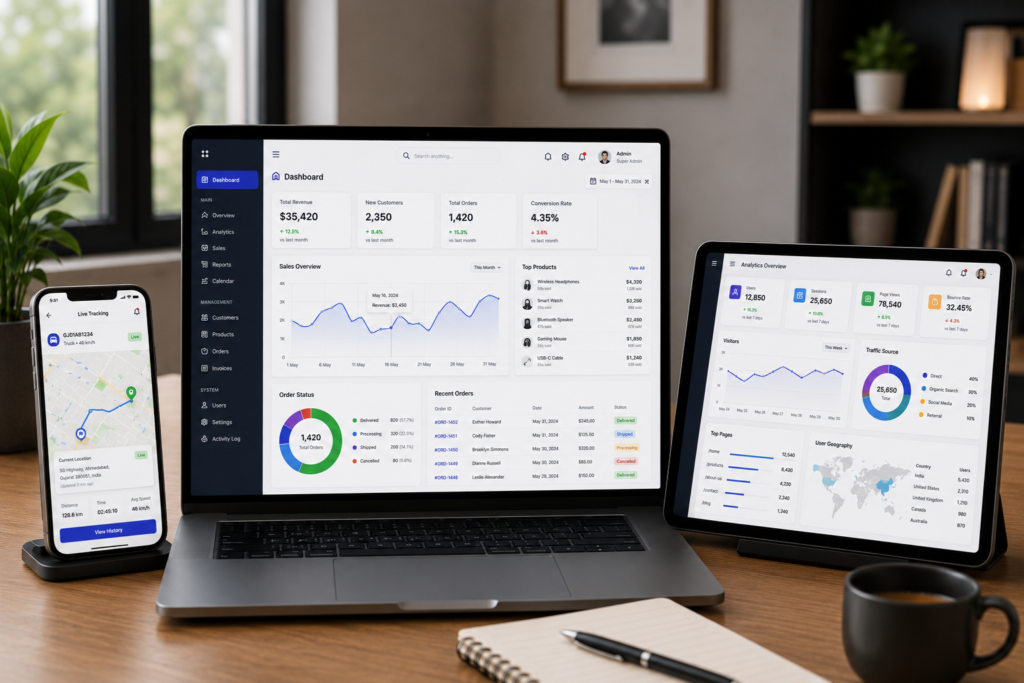
The field service management software market is growing quickly as more businesses move away from manual scheduling and paper-based workflows. According to Gartner, field service applications have continued to see strong adoption across industries, driven by the need for better scheduling, mobile workforce management, and improved customer service. Gartner has also estimated sustained double-digit growth in the field service software market over the years as organizations invest in digital service operations.
Whether you operate a small HVAC business, a nationwide telecom company, or a large manufacturing enterprise, managing technicians efficiently has become a competitive advantage. Customers expect accurate appointment times, real-time service updates, and faster issue resolution. At the same time, businesses need tools that reduce travel time, automate dispatching, generate invoices quickly, and give managers complete visibility into field operations.
What Is Field Service Management Software, And Why Does It Matter in 2026
Field service management (FSM) software is the system that connects your office, your dispatchers, and your technicians who work at customer sites. It handles job scheduling, technician dispatch, work order management, inventory and parts tracking, invoicing, and customer communication, usually through a web dashboard for the office and a mobile app for the field.
The market has grown fast because paper based scheduling and spreadsheets simply cannot keep up with modern customer expectations. Customers want a text when the technician is thirty minutes away. Dispatchers need to reassign a job in seconds when someone calls in sick. Finance needs invoices generated the moment a job closes, not three days later when someone finally submits a paper form.
That pressure is why FSM adoption keeps climbing across HVAC, plumbing, solar, telecom, manufacturing, and enterprise equipment servicing. Whether you run a two person handyman outfit or a global fleet of service technicians, the right field service management software turns a chaotic day into a set of jobs that get done, billed, and closed without anyone chasing paperwork.
How I Evaluated These Field Service Management Apps
Before ranking anything, I looked at a few consistent factors for every product on this list:
- Core FSM functionality: scheduling, dispatch, work order management, and mobile technician tools
- Ease of use, based on verified reviews from real users on Gartner, Capterra, and G2
- Pricing transparency, using published pricing where vendors share it
- Industry fit, since some tools are built for enterprise asset heavy operations while others suit small and mid sized service teams
- Integration depth with CRM, ERP, and accounting systems
I have grouped the list from platforms built for small and growing service businesses through to enterprise grade suites, since “best” depends heavily on your team size and the complexity of your service operations.
Quick Comparison: Best Field Service Management Software in 2026
| Software | Best For | Standout Feature |
| UpTeams | Small to mid sized field force teams | Bundled CRM, HR, and visit tracking |
| IFS Field Service Management | Asset intensive enterprises | IFS.ai continuous scheduling optimization |
| Field Force Connect | Small and mid sized field/sales teams | GPS tracking with built in lead management |
| Microsoft Dynamics 365 Field Service | Enterprises on Microsoft ecosystem | Azure IoT and Copilot integration |
| Oracle Field Service | Large scale utilities and telecom | Self learning, time based scheduling |
| Scoop | Solar and renewable energy companies | Industry specific workflows and templates |
| Fieldy | Small to mid sized HVAC and home services | Low cost AMC renewal automation |
| PTC (ServiceMax) | Complex, long lifecycle equipment makers | Asset centric service tied to product data |
| Salesforce Field Service | Businesses already on Salesforce | Agentforce powered scheduling and dispatch |
| Praxedo | Mid sized, ERP agnostic service teams | Fast deployment, under 5 days typical |
Top 10 Best Field Service Management Software in 2026
1. UpTeams
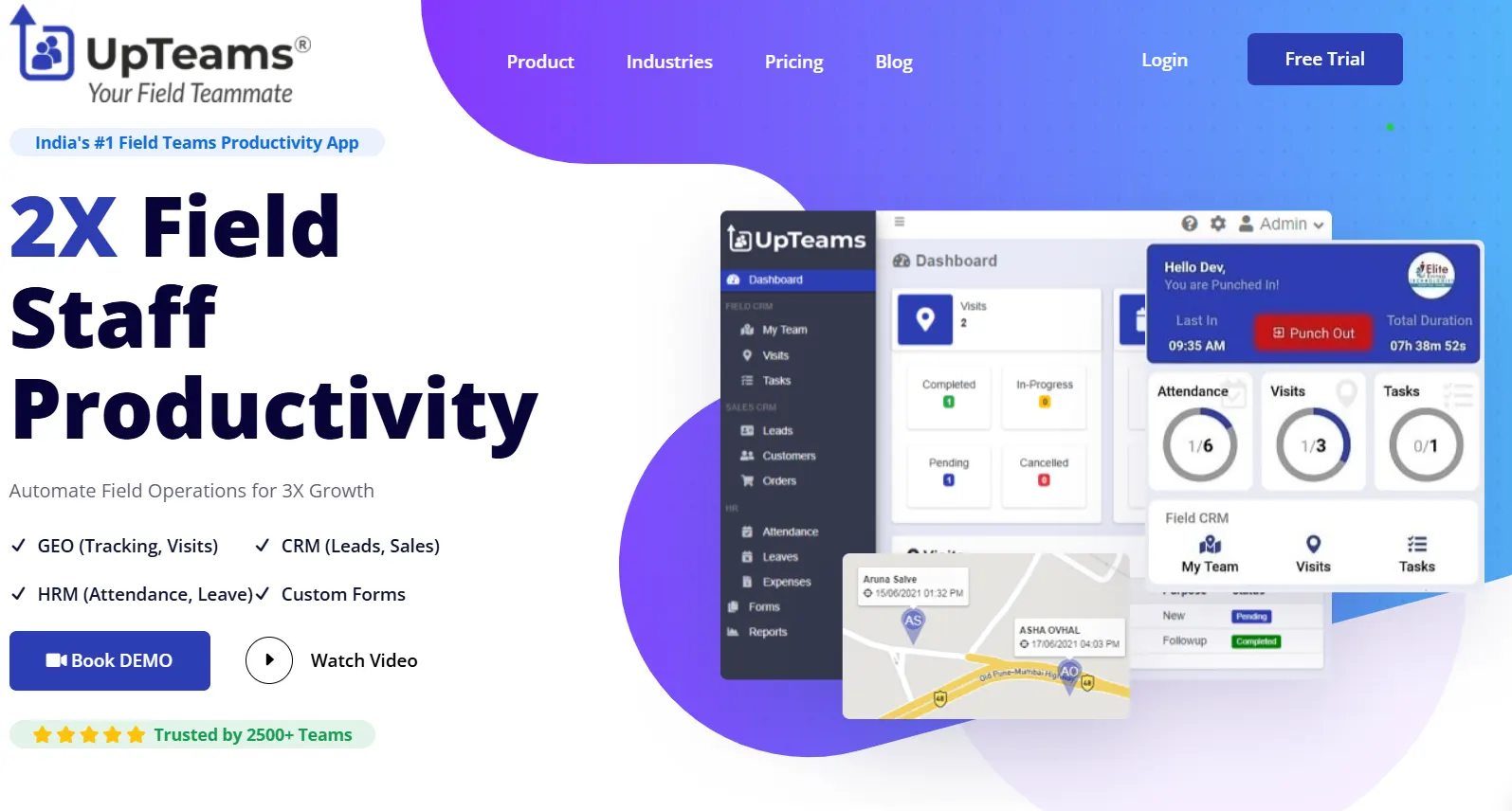
UpTeams is a field force and field service management app built around visit tracking, work order scheduling, and staff monitoring. It combines field service scheduling with a lightweight CRM and HR module, so smaller service companies do not need three separate tools to manage technicians, leads, and attendance.
Key features:
- Real time GPS tracking and geo fencing for field staff
- Service scheduling and dispatching with route optimization
- Custom digital forms for site visits and job reports
- Built in CRM for leads and customer records
- Expense tracking, leave management, and attendance monitoring
Best for: Small to mid sized service companies in retail, pharma, real estate, or transportation that want field force tracking bundled with basic CRM and HR features, without paying enterprise pricing.
2. IFS Field Service Management

IFS has become one of the most consistently recognized names in enterprise FSM. It has been named a Leader in the Gartner Magic Quadrant for Field Service Management, and IFS was the only vendor named a Customers’ Choice in the 2025 Gartner Peer Insights Voice of the Customer report for the category.
Key features:
- IFS.ai powered continuous scheduling optimization
- Full service lifecycle coverage, from contracts and warranties to depot repair
- Parts logistics and spare parts inventory management
- Contractor management and mobile work execution, online and offline
- Integrations with Salesforce, SAP, and Microsoft Dynamics
Pricing: IFS does not publish flat pricing. It is quoted per deployment, and reviewers on Capterra describe it as a premium priced solution, particularly for large telecom and industrial accounts.
Best for: Asset intensive enterprises in manufacturing, utilities, and telecom that need deep parts, contract, and warranty management alongside scheduling.
3. Field Force Connect
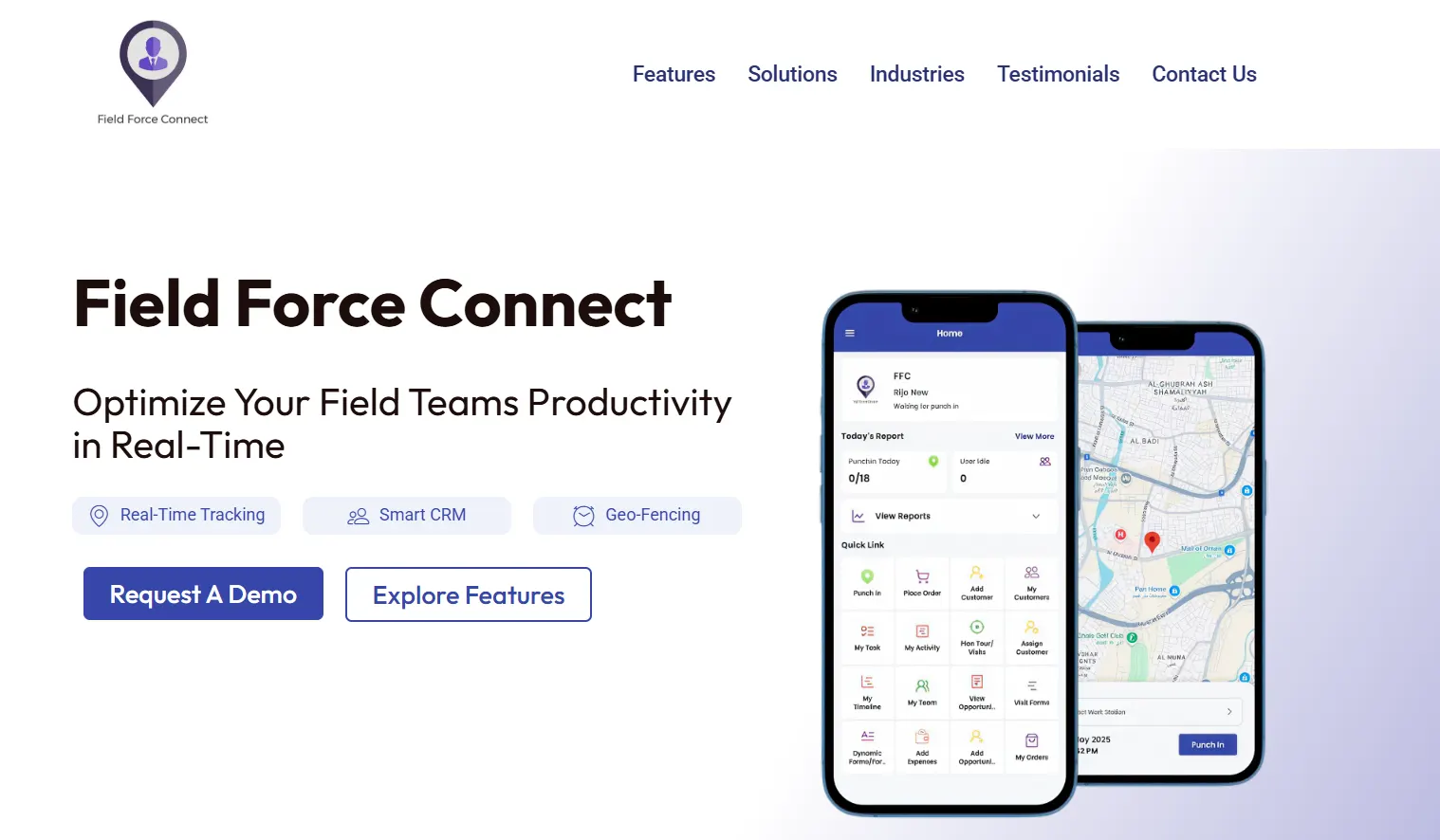
Field Force Connect is a mobile workforce management platform built around GPS tracking, task management, and field reporting. It has picked up recognition on G2 and Capterra’s shortlist for field service management, and it is aimed squarely at teams that need visibility into field staff without an enterprise price tag.
Key features:
- Live GPS location tracking and geo fencing for attendance
- Order booking and processing directly from the field
- Expense tracking and travel report generation
- Custom dynamic forms for site visits
- Sales pipeline and lead management built in
Best for: Small and mid sized service, sales, or delivery teams that primarily need location tracking, order management, and lightweight CRM in one app.
Where it falls short: It is closer to a field force automation and sales tracking tool than a full asset centric FSM suite, so businesses managing complex maintenance contracts may need to pair it with another system.
4. Microsoft Dynamics 365 Field Service
Dynamics 365 Field Service is Microsoft’s cloud based FSM platform, and its biggest advantage is how deeply it plugs into the rest of the Microsoft ecosystem. If your team already lives in Teams, Power BI, and Azure, this tool extends that investment rather than adding a disconnected system.
Key features:
- Work order management, scheduling, and resource optimization
- Azure IoT Hub integration for predictive maintenance alerts
- Copilot powered natural language summaries and scheduling suggestions
- Mixed reality remote assistance through HoloLens and Teams
- Customer self service portal for booking and rescheduling
Pricing: Microsoft lists the standard Dynamics 365 Field Service license at $105 per user per month, with a lower cost Field Service Contractor license at $50 per user per month for external technicians, both billed annually.
Best for: Mid to large enterprises already running other Dynamics 365 or Microsoft 365 products, especially in manufacturing, energy, and utilities.
5. Oracle Field Service
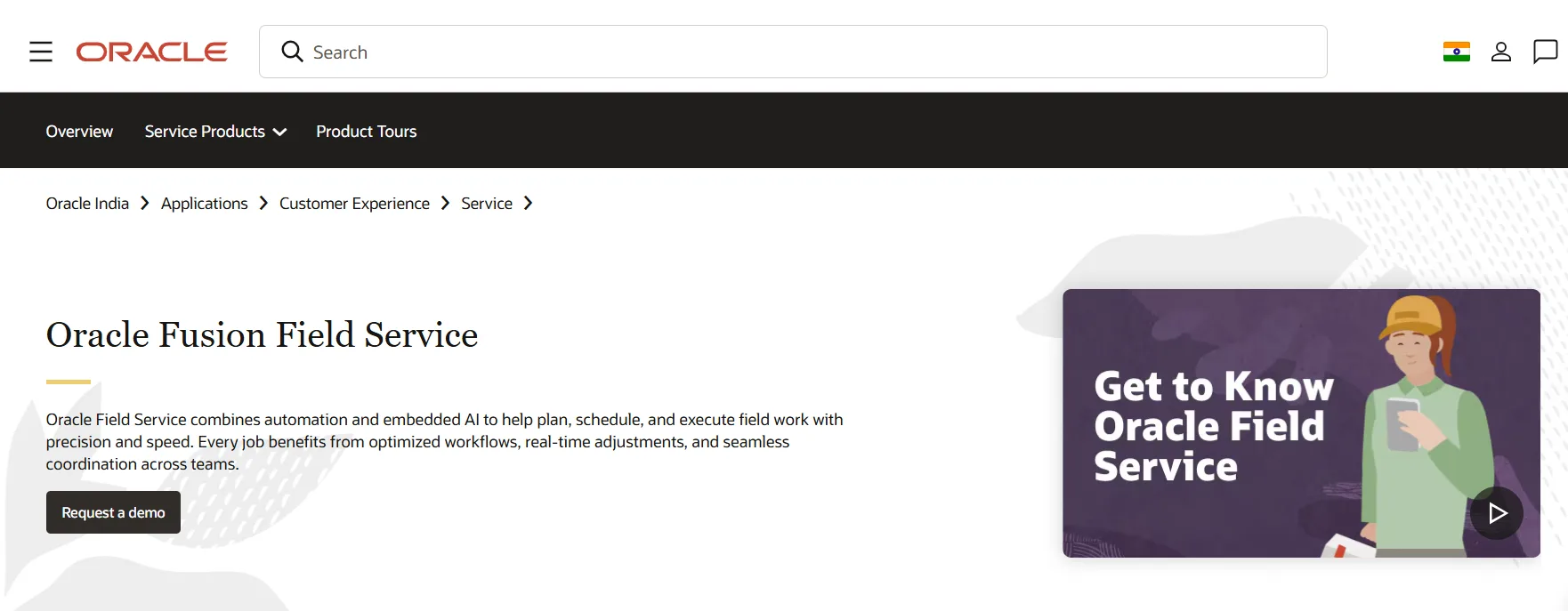
Oracle Field Service, built on technology from Oracle’s TOA Technologies acquisition, is known for one of the strongest scheduling engines in the enterprise FSM category. Its time based scheduling model predicts appointment windows using actual historical travel and job duration data instead of fixed time slots.
Key features:
- AI driven scheduling and routing with self learning accuracy over time
- IoT integration for proactive maintenance and asset monitoring
- Native integration with Oracle ERP, HCM, and Supply Chain
- Real time technician tracking and street level routing
- Customer self service and appointment tracking
Pricing: Independent reviews place Oracle Field Service in the $100 to $300 per user per month range depending on modules, with enterprise implementations often running from $500,000 to well over a million dollars for very large deployments.
Best for: Utilities, telecom operators, and insurance companies running thousands of field technicians where scheduling precision at scale justifies the investment.
6. Scoop
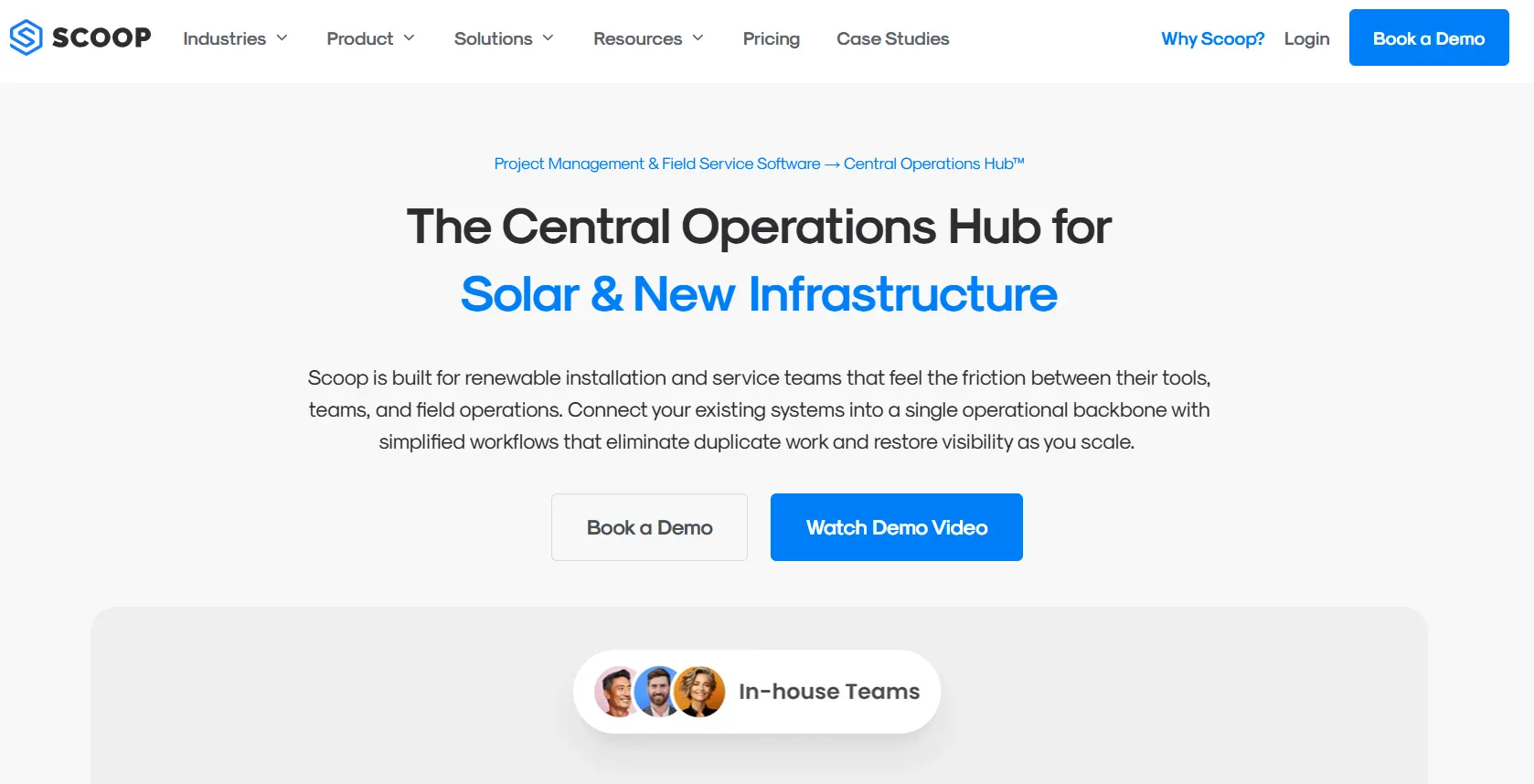
Scoop is a field service and operations platform purpose built for solar, renewable energy, and broader clean energy infrastructure. It calls itself a Central Operations Hub, and it now supports job sites across multiple countries, standing out as one of the only true niche specialists on this list.
Key features:
- Mobile field work execution with offline mode for remote job sites
- GLOO integration service connecting CRM, ERP, and accounting tools
- LOOXY analytics for real time dashboards and pipeline reporting
- Standardized checklists and templates for solar, EV charging, and BESS projects
- Unlimited user seats without per user cost friction
Best for: Solar installers, EV charging companies, and renewable energy service teams that need field execution tools built specifically around their industry’s workflows.
7. Fieldy
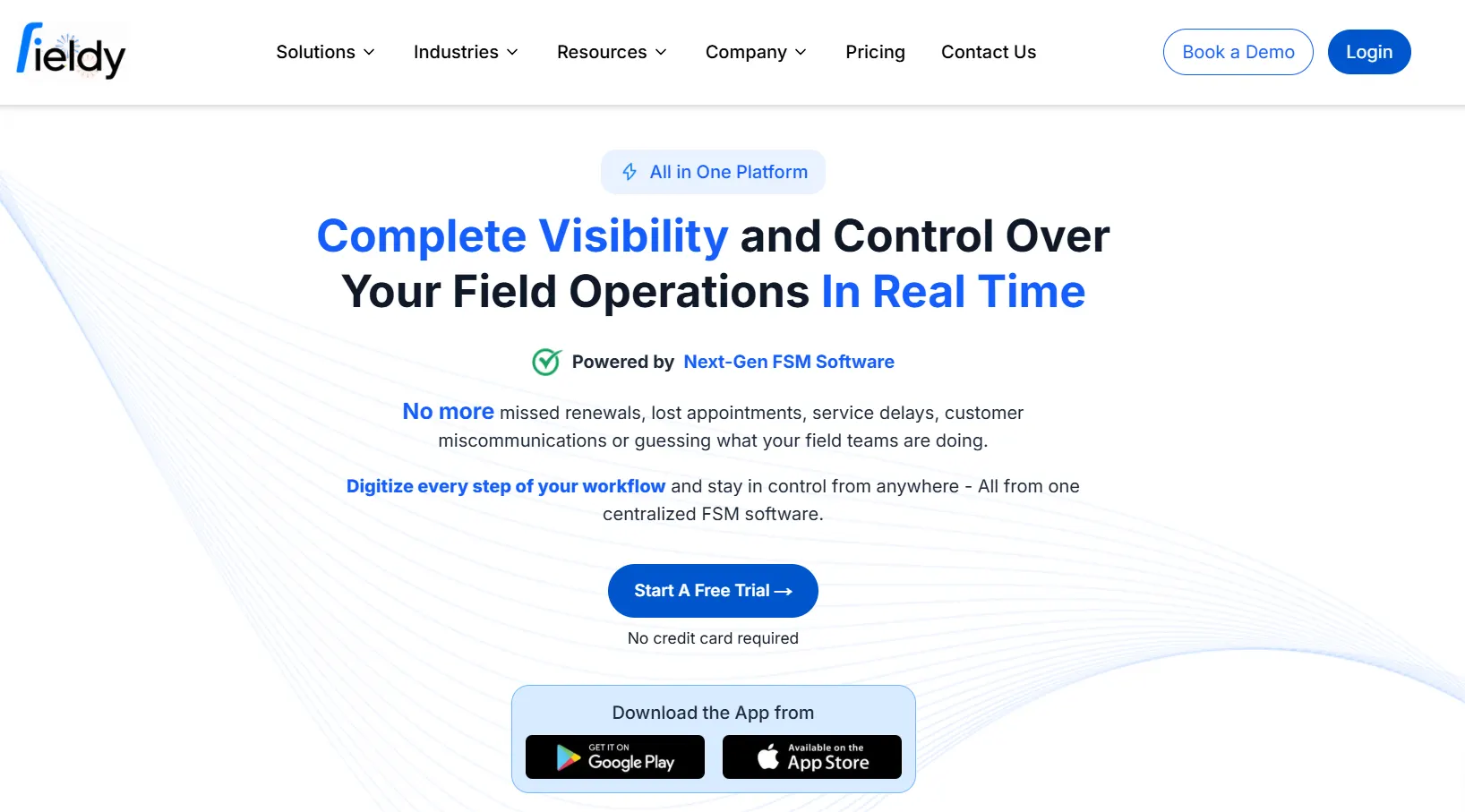
Fieldy is a field service management platform aimed at small and mid sized service businesses, with a particular focus on affordability and fast onboarding. It covers scheduling, technician tracking, invoicing, and annual maintenance contract (AMC) renewals in one dashboard.
Key features:
- Smart job scheduling based on technician skill and location
- Real time technician tracking and timesheet management
- QR code based online booking for customers
- AMC and service agreement renewal automation
- Quoting, invoicing, and online payment processing
Pricing: Fieldy is priced around $20 to $25 per user per month, positioning it as a lower cost alternative to larger US centric platforms like ServiceTitan or Housecall Pro.
Best for: HVAC, home appliance, and home improvement service businesses in India and the US that want an affordable, quick to deploy FSM tool with strong contract renewal automation.
8. PTC (ServiceMax)
PTC entered the FSM space through its 2023 acquisition of ServiceMax, a cloud native field service platform built on the Salesforce platform. ServiceMax has long been recognized as a leader in asset centric field service, and PTC has since folded it into its broader closed loop product lifecycle management strategy alongside tools like ThingWorx and Windchill.
Key features:
- Asset centric service execution with full installed base visibility
- Service Board for advanced technician scheduling and dispatch
- Mobile tools that work online or offline, including entitlement and contract visibility
- Depot repair management with SLA tracking
- Integration with PTC’s IoT, CAD, and digital twin tools for connected service
Best for: Manufacturers of complex, long lifecycle equipment in medical devices, industrial products, and aerospace that need asset history and service data tied directly back to product design data.
9. Salesforce Field Service
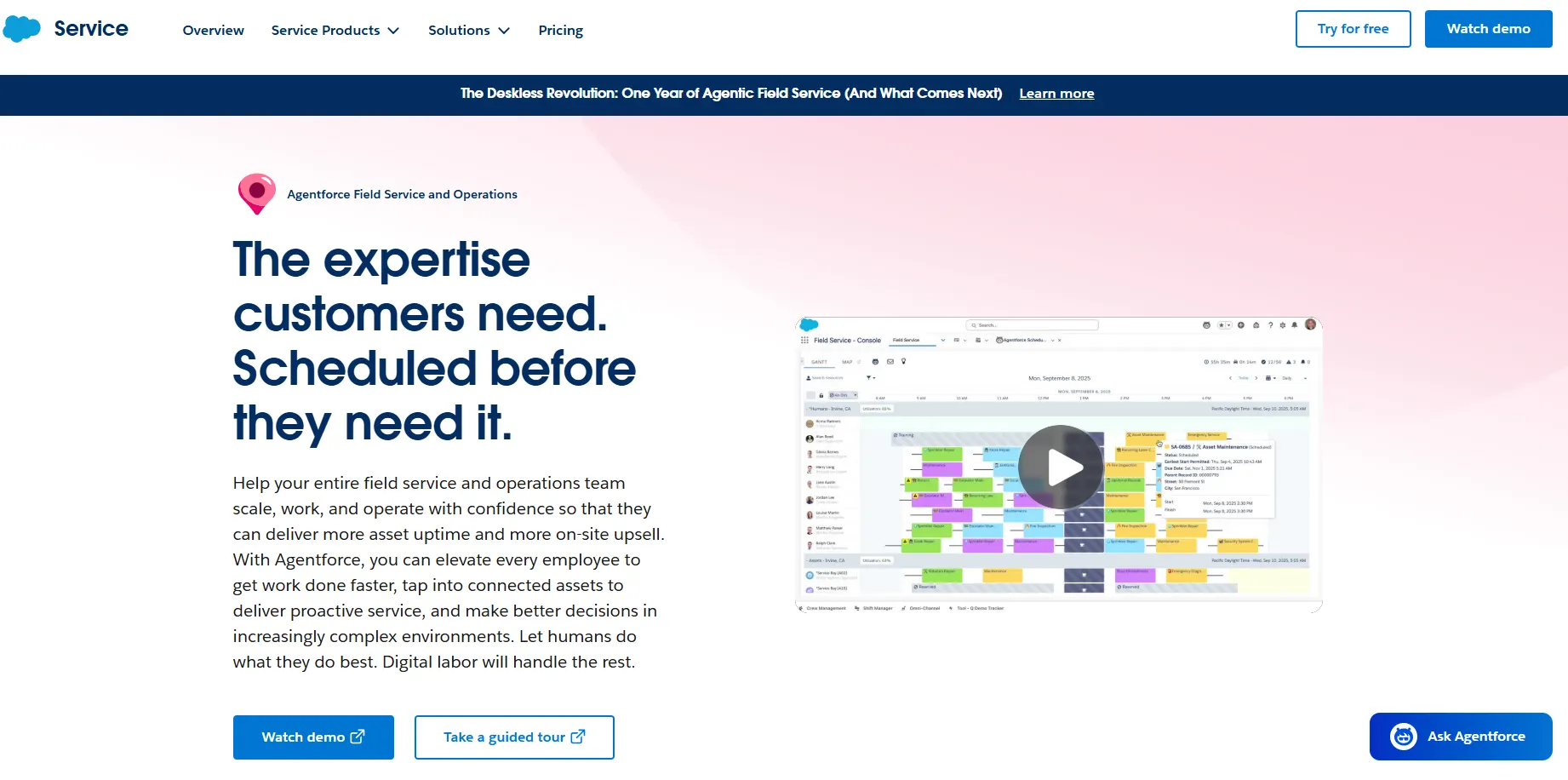
Salesforce Field Service is built directly into Salesforce’s Service Cloud, and it leans heavily on Agentforce, Salesforce’s AI layer, to automate scheduling, technician guidance, and post job summaries. For businesses already running Salesforce CRM, it is often the path of least resistance for adding field service capability.
Key features:
- Agentforce powered scheduling, dispatch, and appointment management
- Work order lifecycle management from creation through debrief
- Mobile app with pre work briefs, asset history, and troubleshooting guidance
- Tableau powered analytics for KPIs like first time fix rate and technician utilization
- Data 360 for unifying operational data across ERP, CRM, and asset systems
Best for: Companies already invested in the Salesforce ecosystem that want field service tightly connected to their existing customer and sales data.
10. Praxedo
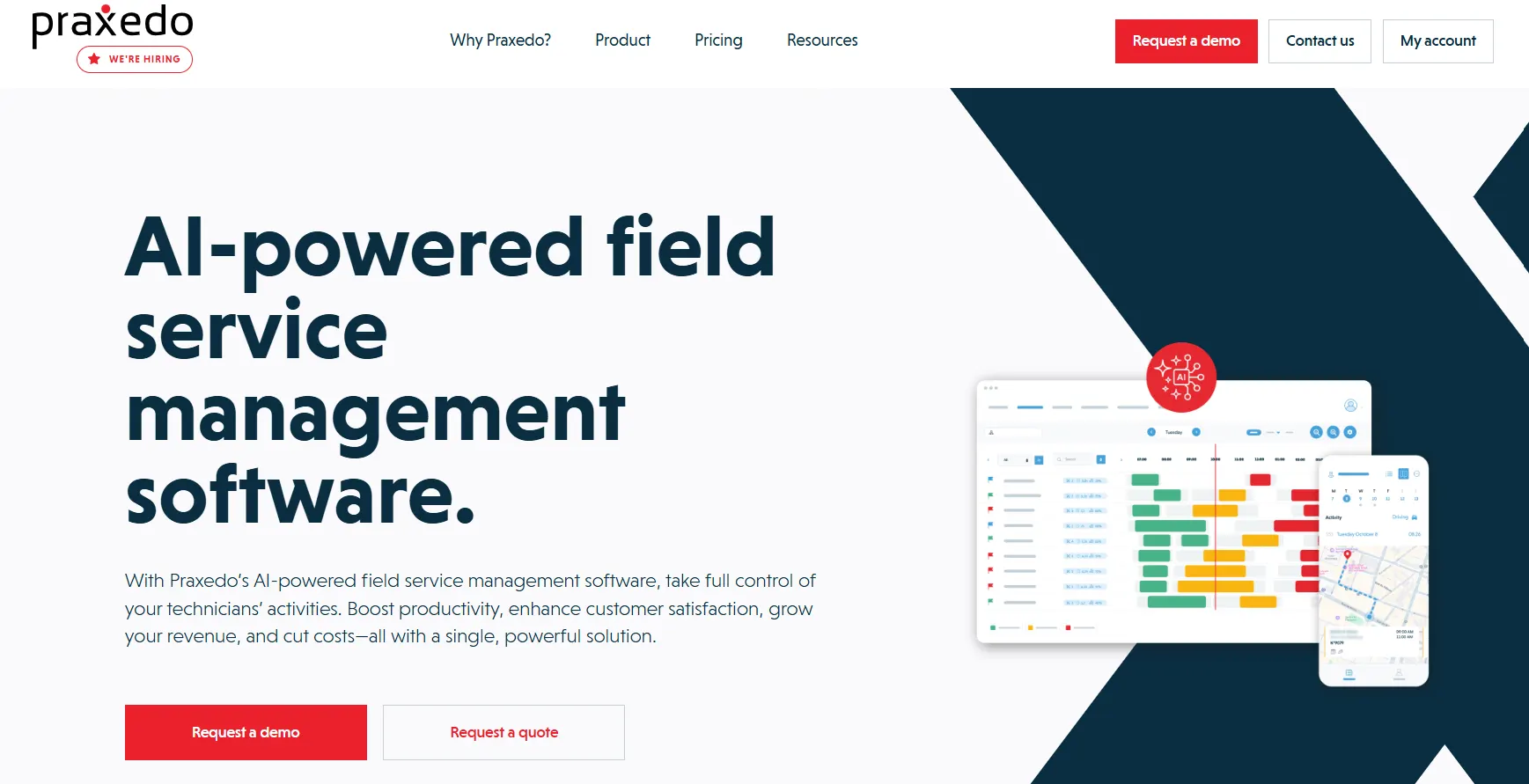
Praxedo is a France founded, cloud based FSM platform that has been named to Gartner’s Magic Quadrant for Field Service Management every year since 2016. Unlike some of the ERP giants on this list, Praxedo positions itself as a “best of breed” specialist that integrates with whatever ERP or CRM you already use, rather than trying to replace it.
Key features:
- Highly configurable scheduling based on technician skill, location, and availability
- Offline capable mobile app with digital signature and photo capture
- Open APIs and pre built connectors for ERP, CRM, and accounting systems
- Coverage across more than 50 industries, from telecom to elevator maintenance
- Typical rollout time of under five days according to Gartner Peer Insights
Pricing: Praxedo’s Start tier begins at $39 per user per month, making it one of the more transparently priced options for mid sized service businesses.
Best for: Mid sized service companies in telecom, utilities, HVAC, or facility management that want a specialist FSM tool with fast deployment and flexible ERP integration, without being locked into one ERP vendor’s ecosystem.
How to Choose the Best Field Service Management App for Your Business
With ten solid options above, the right pick really comes down to three questions.
How many technicians are you scheduling? Small teams under 20 technicians are usually better served by Fieldy, UpTeams, or Field Force Connect, where pricing is predictable and setup takes days, not months. Mid sized teams often do well with Praxedo or Scoop if they are in a specialized industry like solar. Enterprise operations with hundreds or thousands of technicians should be looking at IFS, Oracle Field Service, Salesforce Field Service, Microsoft Dynamics 365, or PTC’s ServiceMax.
What system do you already run? If your company already lives inside Salesforce, Microsoft, or Oracle, choosing that vendor’s FSM product usually means faster integration and fewer duplicate systems. If you are ERP agnostic, a specialist like Praxedo keeps you flexible.
Do you need asset and contract management, or just scheduling? Businesses servicing complex, long lifecycle equipment, think medical devices or industrial machinery, benefit from asset centric platforms like ServiceMax or IFS that track full service history against the product itself. Businesses doing simpler service calls, like HVAC repairs or home appliance servicing, do not need that complexity and will get more value from a lighter, faster tool like Fieldy.
If your company also runs broader operations software alongside field service, our roundup of the top SaaS software for manufacturing companies is worth reading next. Many FSM buyers in manufacturing end up needing both categories working together.
Frequently Asked Questions
- What is the best field service management software for small businesses? Fieldy, UpTeams, and Field Force Connect are strong picks for small businesses because of their lower per user pricing and faster onboarding compared to enterprise platforms like IFS or Oracle Field Service.
- What is the best field service management app for enterprise companies? IFS Field Service Management, Oracle Field Service, PTC’s ServiceMax, and Salesforce Field Service are built for large, asset intensive operations, and each has strong Gartner and Capterra recognition for enterprise deployments.
- How much does field service management software cost? Pricing ranges widely. Fieldy starts around $20 to $25 per user per month, Praxedo starts at $39 per user per month, Microsoft Dynamics 365 Field Service starts near $105 per user per month, and enterprise platforms like Oracle Field Service can run $100 to $300 per user per month before implementation costs.
- What features should I look for in field service management software? Look for scheduling and dispatch, mobile technician access with offline capability, work order management, inventory or parts tracking, invoicing, and reporting on metrics like first time fix rate and technician utilization.
- Is field service management software worth it for a small team? Yes. Even teams with five to ten technicians benefit from replacing spreadsheets and paper work orders with a system that automates scheduling, invoicing, and customer updates, which reduces missed appointments and speeds up payment.
- Which field service management software integrates best with Salesforce? Salesforce Field Service is the native option, since it runs directly inside Salesforce Service Cloud. IFS and PTC’s ServiceMax also support Salesforce integrations for businesses using Salesforce as their core CRM.
- What is the difference between field service management and field force management? Field service management typically covers the full service lifecycle, including work orders, contracts, parts, and asset history, while field force management often focuses more narrowly on tracking technician location, attendance, and task completion.
- Can field service management software work offline? Most platforms on this list, including Praxedo, Oracle Field Service, PTC’s ServiceMax, and IFS, offer offline mobile functionality so technicians can access job details and update records in areas without signal, syncing once connectivity returns.
- Is there field service management software built specifically for solar companies? Yes. Scoop is built specifically for solar, renewable energy, and clean energy infrastructure companies, with templates and workflows designed around installation and service visit standards in that industry.
- How long does it take to implement field service management software? Implementation time varies by platform size. Praxedo reports typical rollout in under five days, while enterprise platforms like Oracle Field Service or IFS can take 12 to 24 months for large scale deployments with deep ERP integration.
Conclusion
The best field service management software is the one that aligns with your business size, industry, and operational needs. Small service teams may find greater value in affordable and easy-to-use platforms like Fieldy or UpTeams, while larger organizations managing hundreds or thousands of technicians often require enterprise solutions such as IFS, Oracle Field Service, Microsoft Dynamics 365 Field Service, or Salesforce Field Service.
Before making your final decision, focus on the capabilities that matter most to your business. Intelligent scheduling, mobile access, offline functionality, work order management, inventory tracking, reporting, and seamless integrations with your CRM or ERP system can significantly improve efficiency and customer satisfaction. The right platform should simplify daily operations, reduce administrative work, and help your technicians deliver better service on every job.
As field service operations continue to evolve through artificial intelligence, predictive maintenance, and connected technologies, investing in the right software today will prepare your business for long-term growth. A well-chosen field service management solution helps your team work more efficiently, respond faster to customers, and stay competitive in an increasingly digital service industry.